Gibson Graham C, Reich Nicholas G, Sheldon Daniel
medRxiv. 2020 Dec 24:2020.12.22.20248736. doi: 10.1101/2020.12.22.20248736.
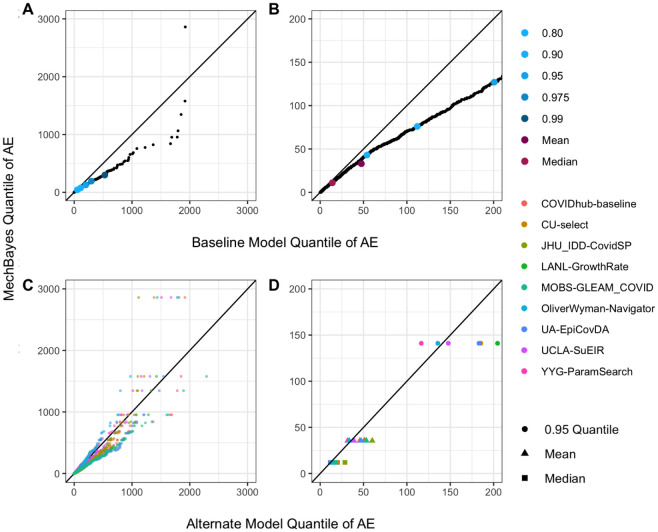
The COVID-19 pandemic emerged in late December 2019. In the first six months of the global outbreak, the US reported more cases and deaths than any other country in the world. Effective modeling of the course of the pandemic can help assist with public health resource planning, intervention efforts, and vaccine clinical trials. However, building applied forecasting models presents unique challenges during a pandemic. First, case data available to models in real-time represent a non-stationary fraction of the true case incidence due to changes in available diagnostic tests and test-seeking behavior. Second, interventions varied across time and geography leading to large changes in transmissibility over the course of the pandemic. We propose a mechanistic Bayesian model (MechBayes) that builds upon the classic compartmental susceptible-exposed-infected-recovered (SEIR) model to operationalize COVID-19 forecasting in real time. This framework includes non-parametric modeling of varying transmission rates, non-parametric modeling of case and death discrepancies due to testing and reporting issues, and a joint observation likelihood on new case counts and new deaths; it is implemented in a probabilistic programming language to automate the use of Bayesian reasoning for quantifying uncertainty in probabilistic forecasts. The model has been used to submit forecasts to the US Centers for Disease Control, through the COVID-19 Forecast Hub. We examine the performance relative to a baseline model as well as alternate models submitted to the Forecast Hub. Additionally, we include an ablation test of our extensions to the classic SEIR model. We demonstrate a significant gain in both point and probabilistic forecast scoring measures using MechBayes when compared to a baseline model and show that MechBayes ranks as one of the top 2 models out of 10 submitted to the COVID-19 Forecast Hub. Finally, we demonstrate that MechBayes performs significantly better than the classical SEIR model.
2019年12月下旬出现了新型冠状病毒肺炎疫情。在全球疫情爆发的头六个月里,美国报告的病例和死亡人数比世界上任何其他国家都多。对疫情发展过程进行有效的建模有助于公共卫生资源规划、干预措施以及疫苗临床试验。然而,在疫情期间构建应用预测模型面临着独特的挑战。首先,由于可用诊断测试和检测行为的变化,模型实时可用的病例数据仅代表真实病例发病率的一个非平稳部分。其次,干预措施随时间和地理位置而变化,导致疫情期间传播性发生了巨大变化。我们提出了一种基于经典的易感-暴露-感染-康复(SEIR)模型的机械贝叶斯模型(MechBayes),以实时实现新型冠状病毒肺炎的预测。该框架包括对变化的传播率进行非参数建模、对由于检测和报告问题导致的病例和死亡差异进行非参数建模,以及对新增病例数和新增死亡人数进行联合观测似然估计;它是用概率编程语言实现的,以自动使用贝叶斯推理来量化概率预测中的不确定性。该模型已通过新型冠状病毒肺炎预测中心向美国疾病控制中心提交预测。我们考察了相对于基线模型以及提交给预测中心的其他模型的性能。此外,我们对经典SEIR模型的扩展进行了消融测试。与基线模型相比,我们证明了使用MechBayes在点预测和概率预测评分指标上都有显著提高,并表明MechBayes在提交给新型冠状病毒肺炎预测中心的10个模型中排名前2。最后,我们证明了MechBayes的性能明显优于经典的SEIR模型。