Department of Internal Medicine, Korea University Guro Hospital, Gurodong-ro 148, Guro-gu, Seoul, 08308, South Korea.
Department of Internal Medicine, Korea University College of Medicine, 150-7 Anamdong 5(o)-ga, Seongbuk-gu, Seoul, 02841, South Korea.
Clin Exp Nephrol. 2021 Apr;25(4):376-384. doi: 10.1007/s10157-020-01997-3. Epub 2021 Jan 4.
The renoprotective effect of water intake remains unclear. We aimed to investigate the relationship between water intake and renal impairment in the Korean general population, focusing on individual differences in body fluid distribution and risk of chronic dehydration.
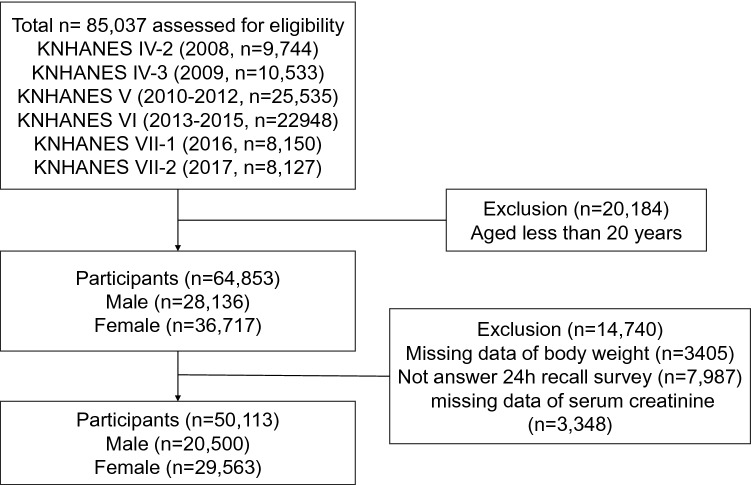
We conducted a cross-sectional analysis of the 2008-2017 Korea National Health and Nutrition Examination Survey (KNHANES). Adult participants who had body weight and serum creatinine data and had answered 24-h recall nutritional survey were included. Four water intake groups were defined by daily total water intake per body weight: lowest (< 20 mL/kg/day), low-moderate (20-29.9 mL/kg/day), high-moderate (30-49.9 mL/kg/day), and highest (≥ 50 mL/kg/day). We assessed the risk of renal impairment (estimated glomerular filtration rate ≤ 60 mL/min/1.73 m) according to water intake.
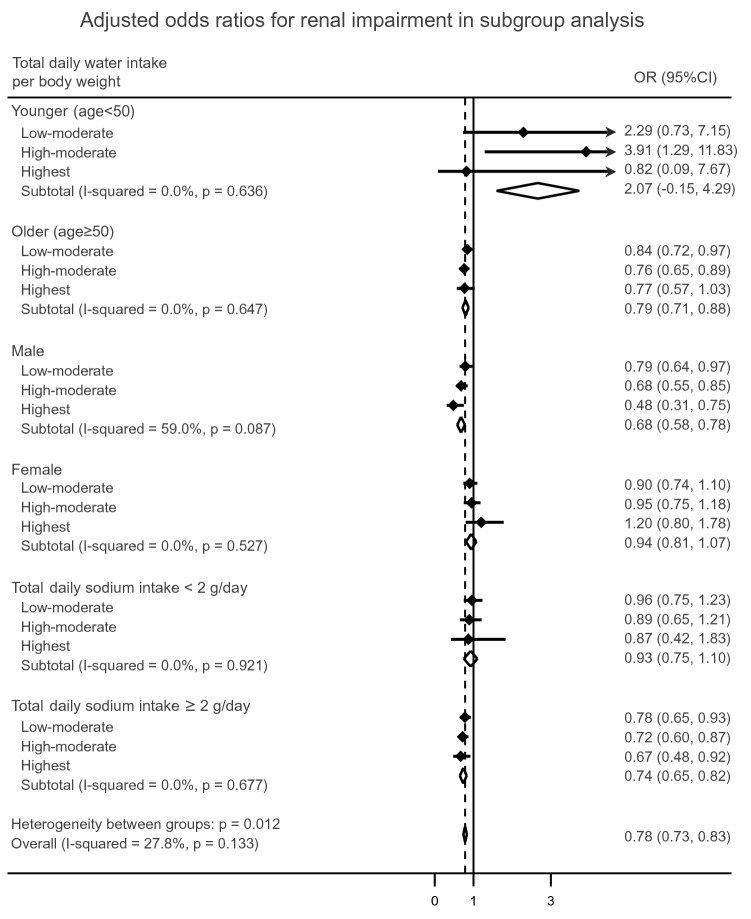
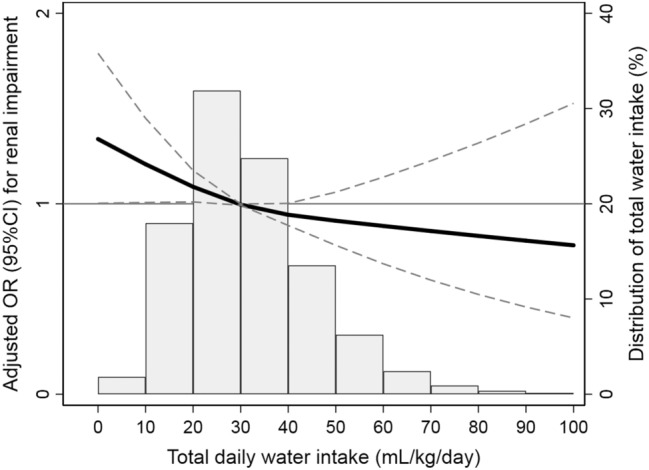
In total of 50,113 participants, 3.9% had renal impairment. The risk of renal impairment gradually decreased as water intake increased. After adjustment of sodium intake, the trend of renoprotective effect was remained in low-moderate and high-moderate water intake group compared to low intake group, whereas no significant impact was observed with the highest water intake due to concurrent intake of high sodium. In subgroup analysis, the renoprotective effect of water intake was significant in the participants with elderly, male and daily sodium intake over 2 g/day.
High daily water intake is renoprotective. Our data may provide an important basis for determining the amount of water intake needed to prevent renal impairment, considering variations in body weight, body composition and risk of chronic dehydration.
水摄入对肾脏的保护作用尚不清楚。我们旨在研究在韩国普通人群中,水摄入与肾功能损害之间的关系,重点关注体液分布的个体差异和慢性脱水的风险。
我们对 2008-2017 年韩国国家健康和营养检查调查(KNHANES)进行了横断面分析。纳入了有体重和血清肌酐数据且回答了 24 小时回顾性营养调查的成年参与者。根据每日总水摄入量与体重的比值,将参与者分为 4 个水摄入组:最低组(<20 mL/kg/天)、低-中组(20-29.9 mL/kg/天)、中-高组(30-49.9 mL/kg/天)和最高组(≥50 mL/kg/天)。我们根据水摄入量评估了肾功能损害(估算肾小球滤过率≤60 mL/min/1.73 m)的风险。
在总共 50113 名参与者中,3.9%患有肾功能损害。随着水摄入的增加,肾功能损害的风险逐渐降低。在调整钠摄入量后,与低摄入量组相比,低-中组和中-高组水摄入仍具有保护肾脏的作用,而高摄入量组由于同时摄入了高钠,因此没有观察到显著影响。在亚组分析中,水摄入对肾功能的保护作用在年龄较大、男性和每日钠摄入量超过 2 g/天的参与者中更为显著。
高每日水摄入具有保护肾脏的作用。考虑到体重、身体成分和慢性脱水的风险变化,我们的数据可能为确定预防肾功能损害所需的水摄入量提供了重要依据。