Department of Ophthalmology, Pusan National University Hospital, Busan, Korea.
Biomedical Research Institute of Pusan National University Hospital, Busan, Korea.
J Korean Med Sci. 2021 Jan 4;36(1):e5. doi: 10.3346/jkms.2021.36.e5.
To evaluate the patterns of distribution and clinical manifestations of ocular injuries referred to the level 1 trauma center of Pusan National University Hospital (PNUH) in Korea.
We analyzed 254 of 4,287 patients who were referred to the Department of Ophthalmology at the level 1 trauma center of the PNUH, from January 2016 through December 2018. Data on the incidence of ocular injuries, sex, age, monthly and seasonal distribution, day and time of injury, side of injury, cause, residence of patients, referral time to an ophthalmologist and subsequent examination time, final visual acuity (VA), and complications were obtained from medical records and retrospectively reviewed. The patients were grouped according to their main diagnosis using the Birmingham Eye Trauma Terminology System (BETTS) and Ocular Trauma Score (OTS).
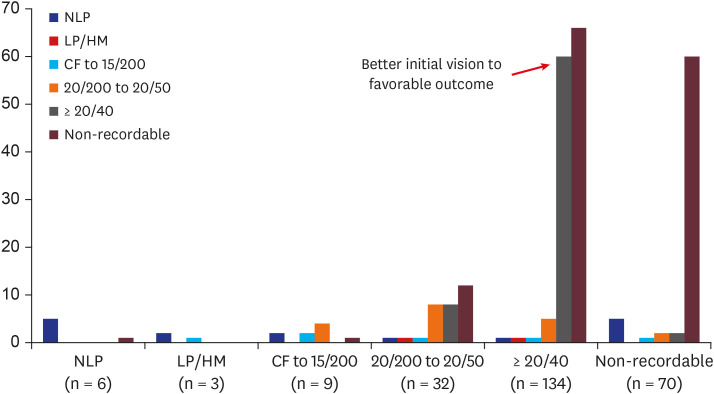
The incidence of ocular injuries with major trauma was higher in men (n = 207, 81.5%), the median age at time of injury was 54 years, and Pusan recorded the most cases. The incidences of ocular injury were 1.47/100,000, 1.57/100,000, 1.48/100,000 in 2016, 2017 and 2018, respectively. The most common cause was by a motorbike accident, followed by a pedestrian traffic accident and falls. According to the BETTS classification, open-globe injuries represented 4% of cases, closed-globe injuries represented 12.6%, and other injuries represented 83.1%. Open-globe injuries were significantly associated with low final VA ( = 0.01). In the OTS, 79.4% of patients received 4 or 5 points and 13.7% of patients received 1 or 2 points. The patients who received 1 or 2 points in the OTS score showed final VA below hand movement ( < 0.001), except for two patients. Lid laceration and low initial VA were highly correlated with poor final VA ( < 0.001).
This is the first study on the epidemiology and clinical manifestations in trauma patients with ocular injuries at a level 1 trauma center. The incidences of ocular injuries with major trauma were about 1.47-1.57/100,000. BETTS, OTS, lid laceration and initial VA were associated with final VA. We expect our study to provide a basis of data for the evaluation, prevention, and management of ocular injuries in patients with systemic trauma.
评估韩国釜山大学医院(PNUH)1 级创伤中心转诊的眼部损伤分布和临床表现模式。
我们分析了 2016 年 1 月至 2018 年 12 月期间,从 PNUH 1 级创伤中心眼科转诊的 4287 名患者中的 254 名。从病历中获得眼部损伤发生率、性别、年龄、每月和季节性分布、受伤日和时间、受伤侧、损伤原因、患者居住地、转诊至眼科医生的时间和后续检查时间、最终视力(VA)和并发症等数据,并进行回顾性分析。根据 Birmingham Eye Trauma Terminology System(BETTS)和 Ocular Trauma Score(OTS),将患者按照主要诊断进行分组。
男性(n = 207,81.5%)眼部严重创伤发生率较高,受伤时的中位年龄为 54 岁,其中釜山市的病例最多。2016 年、2017 年和 2018 年眼部损伤发生率分别为 1.47/100,000、1.57/100,000 和 1.48/100,000。最常见的原因是摩托车事故,其次是行人交通事故和跌倒。根据 BETTS 分类,开放性眼球损伤占 4%,闭合性眼球损伤占 12.6%,其他损伤占 83.1%。开放性眼球损伤与最终 VA 较低显著相关( = 0.01)。在 OTS 中,79.4%的患者得分为 4 或 5 分,13.7%的患者得分为 1 或 2 分。OTS 评分得 1 或 2 分的患者最终 VA 低于手动视力( < 0.001),除了两名患者。眼睑裂伤和初始 VA 较低与最终 VA 不良高度相关( < 0.001)。
这是关于 1 级创伤中心创伤患者眼部损伤的流行病学和临床表现的第一项研究。严重眼部创伤的发生率约为 1.47-1.57/100,000。BETTS、OTS、眼睑裂伤和初始 VA 与最终 VA 相关。我们希望本研究为评估、预防和管理全身性创伤患者的眼部损伤提供数据基础。