Sahu Sandip Kumar, Radhakrishnan Rakesh Vadakkethil, Mohanty Chitta Ranjan, Parija Sucheta, Palanisamy Shanmugasundaram, Mishra Priyadarshini, Sadangi Debasish
Department of Ophthalmology, All India Institute of Medical Sciences, Bhubaneswar, Odisha, India.
Department of College of Nursing, All India Institute of Medical Sciences, Bhubaneswar, Odisha, India.
Turk J Emerg Med. 2024 Apr 4;24(2):90-96. doi: 10.4103/tjem.tjem_219_23. eCollection 2024 Apr-Jun.
One major contributor to avoidable ocular morbidity is ocular trauma (OT). The study aimed to document the epidemiological factors, pattern of injury, and outcome among patients with OT presenting to the emergency department (ED).
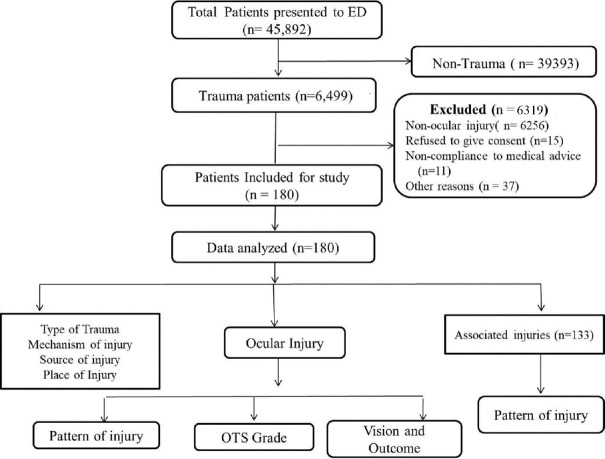
This was a prospective observational study conducted in the ED of a tertiary care teaching hospital in Eastern India after due approval from the institutional ethics committee. The data were collected during the period from March 2021 to February 2022. Data pertaining to age, sex, type of injury, mechanism of injury, time and place of injury, details of tissue involvement, visual acuity, any prior history of injury, initial diagnosis, and management were noted. To estimate the severity of the injury and the probable visual outcome, we calculated through OT score (OTS), including one raw score and OTS. Statistical analysis was performed using the R, version 4.6.1.
A total of 180 patient's data were included for final analysis. The median (interquartile range) age of the patients was 32 (24-45) years. The majority were males ( = 147 [81.6%]) with a male-female ratio of 4.5:1. Road traffic accidents (RTA) were the common cause of injury ( = 122 [67.7%]). Unilateral eye involvement was the most common ( = 147 [81.6%]). In the pattern of injury, most of the patients sustained closed globe injuries (CGIs) (n = 158 [87.7%]). Among the CGIs, injury to the ocular adnexa and conjunctiva ( = 141 and 127, respectively) was the most common. Injury to the retina and choroids occurred in 20 (11%) patients. The vision was not affected in most of the cases ( = 125 [69.4%]) with a visual acuity of > 6/18. The majority ( = 120 [67%]) of the patients had an OTS of grade-4, followed by grade-2 ( = 22 [12%]). Most of the patients required only medical management (n = 100 [56%]), whereas 77 (43%) patients required surgical interventions.
OT was a common presentation in the ED. Male patients with monocular injuries involved in RTAs were mostly affected. The vision was preserved in most of the cases.
可避免的眼部发病的一个主要因素是眼外伤(OT)。本研究旨在记录到急诊科(ED)就诊的眼外伤患者的流行病学因素、损伤模式及预后情况。
这是一项前瞻性观察性研究,在印度东部一家三级护理教学医院的急诊科进行,并获得了机构伦理委员会的适当批准。数据收集时间为2021年3月至2022年2月。记录了有关年龄、性别、损伤类型、损伤机制、损伤时间和地点、组织受累细节、视力、既往任何损伤史、初始诊断及治疗的相关数据。为评估损伤的严重程度和可能的视力预后,我们通过眼外伤评分(OTS)进行计算,包括一个原始评分和OTS。使用R 4.6.1版本进行统计分析。
共纳入180例患者的数据进行最终分析。患者的年龄中位数(四分位间距)为32(24 - 45)岁。大多数为男性(n = 147 [81.6%]),男女比例为4.5:1。道路交通事故(RTA)是常见的损伤原因(n = 122 [67.7%])。单眼受累最为常见(n = 147 [81.6%])。在损伤模式方面,大多数患者遭受闭合性眼球损伤(CGI)(n = 158 [87.7%])。在CGI中,眼附属器和结膜损伤(分别为n = 141和127)最为常见。20例(11%)患者发生视网膜和脉络膜损伤。大多数病例(n = 125 [69.4%])视力未受影响,视力> 6/18。大多数患者(n = 120 [67%])的OTS为4级,其次是2级(n = 22 [12%])。大多数患者仅需药物治疗(n = 100 [56%]),而77例(43%)患者需要手术干预。
眼外伤是急诊科的常见病症。涉及道路交通事故的单眼受伤男性患者受影响最大。大多数病例视力得以保留。