DiSano Krista D, Gilli Francesca, Pachner Andrew R
Department of Neurology, Geisel School of Medicine & Dartmouth-Hitchcock Medical Center, Lebanon, USA.
Mult Scler J Exp Transl Clin. 2020 Dec 16;6(4):2055217320981396. doi: 10.1177/2055217320981396. eCollection 2020 Oct-Dec.
Clinicians caring for patients with Multiple Sclerosis (MS) need improved biomarkers to aid them in disease management.
We assessed the predictive value of the candidate biomarker CXCL13 index in comparison to oligoclonal bands (OCBs) and CSF neurofilament light (NfL) concentration, examining the ability of each biomarker to predict future disease activity in clinically and radiologically isolated syndromes, relapsing-remitting MS, and progressive MS.
Matched serum and CSF samples were obtained from 67 non-inflammatory neurologic disease patients and 67 MS patients. CSF and serum CXCL13 and CSF NfL were analyzed by Luminex and ELISA, respectively. CXCL13 data were also analyzed as CSF/serum ratios and indices. Electronic medical records were accessed to determine diagnosis, CSF profiles, and disease activity after the lumbar puncture.
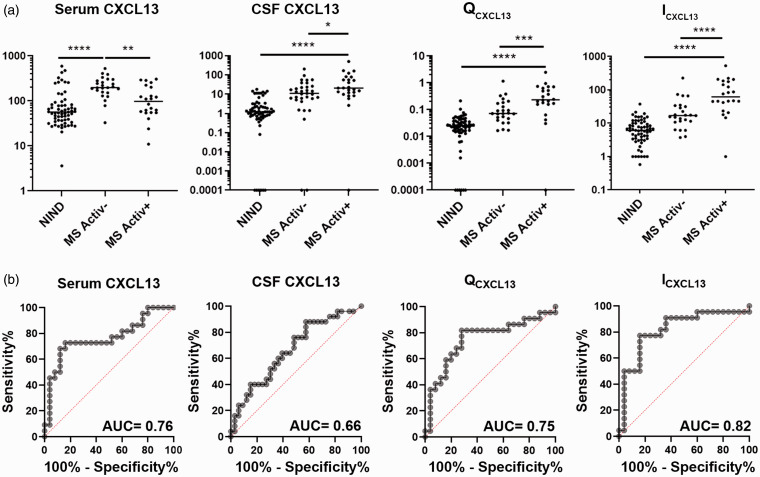
Among CXCL13 measures, CXCL13 index was the best predictor of future disease activity in MS patients (AUC = 0.82; CI = 0.69-0.95; p = 0.0002). CXCL13 index values were significantly elevated in activity-positive MS patients compared to activity-negative patients (p < 0.0001). As a single predictor, CXCL13 index outperformed both OCBs and CSF NfL in sensitivity, specificity, and positive and negative predictive value, for future disease activity in MS patients. Moreover, combining CXCL13 index and CSF NfL status improved sensitivity and predictive values for disease activity in MS patients.
The CXCL13 index is an excellent candidate prognostic biomarker for disease activity in patients with MS.
照顾多发性硬化症(MS)患者的临床医生需要更好的生物标志物来辅助疾病管理。
我们评估了候选生物标志物CXCL13指数相对于寡克隆带(OCB)和脑脊液神经丝轻链(NfL)浓度的预测价值,研究了每种生物标志物预测临床孤立综合征、复发缓解型MS和进展型MS未来疾病活动的能力。
从67例非炎性神经系统疾病患者和67例MS患者中获取配对的血清和脑脊液样本。分别通过Luminex和ELISA分析脑脊液和血清中的CXCL13以及脑脊液中的NfL。CXCL13数据也作为脑脊液/血清比值和指数进行分析。查阅电子病历以确定腰椎穿刺后的诊断、脑脊液特征和疾病活动情况。
在CXCL13的各项测量指标中,CXCL13指数是MS患者未来疾病活动的最佳预测指标(曲线下面积[AUC]=0.82;可信区间[CI]=0.69-0.95;p=0.0002)。与活动阴性的患者相比,活动阳性的MS患者CXCL13指数值显著升高(p<0.0001)。作为单一预测指标,CXCL13指数在敏感性、特异性以及阳性和阴性预测值方面均优于OCB和脑脊液NfL,可用于预测MS患者未来的疾病活动。此外,联合CXCL13指数和脑脊液NfL状态可提高MS患者疾病活动的敏感性和预测值。
CXCL13指数是MS患者疾病活动的优秀候选预后生物标志物。