Direction générale de la santé publique, Ministère de la Santé et des Services sociaux, Quebec, Quebec, Canada.
Department of Family Medicine, Montreal, McGill University, Montreal, Quebec, Canada.
Matern Child Nutr. 2021 Apr;17(2):e13129. doi: 10.1111/mcn.13129. Epub 2021 Jan 6.
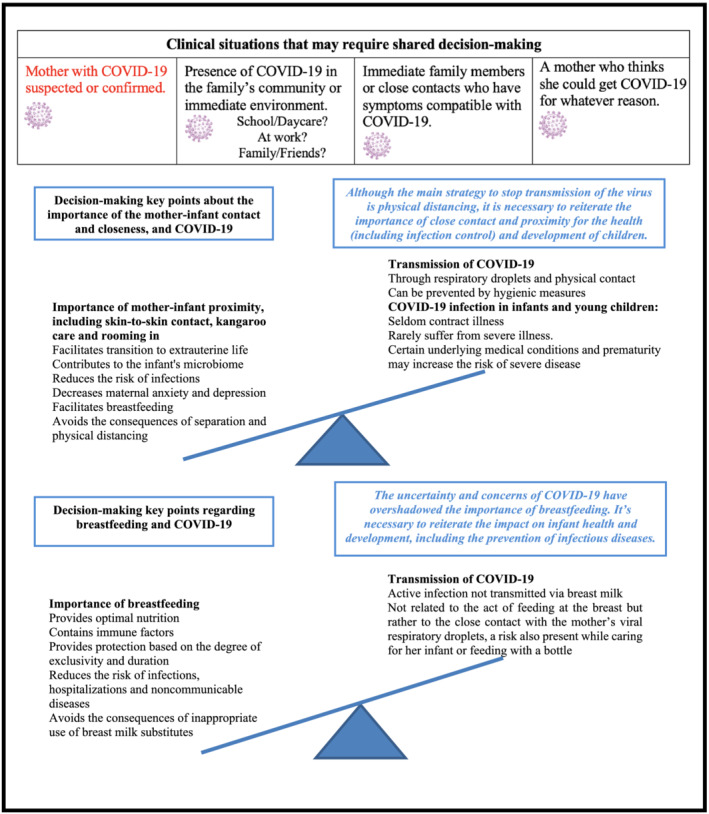
Despite decades of research establishing the importance of breastfeeding, skin-to-skin contact and mother-infant closeness, the response to the coronavirus disease 2019 (COVID-19) pandemic has underscored the hidden assumption that these practices can be dispensed with no consequences to mother or child. This article aims to support shared decision-making process for infant feeding and care with parents and health care providers during the unprecedented times of the pandemic. It proposes a structure and rationale to guide the process that includes (1) discussing with parents evidence-based information and the different options to feed and care for an infant and young child in the context of the pandemic as well as their potential benefits, risks and scientific uncertainties; (2) helping parents to recognize the sensitive nature of the decisions and to clarify the value they place on the different options to feed and care for their infant or young child; and (3) providing guidance and support needed to make and implement their decisions. A shared decision-making process will help parents navigate complex feeding and care decisions for their child as we face the different stages of the COVID-19 pandemic.
尽管数十年来的研究已经确定了母乳喂养、皮肤接触和母婴亲近的重要性,但 2019 年冠状病毒病(COVID-19)大流行的应对情况突显了一个隐藏的假设,即这些做法可以在不影响母婴的情况下实施。本文旨在为父母和医疗保健提供者在 COVID-19 大流行的空前时期提供婴儿喂养和护理的共同决策过程提供支持。它提出了一个结构和基本原理来指导这一过程,包括(1)与父母讨论在大流行背景下为婴儿和幼儿提供喂养和护理的循证信息和不同选择以及它们的潜在益处、风险和科学不确定性;(2)帮助父母认识到决策的敏感性,并阐明他们对不同的喂养和护理婴儿或幼儿的选择的重视程度;(3)为做出和实施决策提供所需的指导和支持。在我们面对 COVID-19 大流行的不同阶段时,共同决策过程将帮助父母为孩子做出复杂的喂养和护理决策。