CDC COVID-19 Response Team, Centers for Disease Control and Prevention (CDC), Atlanta, GA, USA.
Epidemic Intelligence Service, CDC, Atlanta, GA, USA.
Influenza Other Respir Viruses. 2021 May;15(3):345-351. doi: 10.1111/irv.12832. Epub 2021 Jan 6.
Symptoms of mild COVID-19 illness are non-specific and may persist for prolonged periods. Effects on quality of life of persistent poor physical or mental health associated with COVID-19 are not well understood.
Adults aged ≥18 years with laboratory-confirmed COVID-19 and matched control patients who tested negative for SARS-CoV-2 infection at outpatient facilities associated with 11 medical centers in the United States were interviewed to assess symptoms, illness duration, and health-related quality of life. Duration of symptoms, health-related quality of life measures, and days of poor physical health by symptoms experienced during illness were compared between case patients and controls using Wilcoxon rank-sum tests. Symptoms associated with COVID-19 case status were evaluated by multivariable logistic regression.
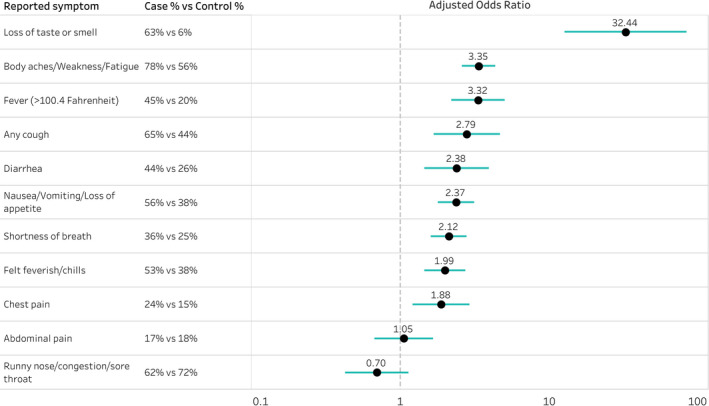
Among 320 participants included, 157 were COVID-19 cases and 163 were SARS-CoV-2 negative controls. Loss of taste or smell was reported by 63% of cases and 6% of controls and was strongly associated with COVID-19 in logistic regression models (adjusted odds ratio [aOR] = 32.4; 95% confidence interval [CI], 12.6-83.1). COVID-19 cases were more likely than controls to have experienced fever, body aches, weakness, or fatigue during illness, and to report ≥1 persistent symptom more than 14 days after symptom onset (50% vs 32%, P < .001). Cases reported significantly more days of poor physical health during the past 14 days than controls (P < .01).
Differentiating COVID-19 from other acute illnesses will require widespread diagnostic testing, especially during influenza seasons. Persistent COVID-19-related symptoms may negatively affect quality of life, even among those initially presenting with mild illness.
轻度 COVID-19 症状是非特异性的,可能持续很长时间。与 COVID-19 相关的持续不良身体或心理健康对生活质量的影响尚未得到很好的理解。
在与美国 11 家医疗中心相关的门诊设施中,对年龄≥18 岁、实验室确诊 COVID-19 的成年人和 SARS-CoV-2 感染检测阴性的匹配对照患者进行了访谈,以评估症状、疾病持续时间和与健康相关的生活质量。采用 Wilcoxon 秩和检验比较病例患者和对照组之间的症状持续时间、与健康相关的生活质量指标以及患病期间经历的症状导致的身体不适天数。采用多变量逻辑回归评估与 COVID-19 病例状态相关的症状。
在纳入的 320 名参与者中,有 157 人为 COVID-19 病例,163 人为 SARS-CoV-2 阴性对照。味觉或嗅觉丧失的病例占 63%,对照占 6%,在逻辑回归模型中与 COVID-19 强烈相关(调整后的优势比[aOR] = 32.4;95%置信区间[CI],12.6-83.1)。与对照组相比,COVID-19 病例在患病期间更有可能出现发热、身体疼痛、虚弱或疲劳,并报告症状出现后≥14 天持续存在≥1 个症状(50%比 32%,P<.001)。病例组在过去 14 天内身体不适的天数明显多于对照组(P<.01)。
将 COVID-19 与其他急性疾病区分开来需要广泛的诊断测试,尤其是在流感季节。持续的 COVID-19 相关症状可能会对生活质量产生负面影响,即使是在最初表现为轻度疾病的患者中也是如此。