Wu Huanhuan, Zheng Lei, Qanmber Ghulam, Guo Mengzhen, Wang Zhi, Yang Zuoren
State Key Laboratory of Cotton Biology, Cotton Research Institute of Chinese Academy of Agricultural Sciences, Anyang, 455000, Henan, China.
National Key Laboratory of Crop Genetic Improvement, Huazhong Agricultural University, Wuhan, 430070, Hubei, China.
BMC Plant Biol. 2021 Jan 6;21(1):13. doi: 10.1186/s12870-020-02787-5.
The sequencing and annotations of cotton genomes provide powerful theoretical support to unravel more physiological and functional information. Plant homeodomain (PHD) protein family has been reported to be involved in regulating various biological processes in plants. However, their functional studies have not yet been carried out in cotton.
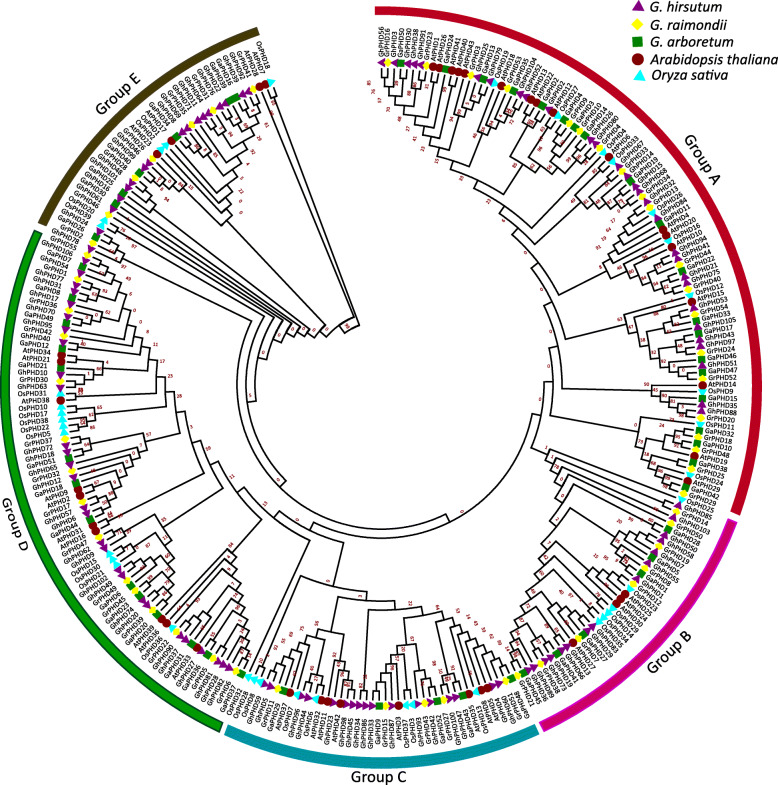
In this study, 108, 55, and 52 PHD genes were identified in G. hirsutum, G. raimondii, and G. arboreum, respectively. A total of 297 PHD genes from three cotton species, Arabidopsis, and rice were divided into five groups. We performed chromosomal location, phylogenetic relationship, gene structure, and conserved domain analysis for GhPHD genes. GhPHD genes were unevenly distributed on each chromosome. However, more GhPHD genes were distributed on At_05, Dt_05, and At_07 chromosomes. GhPHD proteins depicted conserved domains, and GhPHD genes exhibiting similar gene structure were clustered together. Further, whole genome duplication (WGD) analysis indicated that purification selection greatly contributed to the functional maintenance of GhPHD gene family. Expression pattern analysis based on RNA-seq data showed that most GhPHD genes showed clear tissue-specific spatiotemporal expression patterns elucidating the multiple functions of GhPHDs in plant growth and development. Moreover, analysis of cis-acting elements revealed that GhPHDs may respond to a variety of abiotic and phytohormonal stresses. In this regard, some GhPHD genes showed good response against abiotic and phytohormonal stresses. Additionally, co-expression network analysis indicated that GhPHDs are essential for plant growth and development, while GhPHD genes response against abiotic and phytohormonal stresses may help to improve plant tolerance in adverse environmental conditions.
This study will provide useful information to facilitate further research related to the vital roles of GhPHD gene family in plant growth and development.
棉花基因组的测序和注释为揭示更多生理和功能信息提供了有力的理论支持。据报道,植物同源结构域(PHD)蛋白家族参与调控植物的各种生物学过程。然而,尚未在棉花中开展对其功能的研究。
在本研究中,分别在陆地棉、雷蒙德氏棉和亚洲棉中鉴定出108个、55个和52个PHD基因。来自三个棉种、拟南芥和水稻的总共297个PHD基因被分为五组。我们对GhPHD基因进行了染色体定位、系统发育关系、基因结构和保守结构域分析。GhPHD基因在各条染色体上分布不均。然而,更多的GhPHD基因分布在At_05、Dt_05和At_07染色体上。GhPHD蛋白具有保守结构域,具有相似基因结构的GhPHD基因聚集在一起。此外,全基因组复制(WGD)分析表明,纯化选择对GhPHD基因家族的功能维持有很大贡献。基于RNA-seq数据的表达模式分析表明,大多数GhPHD基因表现出清晰的组织特异性时空表达模式,阐明了GhPHD在植物生长发育中的多种功能。此外,顺式作用元件分析表明,GhPHD可能对多种非生物和植物激素胁迫作出反应。在这方面,一些GhPHD基因对非生物和植物激素胁迫表现出良好的反应。此外,共表达网络分析表明,GhPHD对植物生长发育至关重要,而GhPHD基因对非生物和植物激素胁迫的反应可能有助于提高植物在不利环境条件下的耐受性。
本研究将为促进有关GhPHD基因家族在植物生长发育中的重要作用的进一步研究提供有用信息。