The Jackson Heart Study, University of Mississippi Medical Center, 350 W. Woodrow Wilson Avenue, Ste. 701, Jackson, MS, 39213, USA.
BMC Public Health. 2021 Jan 6;21(1):50. doi: 10.1186/s12889-020-10040-9.
Overall mortality has been reported to be lower among individuals classified as overweight/obese when compared with their normal weight counterparts ("obesity paradox") when obesity classification is based on the body mass index (BMI). One possible reason for this apparent paradox is that BMI is not a reliable measure of obesity-related risk as it does not differentiate fat mass from lean muscle mass or fat mass phenotypes. Waist circumference (WC), as a measure of central adiposity, may be a better indicator of obesity-related risk. We examined the association of overall mortality with BMI and with WC measures, including WC, waist-to-height ratio (WHtR) and waist-to-hip ratio (WHR).
Data from 3976 African American participants (551 deaths) in the Jackson Heart Study (JHS) were analyzed. Cox regression models were used to perform survival analysis. Obesity measures were analyzed as dichotomous (obese/non-obese) and continuous variables. Baseline covariates included age, sex and smoking status.
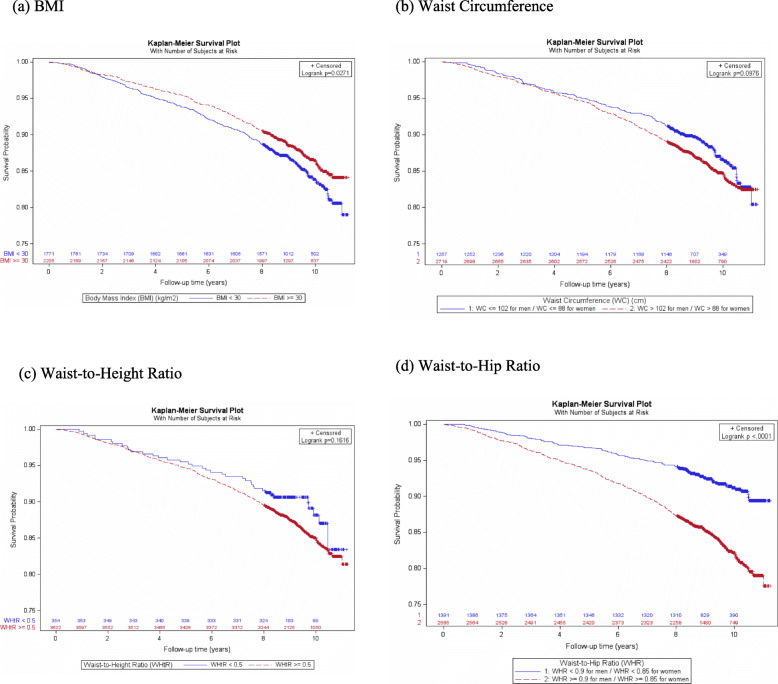
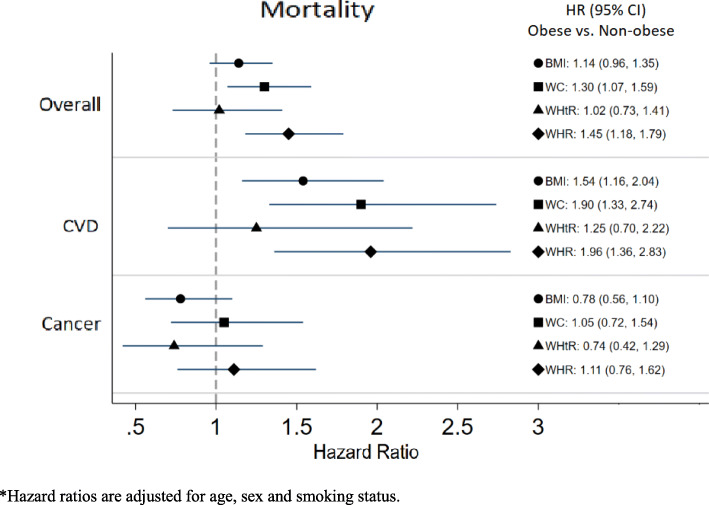
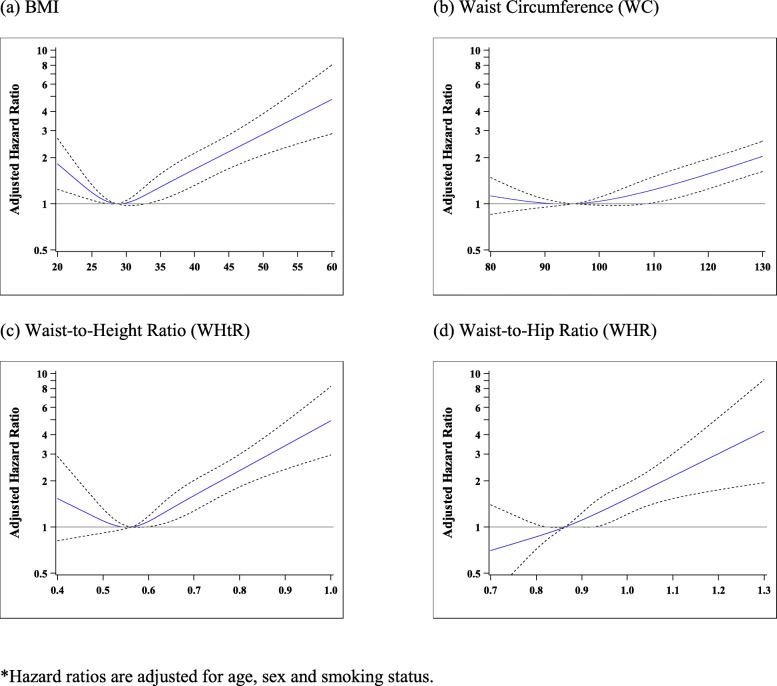
Comparing obese to non-obese participants, adjusted hazard ratios (95% CI) for overall mortality were 1.14 (0.96, 1.35), 1.30 (1.07, 1.59), 1.02 (0.73, 1.41) and 1.45 (1.18, 1.79) when using BMI, WC, WHtR and WHR, respectively. For BMI, WC and WHtR, a J-shaped relationship was observed with overall mortality. For WHR, a monotonic increasing relationship was observed with overall mortality.
In the JHS, we found that obesity as defined by WC and WHR was associated with an increased risk of overall and CVD mortality, while obesity defined by BMI was associated only with an increased risk of CVD mortality. WHR was the only obesity measure that showed a monotonic increasing relationship with overall and CVD mortality.
当根据身体质量指数 (BMI) 对肥胖进行分类时,与正常体重的人相比,超重/肥胖个体的总体死亡率较低(“肥胖悖论”)。这种明显悖论的一个可能原因是,BMI 不是衡量肥胖相关风险的可靠指标,因为它不能区分脂肪量和瘦肌肉量或脂肪量表型。腰围(WC)作为衡量中心性肥胖的指标,可能是衡量肥胖相关风险的更好指标。我们检查了 BMI 和 WC 测量值(包括 WC、腰高比 (WHtR) 和腰臀比 (WHR))与总体死亡率之间的关联。
分析了来自 Jackson 心脏研究 (JHS) 的 3976 名非裔美国参与者(551 人死亡)的数据。使用 Cox 回归模型进行生存分析。肥胖测量值分析为二分类(肥胖/非肥胖)和连续变量。基线协变量包括年龄、性别和吸烟状况。
与肥胖参与者相比,调整后的全因死亡率的危险比(95%CI)分别为 1.14(0.96,1.35)、1.30(1.07,1.59)、1.02(0.73,1.41)和 1.45(1.18,1.79)当使用 BMI、WC、WHtR 和 WHR 时。对于 BMI、WC 和 WHtR,观察到与全因死亡率呈 J 形关系。对于 WHR,观察到与全因死亡率呈单调递增关系。
在 JHS 中,我们发现 WC 和 WHR 定义的肥胖与全因和 CVD 死亡率风险增加相关,而 BMI 定义的肥胖仅与 CVD 死亡率风险增加相关。WHR 是唯一与全因和 CVD 死亡率呈单调递增关系的肥胖指标。