Research School of Population Health, College of Health and Medicine, The Australian National University, Canberra, Australia.
Statistical Consulting Unit, The Australian National University, Canberra, Australia.
Int Breastfeed J. 2021 Jan 6;16(1):7. doi: 10.1186/s13006-020-00347-z.
Infant sleep is of great interest to new parents. There is ongoing debate about whether infants fed with breastmilk substitutes sleep longer than those exclusively or partially breastfed, but what does this mean for the mother? What expectations are realistic for mothers desiring to exclusively breastfeed as recommended by health authorities? There are both biological and social influences on infant and maternal sleep. More accurate information on average maternal sleep hours for diverse feeding practices may help guide realistic expectations and better outcomes for mothers, infants and families.
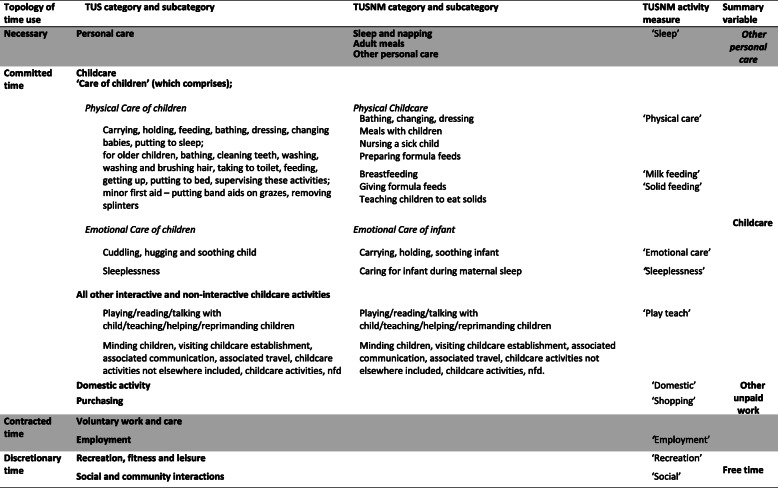
Using a unique time use dataset purposefully designed to study the time use of new mothers, this study investigated whether the weekly duration of maternal sleep, sleep disturbance, unpaid housework, and free time activities differed by detailed feeding method. The study collected 24/7 time use data from 156 mothers of infants aged 3, 6 and/or 9 months between April 2005 and April 2006, recruited via mother's groups, infant health clinics, and childcare services throughout Australia. Sociodemographic and feeding status data were collected by questionnaire. Statistical analysis used linear mixed modelling and residual maximum likelihood analysis to compare effects of different infant feeding practices on maternal time use.
There were no significant differences in time spent asleep between lactating and non lactating mothers, though lactating mothers had more time awake at night. Lactating mothers spent more time (8.5 h weekly) in childcaring activity (p = 0.007), and in employment (2.7 vs. 1.2 h, p < 0.01), but there were no significant differences in free time. Those not breastfeeding spent more time in unpaid domestic work. Exclusive breastfeeding was associated with reduced maternal sleep hours (average 7.08 h daily). Again, free time did not differ significantly between feeding groups. Exclusively breastfeeding mothers experienced reduced sleep hours, but maintained comparable leisure time to other mothers by allocating their time differently. Domestic work hours differed, interacting in complex ways with infant age and feeding practice.
Optimal breastfeeding may require realistic maternal sleep expectations and equitable sharing of paid and unpaid work burdens with other household members in the months after the birth of an infant.
婴儿睡眠是新手父母非常关注的问题。关于母乳喂养和配方奶喂养的婴儿,哪种方式睡眠时间更长一直存在争议,但这对母亲意味着什么呢?对于希望按照卫生当局建议进行纯母乳喂养的母亲来说,现实的期望是什么?婴儿和母亲的睡眠受到生物和社会因素的影响。对于不同喂养方式下母亲平均睡眠时间的更准确信息,可能有助于为母亲、婴儿和家庭提供现实的期望和更好的结果。
本研究使用专门设计的独特时间使用数据集,研究了新母亲的时间使用情况,以调查母亲的每周睡眠时间、睡眠干扰、无报酬家务劳动和空闲时间活动是否因详细喂养方式而异。该研究于 2005 年 4 月至 2006 年 4 月期间通过母亲团体、婴儿健康诊所和儿童保育服务在澳大利亚各地招募了 156 名 3、6 和/或 9 个月大婴儿的母亲,收集了她们 24/7 的时间使用数据。通过问卷收集社会人口统计学和喂养状况数据。使用线性混合模型和残差最大似然分析比较了不同婴儿喂养方式对母亲时间使用的影响。
母乳喂养和非母乳喂养的母亲在睡眠时间上没有显著差异,尽管母乳喂养的母亲夜间醒来的时间更多。母乳喂养的母亲花更多的时间(每周 8.5 小时)在照顾孩子的活动中(p=0.007),并且在就业中(2.7 小时对 1.2 小时,p<0.01),但空闲时间没有显著差异。不进行母乳喂养的母亲花更多的时间在无报酬的家务劳动上。纯母乳喂养与母亲睡眠时间减少(平均每天 7.08 小时)有关。同样,不同喂养组之间的空闲时间没有显著差异。纯母乳喂养的母亲睡眠时间减少,但通过不同的时间分配,与其他母亲保持可比的休闲时间。家务劳动时间不同,与婴儿年龄和喂养方式以复杂的方式相互作用。
优化母乳喂养可能需要对母亲的睡眠期望现实,并在婴儿出生后的几个月内与其他家庭成员公平分担有偿和无偿工作负担。