Gridneva Zoya, Kugananthan Sambavi, Hepworth Anna R, Tie Wan J, Lai Ching T, Ward Leigh C, Hartmann Peter E, Geddes Donna T
School of Chemistry and Biochemistry, The University of Western Australia, Crawley, Perth, Western Australia 6009, Australia.
School of Anatomy, Physiology and Human Biology, The University of Western Australia, Crawley, Perth, Western Australia 6009, Australia.
Nutrients. 2016 Dec 28;9(1):15. doi: 10.3390/nu9010015.
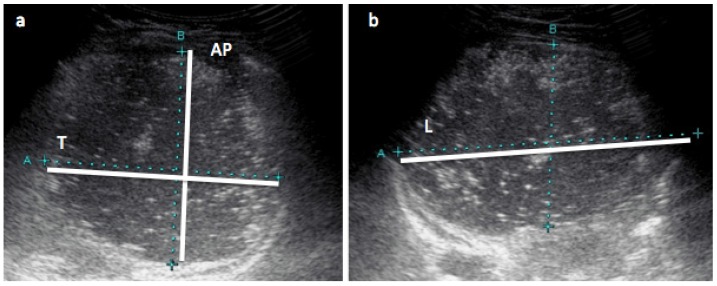
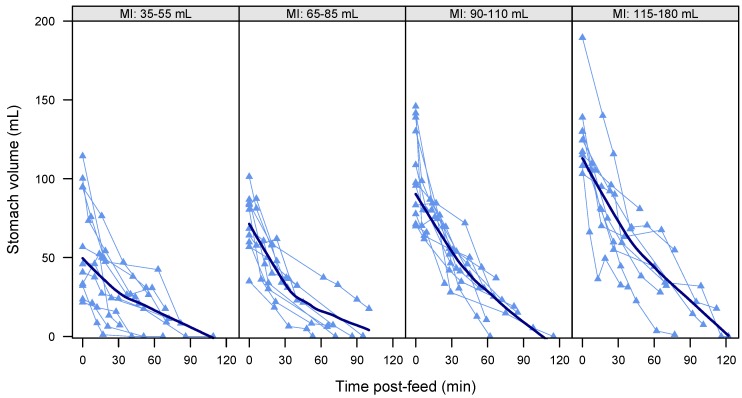
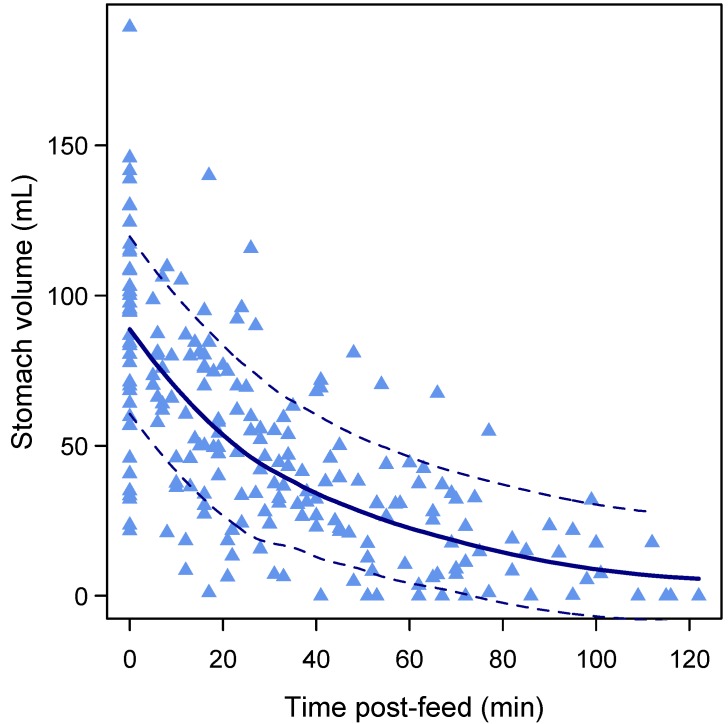
Human milk (HM) components influence infant feeding patterns and nutrient intake, yet it is unclear how they influence gastric emptying (GE), a key component of appetite regulation. This study analyzed GE of a single breastfeed, HM appetite hormones/macronutrients and demographics/anthropometrics/body composition of term fully breastfed infants ( = 41, 2 and/or 5 mo). Stomach volumes (SV) were calculated from pre-/post-feed ultrasound scans, then repeatedly until the next feed. Feed volume (FV) was measured by the test-weigh method. HM samples were analyzed for adiponectin, leptin, fat, lactose, total carbohydrate, lysozyme, and total/whey/casein protein. Linear regression/mixed effect models were used to determine associations between GE/feed variables and HM components/infant anthropometrics/adiposity. Higher FVs were associated with faster (-0.07 [-0.10, -0.03], < 0.001) GE rate, higher post-feed SVs (0.82 [0.53, 1.12], < 0.001), and longer GE times (0.24 [0.03, 0.46], = 0.033). Higher whey protein concentration was associated with higher post-feed SVs (4.99 [0.84, 9.13], = 0.023). Longer GE time was associated with higher adiponectin concentration (2.29 [0.92, 3.66], = 0.002) and dose (0.02 [0.01, 0.03], = 0.005), and lower casein:whey ratio (-65.89 [-107.13, -2.66], = 0.003). FV and HM composition influence GE and breastfeeding patterns in term breastfed infants.
人乳(HM)成分会影响婴儿的喂养模式和营养摄入,但目前尚不清楚它们如何影响胃排空(GE),而胃排空是食欲调节的关键组成部分。本研究分析了足月纯母乳喂养婴儿(n = 41,2和/或5个月)单次母乳喂养的胃排空情况、人乳食欲激素/常量营养素以及人口统计学/人体测量学/身体成分。通过喂养前后的超声扫描计算胃容积(SV),然后反复测量直至下次喂养。采用测试称重法测量喂养量(FV)。对人乳样本进行脂联素、瘦素、脂肪、乳糖、总碳水化合物、溶菌酶以及总蛋白/乳清蛋白/酪蛋白的分析。使用线性回归/混合效应模型来确定胃排空/喂养变量与人乳成分/婴儿人体测量学/肥胖之间的关联。较高的喂养量与更快的胃排空速率(-0.07 [-0.10, -0.03],P < 0.001)、更高的喂养后胃容积(0.82 [0.53, 1.12],P < 0.001)以及更长的胃排空时间(0.24 [0.03, 0.46],P = 0.033)相关。较高的乳清蛋白浓度与较高的喂养后胃容积相关(4.99 [0.84, 9.13],P = 0.023)。更长的胃排空时间与较高的脂联素浓度(2.29 [0.92, 3.66],P = 0.002)和剂量(0.02 [0.01, 0.03],P = 0.005)以及较低的酪蛋白:乳清蛋白比例(-65.89 [-107.13, -2.66],P = 0.003)相关。喂养量和人乳成分会影响足月母乳喂养婴儿的胃排空和母乳喂养模式。