
登革热在中国建筑工地与其周围社区之间的传播。
Dengue fever transmission between a construction site and its surrounding communities in China.
机构信息
State Key Laboratory of Molecular Vaccinology and Molecular Diagnostics, School of Public Health, Xiamen University, Xiamen, Fujian, People's Republic of China.
Guangdong Provincial Center for Disease Control and Prevention, Guangzhou, Guangdong, People's Republic of China.
出版信息
Parasit Vectors. 2021 Jan 6;14(1):22. doi: 10.1186/s13071-020-04463-x.
BACKGROUND
Due to an increase in mosquito habitats and the lack facilities to carry out basic mosquito control, construction sites in China are more likely to experience secondary dengue fever infection after importation of an initial infection, which may then increase the number of infections in the neighboring communities and the chance of community transmission. The aim of this study was to investigate how to effectively reduce the transmission of dengue fever at construction sites and the neighboring communities.
METHODS
The Susceptible-Exposed-Infectious/Asymptomatic-Recovered (SEIAR) model of human and SEI model of mosquitoes were developed to estimate the transmission of dengue virus between humans and mosquitoes within the construction site and within a neighboring community, as well between each of these. With the calibrated model, we further estimated the effectiveness of different intervention scenarios targeting at reducing the transmissibility at different locations (i.e. construction sites and community) with the total attack rate (TAR) and the duration of the outbreak (DO).
RESULTS
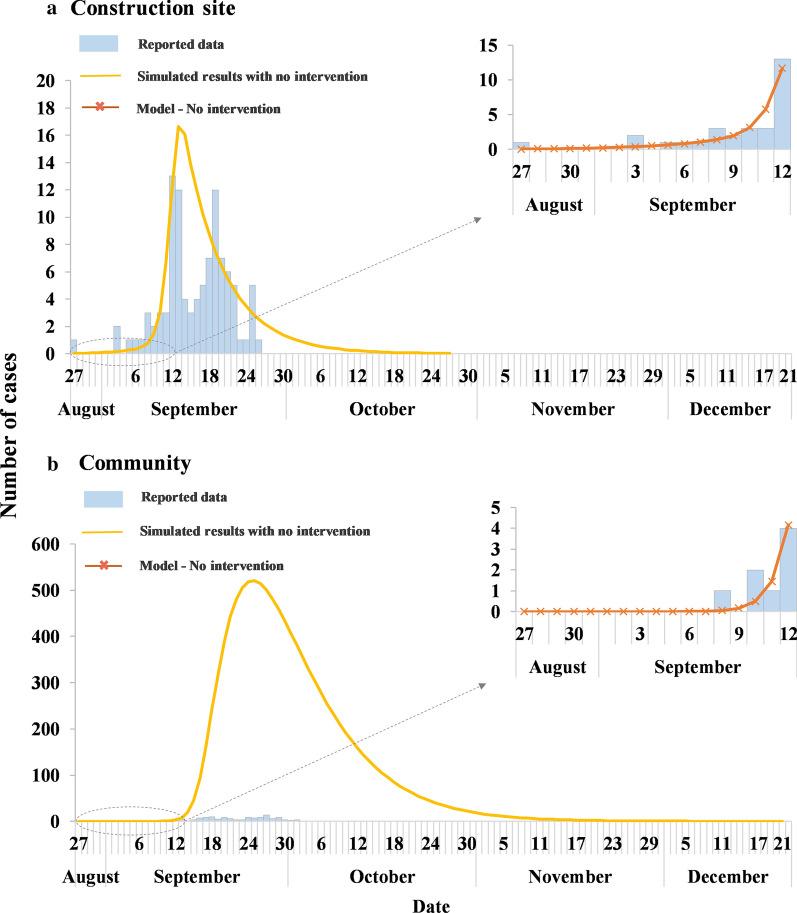
A total of 102 construction site-related and 131 community-related cases of dengue fever were reported in our area of study. Without intervention, the number of cases related to the construction site and the community rose to 156 (TAR: 31.25%) and 10,796 (TAR: 21.59%), respectively. When the transmission route from mosquitoes to humans in the community was cut off, the number of community cases decreased to a minimum of 33 compared with other simulated scenarios (TAR: 0.068%, DO: 60 days). If the transmission route from infectious mosquitoes in the community and that from the construction site to susceptible people on the site were cut off at the same time, the number of cases on the construction site dropped to a minimum of 74 (TAR: 14.88%, DO: 66 days).
CONCLUSIONS
To control the outbreak of dengue fever effectively on both the construction site and in the community, interventions needed to be made both within the community and from the community to the construction site. If interventions only took place within the construction site, the number of cases on the construction site would not be reduced. Also, interventions implemented only within the construction site or between the construction site and the community would not lead to a reduction in the number of cases in the community.
背景
由于蚊虫栖息地的增加和缺乏基本的蚊虫控制设施,中国的建筑工地在输入初始感染后更容易发生二次登革热感染,这可能会增加邻近社区的感染人数和社区传播的机会。本研究旨在探讨如何有效降低建筑工地和邻近社区登革热的传播。
方法
建立了人群的易感-暴露-感染/无症状-恢复(SEIAR)模型和蚊虫的 SEI 模型,以估计建筑工地内和社区内以及两者之间的登革病毒在人与人之间以及蚊子与蚊子之间的传播。通过校准模型,我们进一步估计了针对不同地点(即建筑工地和社区)降低传染性的不同干预场景的效果,使用总攻击率(TAR)和爆发持续时间(DO)。
结果
在我们的研究区域共报告了 102 例与建筑工地相关的和 131 例与社区相关的登革热病例。如果不干预,建筑工地和社区的病例数分别增加到 156 例(TAR:31.25%)和 10796 例(TAR:21.59%)。当社区内蚊子向人类传播的途径被切断时,与其他模拟情景相比,社区内的病例数减少到最低的 33 例(TAR:0.068%,DO:60 天)。如果同时切断社区内有传染性的蚊子与建筑工地内易感人群之间的传播途径,建筑工地的病例数减少到最低的 74 例(TAR:14.88%,DO:66 天)。
结论
要有效控制建筑工地和社区登革热的爆发,需要在社区内和从社区到建筑工地进行干预。如果仅在建筑工地内进行干预,建筑工地内的病例数不会减少。此外,仅在建筑工地内或建筑工地与社区之间实施的干预措施不会导致社区内病例数减少。


 Zotero 插件