MOE Key Laboratory for Analytical Science of Food Safety and Biology, Fujian Provincial Key Laboratory of Analysis and Detection Technology for Food Safety, State Key Laboratory of Photocatalysis on Energy and Environment, College of Chemistry, Fuzhou University, Fuzhou 350116, P. R. China.
Theranostics. 2021 Jan 1;11(4):1970-1981. doi: 10.7150/thno.45777. eCollection 2021.
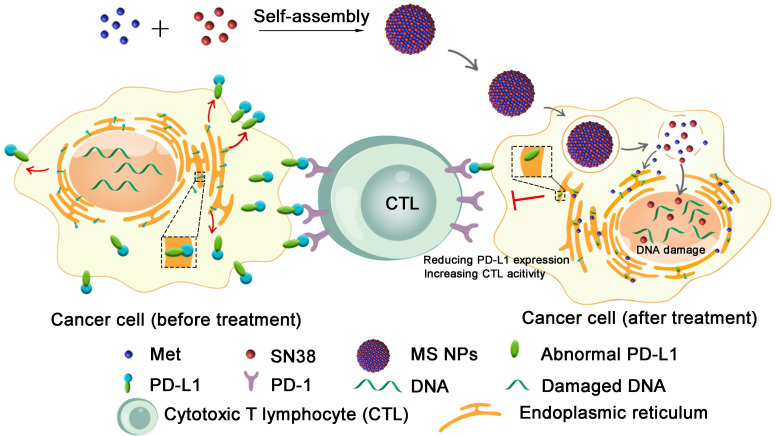
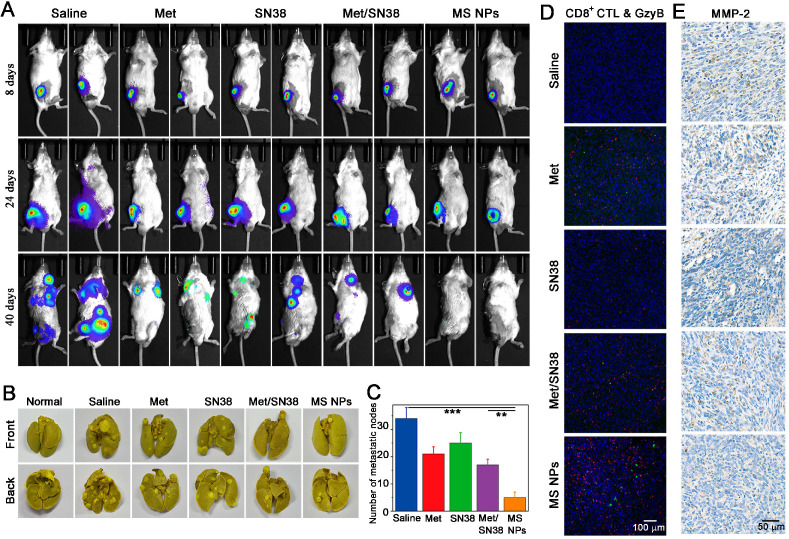
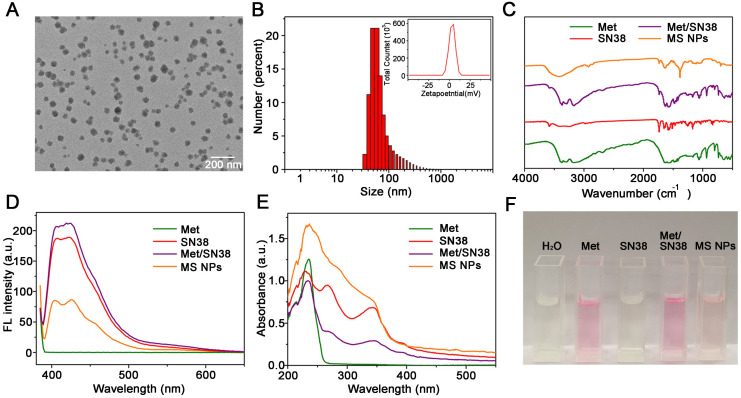
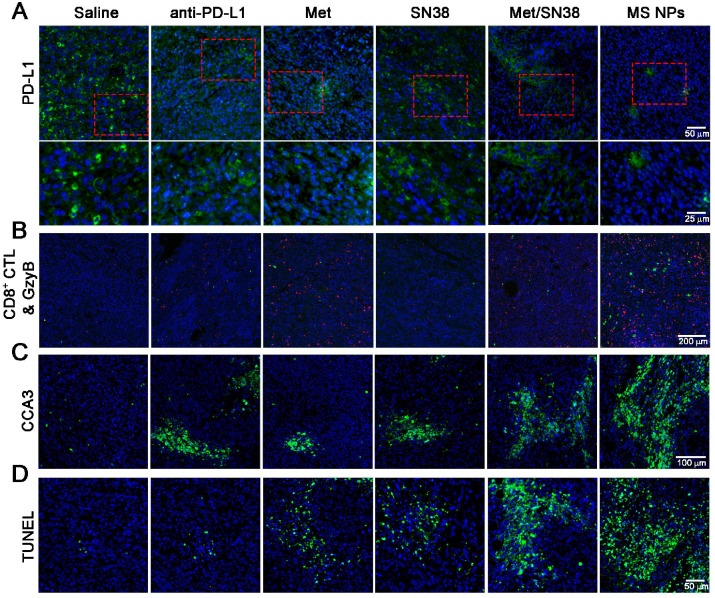
The binding between the immune checkpoints, programmed cell death ligand 1 (PD-L1) and programmed cell death 1 (PD-1), compromises T-cell-mediated immune surveillance. Immune checkpoint therapy using immune checkpoint inhibitors (ICIs) to block PD-L1 on cancer cell membrane or PD-1 on activated T cell membrane can restore antitumor function of T cell. However, the intracellular expression of PD-L1 and its active redistribution to cancer cell membrane may impair the therapeutic benefits of ICIs. To address this issue, herein we develop a nanodrug (MS NPs) capable of reducing PD-L1 expression and enhancing antitumor effects. The nanodrug was self-assembled from immunoadjuvant metformin (Met, an old drug) and anticancer agent 7-ethyl-10-hydroxycamptothecin (SN38) via hydrogen bonds and electrostatic interactions. A series of experiments, including the characterization of MS NPs, the validation of MS NPs-mediated down-regulation of PD-L1 expression and therapeutic effect, the MS NPs-mediated chemo-immunotherapy and tumor metastasis inhibition were carried out. Different from ICIs that conformationally block PD-L1 on cancer cell membrane, MS NPs directly reduced the PD-L1 level via metformin to achieve immunotherapy. Therefore, MS NPs showed enhanced chemo-immunotherapy effect than its counterparts. MS NPs were also effective in inhibiting tumor metastasis by remodeling the extracellular matrix and restoring immune surveillance. Additionally, no obvious toxicity was observed in major organs from MS NPs-treated mice and a high survival rate of mice was obtained after MS NPs treatment. We have designed nanodrug MS NPs by self-assembly of the immunoadjuvant Met and the anticancer agent SN38 for combined immunotherapy and chemotherapy. MS NPs might break the deadlock of antibody-based ICIs in immunotherapy, and repurposing old drug might provide a new perspective on the development of novel ICIs.
免疫检查点,程序性死亡配体 1(PD-L1)和程序性死亡 1(PD-1)之间的结合会损害 T 细胞介导的免疫监视。使用免疫检查点抑制剂(ICIs)阻断癌细胞膜上的 PD-L1 或激活的 T 细胞膜上的 PD-1 来抑制免疫检查点的免疫疗法可以恢复 T 细胞的抗肿瘤功能。然而,PD-L1 的细胞内表达及其向癌细胞膜的主动重新分布可能会损害 ICI 的治疗效果。为了解决这个问题,我们在此开发了一种能够降低 PD-L1 表达并增强抗肿瘤作用的纳米药物(MS NPs)。该纳米药物是通过氢键和静电相互作用由免疫佐剂二甲双胍(Met,一种老药)和抗癌剂 7-乙基-10-羟基喜树碱(SN38)自组装而成的。我们进行了一系列实验,包括 MS NPs 的表征、MS NPs 介导的 PD-L1 表达下调和治疗效果的验证、MS NPs 介导的化疗免疫治疗和肿瘤转移抑制。与通过构象阻断癌细胞膜上 PD-L1 的 ICI 不同,MS NPs 通过二甲双胍直接降低 PD-L1 水平以实现免疫治疗。因此,MS NPs 表现出比其对应物更强的化疗免疫治疗效果。MS NPs 通过重塑细胞外基质和恢复免疫监视也有效抑制肿瘤转移。此外,在接受 MS NPs 治疗的小鼠的主要器官中未观察到明显的毒性,并且在接受 MS NPs 治疗后获得了高的小鼠存活率。我们通过将免疫佐剂 Met 和抗癌剂 SN38 自组装设计了纳米药物 MS NPs 用于联合免疫治疗和化疗。MS NPs 可能打破免疫治疗中基于抗体的 ICI 的僵局,而重新利用旧药可能为开发新型 ICI 提供新的视角。