Sölva Katharina, Haselgruber Alexander, Lueger-Schuster Brigitte
Unit of Psychotraumatology, Department of Applied Psychology, Faculty of Psychology, University of Vienna, Vienna, Austria.
Eur J Psychotraumatol. 2020 Nov 19;11(1):1832757. doi: 10.1080/20008198.2020.1832757.
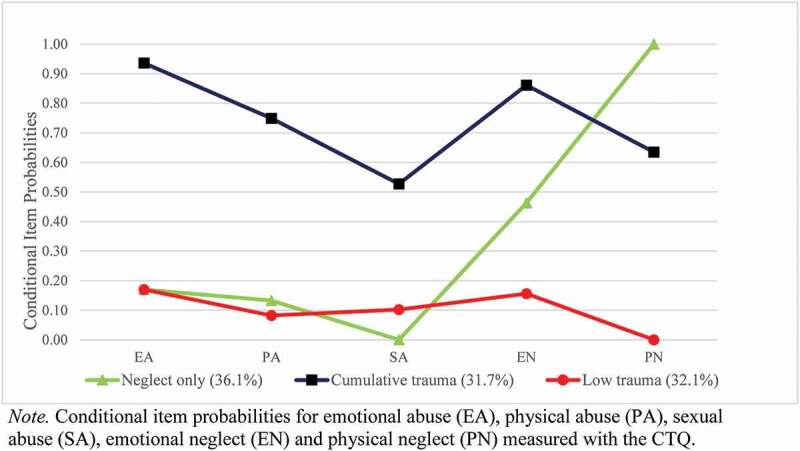
: Children and adolescents in foster care often experience many co-occurring subtypes of maltreatment. However, little is known about different combinations of maltreatment subtypes, referred to as maltreatment classes. Furthermore, the association between those maltreatment classes and ICD-11 posttraumatic stress disorder (PTSD) and complex PTSD (CPTSD) has not been investigated in children and adolescents. In previous studies, classes characterized by cumulative maltreatment were associated with severe psychopathological symptoms. So far, no study investigated ICD-11 PTSD and CPTSD. : The first aim of this study was the detection of distinct maltreatment classes by examining frequently co-occurring maltreatment subtypes. The second aim was the examination of the association between those maltreatment classes and ICD-11 PTSD and CPTSD. : Participants were 147 children and adolescents currently living in foster care institutions in Lower Austria. Maltreatment history, ICD-11 PTSD and CPTSD were assessed using standardized self-report questionnaires. Latent class analysis was applied to examine maltreatment subtypes. χ difference testing was used to examine class associations with PTSD and CPTSD. : Three latent classes that comprised different subtypes of maltreatment were identified (limited maltreatment, = 49; high neglect, = 53; cumulative maltreatment, = 45). Cumulative maltreatment was associated with higher symptom severity of PTSD and CPTSD than the limited maltreatment and the high neglect class, with effect sizes ranging from 0.62 to 0.93. : The association of the cumulative maltreatment class with the highest symptom severity of PTSD and CPTSD highlights the detrimental effect of cumulative maltreatment. The detection of a high neglect class identifies children and adolescents, who are at high-risk of experiencing future maltreatment because of their previous experiences of neglect and the associated lack of protection. The examination of the association of distinct maltreatment classes with ICD-11 PTSD and CPTSD might provide implications for targeted prevention, assessment and treatment.
寄养机构中的儿童和青少年常常经历多种同时出现的虐待亚型。然而,对于被称为虐待类别(maltreatment classes)的不同虐待亚型组合,我们所知甚少。此外,这些虐待类别与国际疾病分类第11版(ICD - 11)创伤后应激障碍(PTSD)和复杂性创伤后应激障碍(CPTSD)之间的关联在儿童和青少年中尚未得到研究。在以往的研究中,以累积性虐待为特征的类别与严重的精神病理症状相关。到目前为止,尚无研究调查ICD - 11 PTSD和CPTSD。
本研究的首要目的是通过检查经常同时出现的虐待亚型来检测不同的虐待类别。第二个目的是检验这些虐待类别与ICD - 11 PTSD和CPTSD之间的关联。
研究参与者为147名目前居住在奥地利下奥地利州寄养机构的儿童和青少年。使用标准化的自我报告问卷评估虐待史、ICD - 11 PTSD和CPTSD。应用潜在类别分析来检查虐待亚型。采用χ差异检验来检查类别与PTSD和CPTSD的关联。
识别出了包含不同虐待亚型的三个潜在类别(有限虐待,n = 49;高度忽视,n = 53;累积性虐待,n = 45)。与有限虐待和高度忽视类别相比,累积性虐待与PTSD和CPTSD的更高症状严重程度相关,效应大小范围为0.62至0.93。
累积性虐待类别与PTSD和CPTSD的最高症状严重程度之间的关联凸显了累积性虐待的有害影响。高度忽视类别的发现识别出了因先前的忽视经历及相关保护缺失而面临未来遭受虐待高风险的儿童和青少年。对不同虐待类别与ICD - 11 PTSD和CPTSD之间关联的研究可能为有针对性的预防、评估和治疗提供启示。