Institute for Social Science Research, The University of Queensland, Brisbane, Australia.
icddr,b, Dhaka, Bangladesh.
JMIR Public Health Surveill. 2021 Mar 9;7(3):e23538. doi: 10.2196/23538.
Diabetic retinopathy can cause blindness even in the absence of symptoms. Although routine eye screening remains the mainstay of diabetic retinopathy treatment and it can prevent 95% of blindness, this screening is not available in many low- and middle-income countries even though these countries contribute to 75% of the global diabetic retinopathy burden.
The aim of this study was to assess the diagnostic accuracy of diabetic retinopathy screening done by non-ophthalmologists using 2 different digital fundus cameras and to assess the risk factors for the occurrence of diabetic retinopathy.
This validation study was conducted in 6 peripheral health facilities in Bangladesh from July 2017 to June 2018. A double-blinded diagnostic approach was used to test the accuracy of the diabetic retinopathy screening done by non-ophthalmologists against the gold standard diagnosis by ophthalmology-trained eye consultants. Retinal images were taken by using either a desk-based camera or a hand-held camera following pupil dilatation. Test accuracy was assessed using measures of sensitivity, specificity, and positive and negative predictive values. Overall agreement with the gold standard test was reported using the Cohen kappa statistic (κ) and area under the receiver operating curve (AUROC). Risk factors for diabetic retinopathy occurrence were assessed using binary logistic regression.
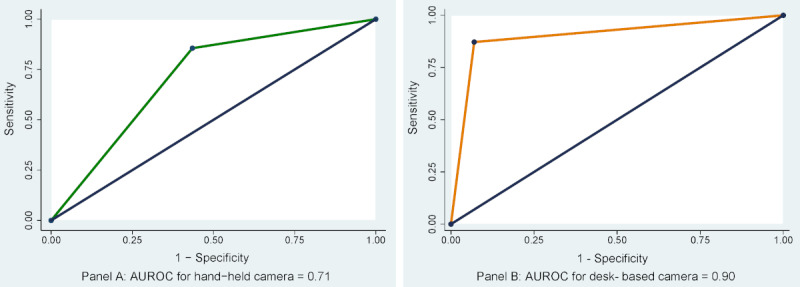
In 1455 patients with diabetes, the overall sensitivity to detect any form of diabetic retinopathy by non-ophthalmologists was 86.6% (483/558, 95% CI 83.5%-89.3%) and the specificity was 78.6% (705/897, 95% CI 75.8%-81.2%). The accuracy of the correct classification was excellent with a desk-based camera (AUROC 0.901, 95% CI 0.88-0.92) and fair with a hand-held camera (AUROC 0.710, 95% CI 0.67-0.74). Out of the 3 non-ophthalmologist categories, registered nurses and paramedics had strong agreement with kappa values of 0.70 and 0.85 in the diabetic retinopathy assessment, respectively, whereas the nonclinical trained staff had weak agreement (κ=0.35). The odds of having retinopathy increased with the duration of diabetes measured in 5-year intervals (P<.001); the odds of having retinopathy in patients with diabetes for 5-10 years (odds ratio [OR] 1.81, 95% CI 1.37-2.41) and more than 10 years (OR 3.88, 95% CI 2.91-5.15) were greater than that in patients with diabetes for less than 5 years. Obesity was found to have a negative association (P=.04) with diabetic retinopathy.
Digital fundus photography is an effective screening tool with acceptable diagnostic accuracy. Our findings suggest that diabetic retinopathy screening can be accurately performed by health care personnel other than eye consultants. People with more than 5 years of diabetes should receive priority in any community-level retinopathy screening program. In a country like Bangladesh where no diabetic retinopathy screening services exist, the use of hand-held cameras can be considered as a cost-effective option for potential system-wide implementation.
糖尿病视网膜病变即使没有症状也可能导致失明。虽然常规眼部筛查仍然是治疗糖尿病视网膜病变的主要手段,可以预防 95%的失明,但即使在这些国家占全球糖尿病视网膜病变负担的 75%的许多低收入和中等收入国家,也无法进行这种筛查。
本研究旨在评估非眼科医生使用两种不同的数字眼底相机进行糖尿病视网膜病变筛查的诊断准确性,并评估糖尿病视网膜病变发生的危险因素。
本验证研究于 2017 年 7 月至 2018 年 6 月在孟加拉国的 6 个基层卫生设施进行。采用双盲诊断方法,将非眼科医生进行的糖尿病视网膜病变筛查与眼科培训的眼顾问进行的金标准诊断进行比较。在瞳孔扩大后,使用台式相机或手持式相机拍摄视网膜图像。使用敏感度、特异性、阳性和阴性预测值来评估测试准确性。使用 Cohen kappa 统计量(κ)和接收器操作曲线下的面积(AUROC)报告与金标准测试的总体一致性。使用二项逻辑回归评估糖尿病视网膜病变发生的危险因素。
在 1455 名糖尿病患者中,非眼科医生检测任何形式的糖尿病视网膜病变的总敏感度为 86.6%(483/558,95%CI 83.5%-89.3%),特异性为 78.6%(705/897,95%CI 75.8%-81.2%)。台式相机的正确分类准确性非常好(AUROC 0.901,95%CI 0.88-0.92),手持式相机的准确性为中等(AUROC 0.710,95%CI 0.67-0.74)。在 3 个非眼科医生类别中,注册护士和辅助医务人员在糖尿病视网膜病变评估中的kappa 值分别为 0.70 和 0.85,具有较强的一致性,而非临床培训人员的一致性较弱(κ=0.35)。糖尿病视网膜病变的几率随着糖尿病的持续时间(以 5 年为间隔测量)而增加(P<.001);糖尿病持续 5-10 年(比值比[OR]1.81,95%CI 1.37-2.41)和 10 年以上(OR 3.88,95%CI 2.91-5.15)的患者发生糖尿病视网膜病变的几率大于糖尿病持续时间不足 5 年的患者。肥胖与糖尿病视网膜病变呈负相关(P=.04)。
数字眼底摄影是一种有效的筛查工具,具有可接受的诊断准确性。我们的研究结果表明,糖尿病视网膜病变筛查可以由眼科顾问以外的医疗保健人员准确进行。任何社区层面的视网膜病变筛查计划都应优先考虑糖尿病持续时间超过 5 年的患者。在孟加拉国等没有糖尿病视网膜病变筛查服务的国家,可以考虑使用手持式相机作为具有成本效益的系统全面实施的选择。
