
奇蹟的消亡:阿拉伯半岛的神奇壁虎(有鳞目,壁虎科)的进化历史和保护评估。
The demise of a wonder: Evolutionary history and conservation assessments of the Wonder Gecko Teratoscincus keyserlingii (Gekkota, Sphaerodactylidae) in Arabia.
机构信息
Institute of Evolutionary Biology (CSIC-Universitat Pompeu Fabra), Passeig Marítim de la Barceloneta, Barcelona, Spain.
Environment and Protected Areas Authority, Sharjah, United Arab Emirates.
出版信息
PLoS One. 2021 Jan 7;16(1):e0244150. doi: 10.1371/journal.pone.0244150. eCollection 2021.
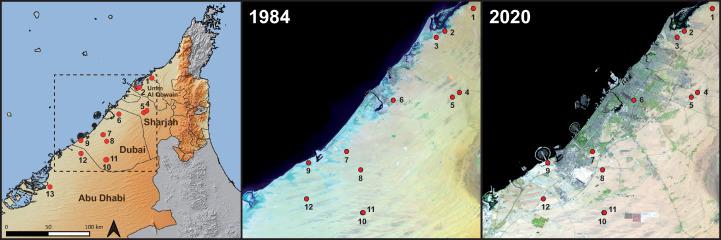
Effective biodiversity conservation planning starts with genetic characterization within and among focal populations, in order to understand the likely impact of threats for ensuring the long-term viability of a species. The Wonder Gecko, Teratoscincus keyserlingii, is one of nine members of the genus. This species is distributed in Iran, Afghanistan, and Pakistan, with a small isolated population in the United Arab Emirates (UAE), where it is classified nationally as Critically Endangered. Within its Arabian range, anthropogenic activity is directly linked to the species' decline, with highly localised and severely fragmented populations. Here we describe the evolutionary history of Teratoscincus, by reconstructing its phylogenetic relationships and estimating its divergence times and ancestral biogeography. For conservation implications of T. keyserlingii we evaluate the genetic structure of the Arabian population using genomic data. This study supports the monophyly of most species and reveals considerable intraspecific variability in T. microlepis and T. keyserlingii, which necessitate broad systematic revisions. The UAE population of T. keyserlingii likely arrived from southern Iran during the Pleistocene and no internal structure was recovered within, implying a single population status. Regional conservation of T. keyserlingii requires improved land management and natural habitat restoration in the species' present distribution, and expansion of current protected areas, or establishment of new areas with suitable habitat for the species, mostly in northern Abu Dhabi Emirate.
有效的生物多样性保护规划始于对焦点种群内和种群间的遗传特征进行描述,以便了解威胁可能对确保物种的长期生存能力产生的影响。奇妙壁虎,Teratoscincus keyserlingii,是该属的九个成员之一。该物种分布于伊朗、阿富汗和巴基斯坦,在阿拉伯联合酋长国(UAE)有一个小的孤立种群,在那里被国家列为极度濒危。在其阿拉伯范围内,人类活动与物种的减少直接相关,导致种群高度本地化和严重碎片化。在这里,我们通过重建其系统发育关系并估计其分歧时间和祖先生物地理学,描述了 Teratoscincus 的进化历史。为了评估 T. keyserlingii 的保护意义,我们使用基因组数据评估了阿拉伯种群的遗传结构。这项研究支持了大多数物种的单系性,并揭示了 T. microlepis 和 T. keyserlingii 中相当大的种内变异性,这需要进行广泛的系统修订。T. keyserlingii 的阿联酋种群可能是在更新世期间从伊朗南部到达的,并且在内部没有发现结构,这意味着存在单一的种群状态。为了保护 T. keyserlingii,需要在该物种现有的分布范围内改善土地管理和自然栖息地的恢复,并扩大现有的保护区,或建立新的有适合该物种的栖息地的保护区,主要在阿布扎比酋长国北部。




 Zotero 插件