Department of Maternal, Child, and Adolescent Health, School of Public Health, Anhui Medical University, No 81 Meishan Road, Hefei, 230032, Anhui, China.
MOE Key Laboratory of Population Health Across Life Cycle, No 81 Meishan Road, Hefei, 230032, Anhui, China.
Environ Health Prev Med. 2021 Jan 7;26(1):3. doi: 10.1186/s12199-020-00926-w.
Previous studies have suggested that screen time (ST) has a negative effect on children's emotional and behavioral health, but there are few longitudinal studies that have been conducted with infants and toddlers. This study sought to examine the effect of ST in early childhood on emotional and behavioral problems in children aged 4 years, based on a birth cohort study in China.
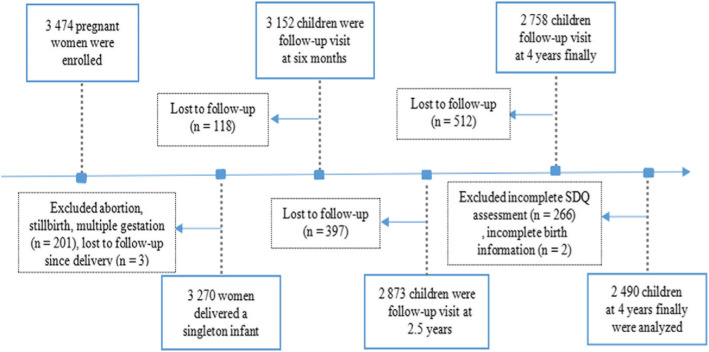
A total of 2492 children aged 4 years were enrolled in this study. The parents and guardians of each child completed a questionnaire that included items eliciting information on children's birth information, socio-demographic information at baseline, and ST at each follow-up. Emotional and behavioral problems were assessed using the Strengths and Difficulties Questionnaire (SDQ) at 4 years of age. Multivariate logistic analysis was used to explore the effects of ST on emotional and behavioral problems.
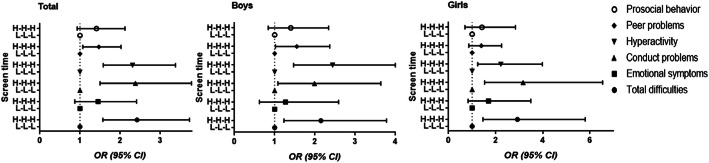
The percentages of children with ST > 0 h/day at age 0.5 years, ST > 2 h/day at age 2.5 years, and ST > 2 h/day at age 4 years were 45.7, 55.5, and 34.5% respectively. The prevalence of emotional and behavioral problems was 10.8%. ST at 6 months was a risk factor for emotional symptoms and hyperactivity at the age of 4 years. ST at age 2.5 years was a risk factor for hyperactivity at the age of 4 years. However, ST at age 4 years was a risk factor for total difficulties, conduct problems, peer problems, hyperactivity, and prosocial behavior.
Higher ST exposure at early childhood is associated with later emotional and behavioral problems. In particular, sustained high ST exposure is a risk factor for behavioral problems. These findings suggested the importance of controlling ST to prevent the occurrence of emotional and behavioral problems in the early years.
先前的研究表明,屏幕时间(ST)对儿童的情绪和行为健康有负面影响,但很少有针对婴儿和幼儿的纵向研究。本研究旨在基于中国的一项出生队列研究,探讨儿童早期 ST 对 4 岁儿童情绪和行为问题的影响。
共有 2492 名 4 岁儿童参加了本研究。每位儿童的父母或监护人完成了一份问卷,其中包括儿童出生信息、基线时的社会人口学信息以及每次随访时的 ST 信息。在 4 岁时使用《长处与困难问卷》(SDQ)评估情绪和行为问题。采用多变量逻辑分析探讨 ST 对情绪和行为问题的影响。
0.5 岁时 ST>0 小时/天、2.5 岁时 ST>2 小时/天和 4 岁时 ST>2 小时/天的儿童比例分别为 45.7%、55.5%和 34.5%。情绪和行为问题的患病率为 10.8%。6 个月时的 ST 是 4 岁时情绪症状和多动的危险因素。2.5 岁时的 ST 是 4 岁时多动的危险因素。然而,4 岁时的 ST 是总困难、行为问题、同伴问题、多动和亲社会行为的危险因素。
儿童早期较高的 ST 暴露与后期的情绪和行为问题有关。特别是持续高 ST 暴露是行为问题的危险因素。这些发现表明控制 ST 对于预防早期情绪和行为问题的发生非常重要。