Department of Pediatrics, University of Alberta, Edmonton, Alberta, Canada.
Department of Medicine, McMaster University, Hamilton, Ontario, Canada.
PLoS One. 2019 Apr 17;14(4):e0213995. doi: 10.1371/journal.pone.0213995. eCollection 2019.
Pre-school children spend an average of two-hours daily using screens. We examined associations between screen-time on pre-school behavior using data from the Canadian Healthy Infant Longitudinal Development (CHILD) study.
CHILD participant parents completed the Child Behavior Checklist (CBCL) at five-years of age. Parents reported their child's total screen-time including gaming and mobile devices. Screen-time was categorized using the recommended threshold of two-hours/day for five-years or one-hour/day for three-years. Multiple linear regression examined associations between screen-time and externalizing behavior (e.g. inattention and aggression). Multiple logistic regression identified characteristics of children at risk for clinically significant externalizing problems (CBCL T-score≥65).
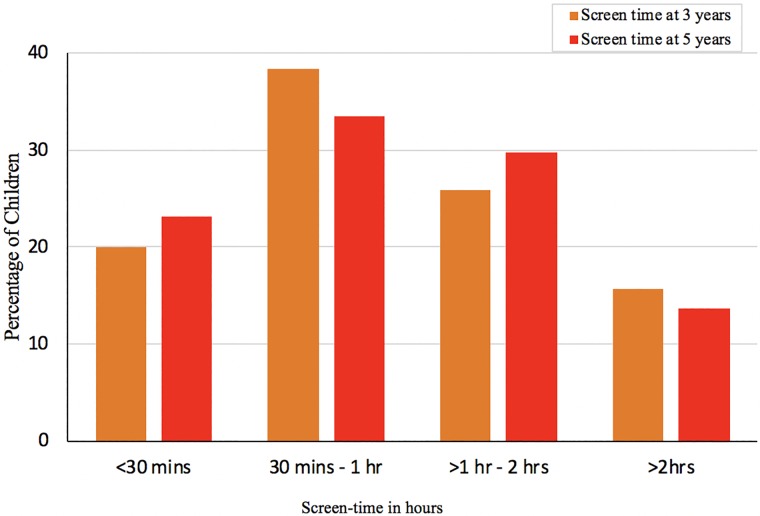
Screen-time was available for over 95% of children (2,322/2,427) with CBCL data. Mean screen-time was 1·4 hours/day (95%CI 1·4, 1·5) at five-years and 1·5 hours/day (95%CI: 1·5, 1·6) at three-years. Compared to children with less than 30-minutes/day screen-time, those watching more than two-hours/day (13·7%) had a 2·2-point increase in externalizing T-score (95%CI: 0·9, 3·5, p≤0·001); a five-fold increased odd for reporting clinically significant externalizing problems (95%CI: 1·0, 25·0, p = 0·05); and were 5·9 times more likely to report clinically significant inattention problems (95%CI: 1·6, 21·5, p = 0·01). Children with a DSM-5 ADHD T-score above the 65 clinical cut-off were considered to have significant ADHD type symptoms (n = 24). Children with more than 2-hours of screen-time/day had a 7·7-fold increased risk of meeting criteria for ADHD (95%CI: 1·6, 38·1, p = 0·01). There was no significant association between screen-time and aggressive behaviors (p>0.05).
Increased screen-time in pre-school is associated with worse inattention problems.
学龄前儿童每天平均有两小时的时间在使用屏幕。我们利用来自加拿大健康婴儿纵向发展(CHILD)研究的数据,检验了学龄前儿童屏幕时间与行为之间的关联。
CHILD 参与者的家长在孩子五岁时完成了儿童行为检查表(CBCL)。家长报告了他们孩子的总屏幕时间,包括游戏和移动设备。屏幕时间的分类使用了每天两小时(五岁)或每天一小时(三岁)的推荐阈值。多线性回归分析了屏幕时间与外化行为(如注意力不集中和攻击性)之间的关联。多逻辑回归确定了有临床显著外化问题风险的儿童特征(CBCL T 评分≥65)。
有超过 95%(2322/2427)的儿童的屏幕时间数据可用,且有 CBCL 数据。五岁时的平均屏幕时间为 1.4 小时/天(95%CI 1.4,1.5),三岁时为 1.5 小时/天(95%CI:1.5,1.6)。与每天屏幕时间少于 30 分钟的儿童相比,每天观看超过两小时(13.7%)的儿童外化 T 评分增加了 2.2 分(95%CI:0.9,3.5,p≤0.001);报告临床显著外化问题的几率增加了五倍(95%CI:1.0,25.0,p=0.05);报告临床显著注意力不集中问题的几率增加了 5.9 倍(95%CI:1.6,21.5,p=0.01)。具有 DSM-5 ADHD T 评分高于 65 临床临界值的儿童被认为具有显著的 ADHD 类型症状(n=24)。每天屏幕时间超过两小时的儿童患 ADHD 的风险增加了 7.7 倍(95%CI:1.6,38.1,p=0.01)。屏幕时间与攻击性行为之间没有显著关联(p>0.05)。
学龄前儿童屏幕时间增加与注意力不集中问题更严重有关。