Department of Pharmacology and Toxicology, School of Pharmacy, College of Health Sciences, University of Ghana, P.O. Box LG 43, Legon, Accra, Ghana.
Department of Pharmaceutical Chemistry, School of Pharmacy, College of Health Sciences, University of Ghana, P.O. Box LG 43, Legon, Accra, Ghana.
BMC Complement Med Ther. 2021 Jan 7;21(1):22. doi: 10.1186/s12906-020-03195-w.
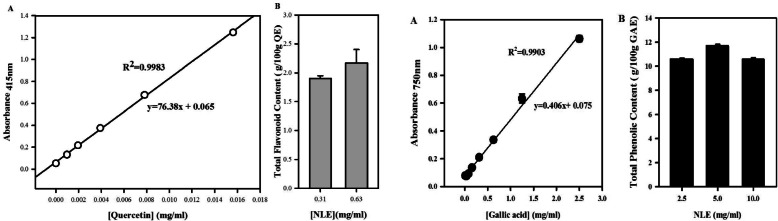
Nymphaea lotus L. (N. lotus) is an aquatic plant with anecdotal reports suggesting its use in the traditional management of cancer. However, there is a paucity of data on the antioxidant, anti-inflammatory and cytotoxic properties of N. lotus in relation to its phytochemical and elemental contents. This study aimed at determining the antioxidant, anti-inflammatory and cytotoxic properties of the hydro-ethanolic extract of N. lotus leaves (NLE), and its phenolic, flavonoid and elemental constituents.
The antioxidant property of NLE was determined using total phenolic and flavonoid, DPPH radical scavenging, lipid peroxidation and reducing power assays. The anti-inflammatory activity of NLE (100-250-500 mg/kg), diclofenac and hydrocortisone (positive controls) were determined by paw oedema and skin prick tests in Sprague Dawley rats. Also, the erythrocyte sedimentation rate (ESR) was determined by Westergren method. The macro/micro-elements content was determined by the XRF method. The cytotoxic property of NLE was determined by the MTT assay, on two cancer cell lines (MCF-7 and Jurkat) and compared to a normal cell line (Chang liver). Inhibitory concentrations were determined as IC values (±SEM).
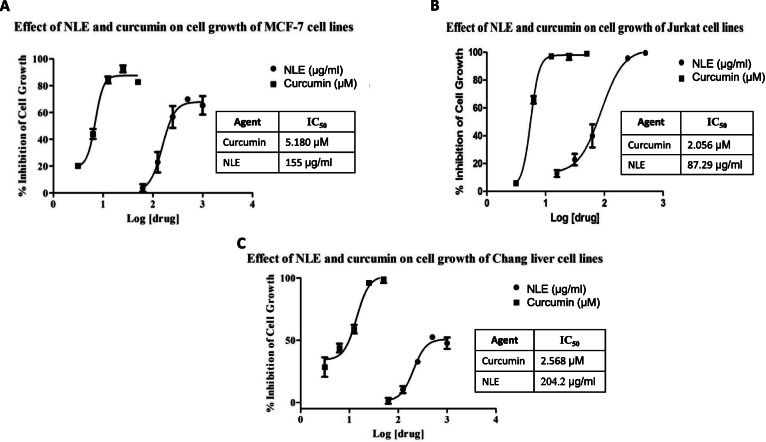
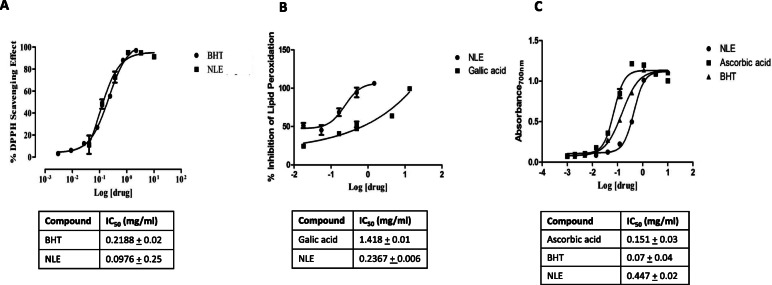
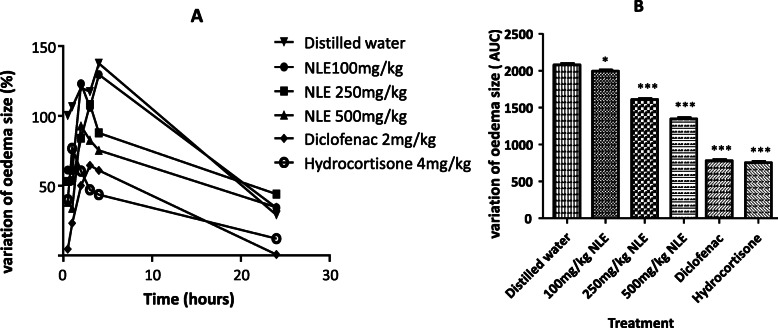
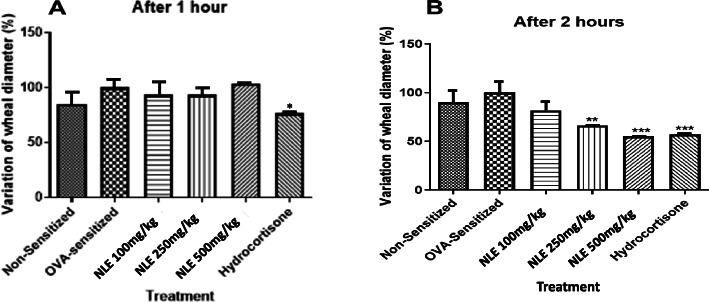
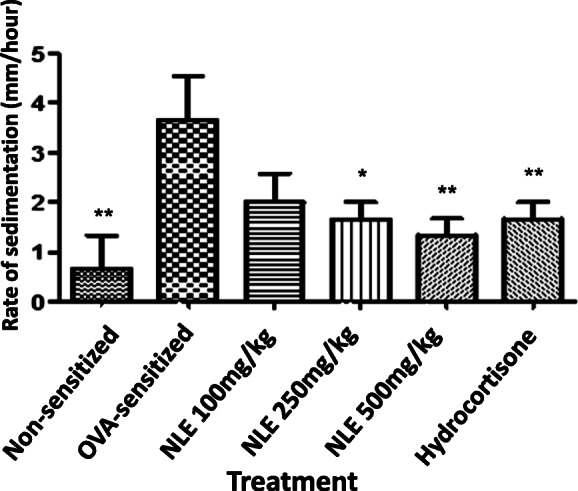
The extract had appreciable levels of phenolic and flavonoids compounds and was two-fold more potent in scavenging DPPH radicals than Butylated hydroxytoluene (BHT). However, NLE was three- and six-fold less potent than ascorbic acid and BHT, respectively, in reducing Fe to Fe. The extract was six-fold more potent than gallic acid in inhibiting lipid peroxidation. The extract caused a dose-dependent decrease in rat paw oedema sizes, comparable to diclofenac, and a significant decrease in wheel diameters and ESR. The elemental analysis revealed relevant concentrations of Mg, P, S, K, Mn, Fe, Cu, Zn and Cd. The extract exhibited cytotoxic activity on both MCF-7 (IC = 155.00 μg/ml) and Jurkat (IC = 87.29 μg/ml), with higher selectivity for Jurkat cell line. Interestingly, the extract showed low cytotoxicity to the normal Chang liver cell line (IC = 204.20 μg/ml).
N. lotus leaves extract exhibited high antioxidant, anti-inflammatory and cancer-cell-specific cytotoxic properties. These aforementioned activities could be attributed to its phenolic, flavonoid and elemental constituents.
莲(N. lotus)是一种水生植物,有传闻称其可用于传统的癌症治疗。然而,关于莲叶的抗氧化、抗炎和细胞毒性特性与其植物化学和元素含量的关系,数据仍然很少。本研究旨在确定莲叶水-乙醇提取物(NLE)的抗氧化、抗炎和细胞毒性特性,以及其酚类、类黄酮和元素成分。
通过总酚和类黄酮、DPPH 自由基清除、脂质过氧化和还原能力测定来测定 NLE 的抗氧化特性。通过爪肿胀和皮肤划痕试验,在 Sprague Dawley 大鼠中测定 NLE(100-250-500mg/kg)、双氯芬酸钠和氢化可的松(阳性对照)的抗炎活性。此外,通过 Westergren 法测定红细胞沉降率(ESR)。采用 XRF 法测定宏/微量元素含量。通过 MTT 测定法测定 NLE 的细胞毒性,比较两种癌细胞系(MCF-7 和 Jurkat)和正常细胞系(Chang 肝)。抑制浓度被确定为 IC 值(±SEM)。
该提取物含有相当水平的酚类和类黄酮化合物,其清除 DPPH 自由基的能力是丁羟甲苯(BHT)的两倍。然而,NLE 在将 Fe 还原为 Fe 方面的效力分别比抗坏血酸和 BHT 低三倍和六倍。该提取物在抑制脂质过氧化方面比没食子酸有效六倍。该提取物在剂量依赖性地减少大鼠爪肿胀方面表现出与双氯芬酸钠相当的效果,并显著减少了车轮直径和 ESR。元素分析显示了镁、磷、硫、钾、锰、铁、铜、锌和镉的相关浓度。该提取物对 MCF-7(IC=155.00μg/ml)和 Jurkat(IC=87.29μg/ml)均表现出细胞毒性活性,对 Jurkat 细胞系的选择性更高。有趣的是,该提取物对正常 Chang 肝细胞系的细胞毒性较低(IC=204.20μg/ml)。
莲叶提取物表现出高抗氧化、抗炎和癌细胞特异性细胞毒性特性。这些活性可能归因于其酚类、类黄酮和元素成分。