Ledda Caterina, Cannizzaro Emanuele, Cinà Diana, Filetti Vera, Vitale Ermanno, Paravizzini Gianluca, Di Naso Concettina, Iavicoli Ivo, Rapisarda Venerando
Department of Clinical and Experimental Medicine, Occupational Medicine, University of Catania, Via Santa Sofia, 89 - 95123, Catania, Italy.
Department of Sciences for Health Promotion and Mother and Child Care, Occupational Medicine, University of Palermo, Palermo, Italy.
J Occup Med Toxicol. 2021 Jan 7;16(1):1. doi: 10.1186/s12995-020-00290-z.
Recent epidemiological studies on workers describe that exposure to pesticides can induce oxidative stress by increased production of free radicals that can accumulate in the cell and damage biological macromolecules, for example, RNA, DNA, DNA repair proteins and other proteins and/or modify antioxidant defense mechanisms, as well as detoxification and scavenger enzymes. This study aimed to assess oxidative stress and DNA damage among workers exposed to pesticides.
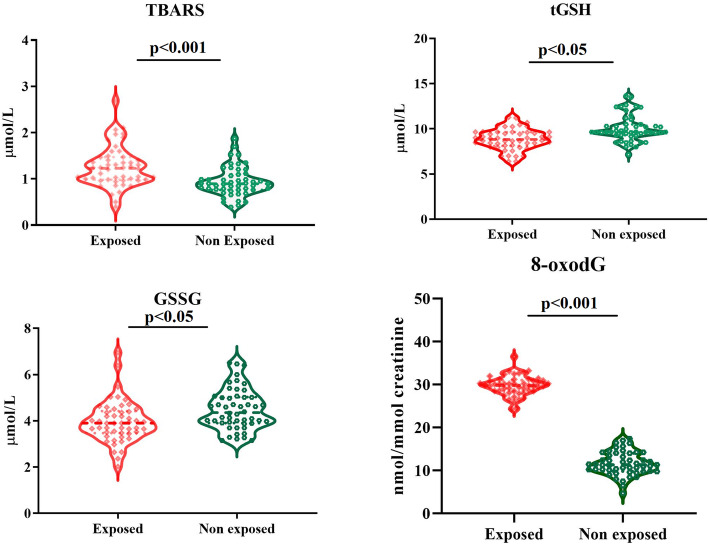
For this purpose, 52 pesticide exposed workers and 52 organic farmers were enrolled. They were assessed: the pesticide exposure, thiobarbituric acid reactive substances (TBARS), total glutathione (TG), oxidized glutathione levels (GSSG), and 8-oxo-7,8-dihydro-2'-deoxyguanosine (8-oxodG), levels.
Correlation between pesticide exposure was positively associated with high TBARS and 8-oxodG levels (p < 0.001). A negative association was founded with TG and GSSG and pesticide exposure.
The present investigation results seem to indicate a mild augment in oxidative stress associated with pesticide exposure, followed by an adaptive response to increase the antioxidant defenses to prevent sustained oxidative adverse effects stress.
近期针对工人的流行病学研究表明,接触农药会通过增加自由基的产生来诱导氧化应激,这些自由基会在细胞内积累并损害生物大分子,例如RNA、DNA、DNA修复蛋白和其他蛋白质,和/或改变抗氧化防御机制以及解毒和清除酶。本研究旨在评估接触农药的工人的氧化应激和DNA损伤情况。
为此,招募了52名接触农药的工人和52名有机农场主。对他们进行了以下评估:农药接触情况、硫代巴比妥酸反应性物质(TBARS)、总谷胱甘肽(TG)、氧化型谷胱甘肽水平(GSSG)以及8-氧代-7,8-二氢-2'-脱氧鸟苷(8-oxodG)水平。
农药接触与高TBARS和8-oxodG水平呈正相关(p < 0.001)。TG和GSSG与农药接触呈负相关。
目前的调查结果似乎表明,与农药接触相关的氧化应激有轻度增加,随后是一种适应性反应,以增强抗氧化防御能力,防止持续的氧化应激产生不良影响。