Department of Neurology, Center for Neurodegeneration and Experimental Therapeutics, University of Alabama at Birmingham, Birmingham, AL, 35294, USA.
Center for Neurodegenerative Disease Research, Perelman School of Medicine at the University of Pennsylvania, Maloney Building, 3rd Floor, 3600 Spruce Street, Philadelphia, PA, 19104-2676, USA.
Acta Neuropathol Commun. 2021 Jan 7;9(1):13. doi: 10.1186/s40478-020-01110-5.
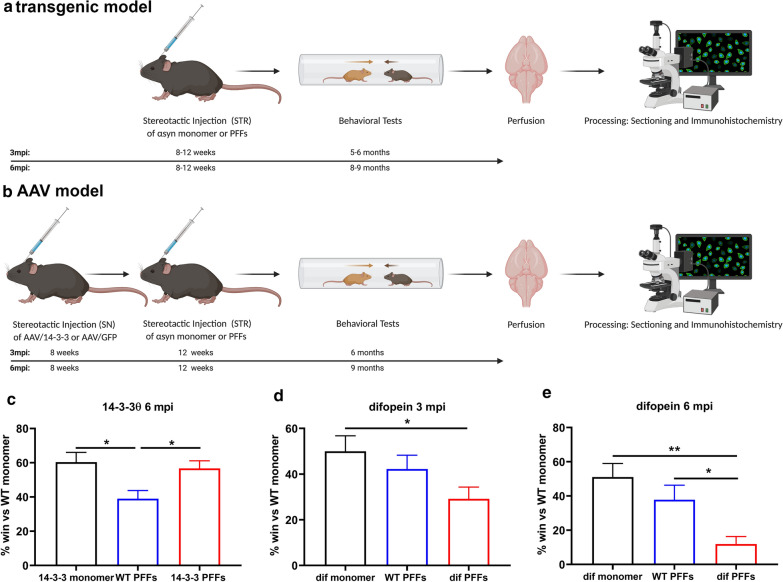
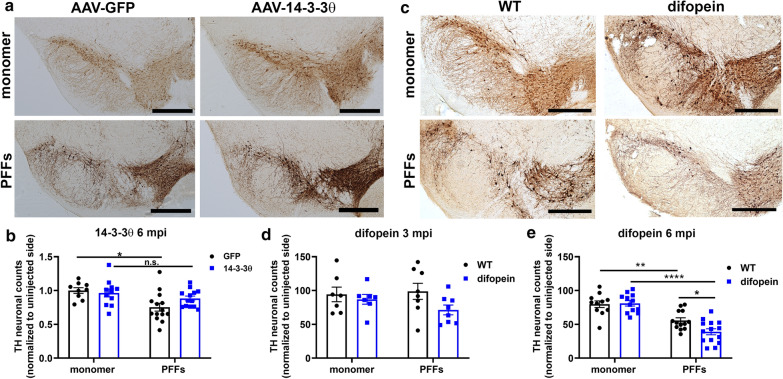
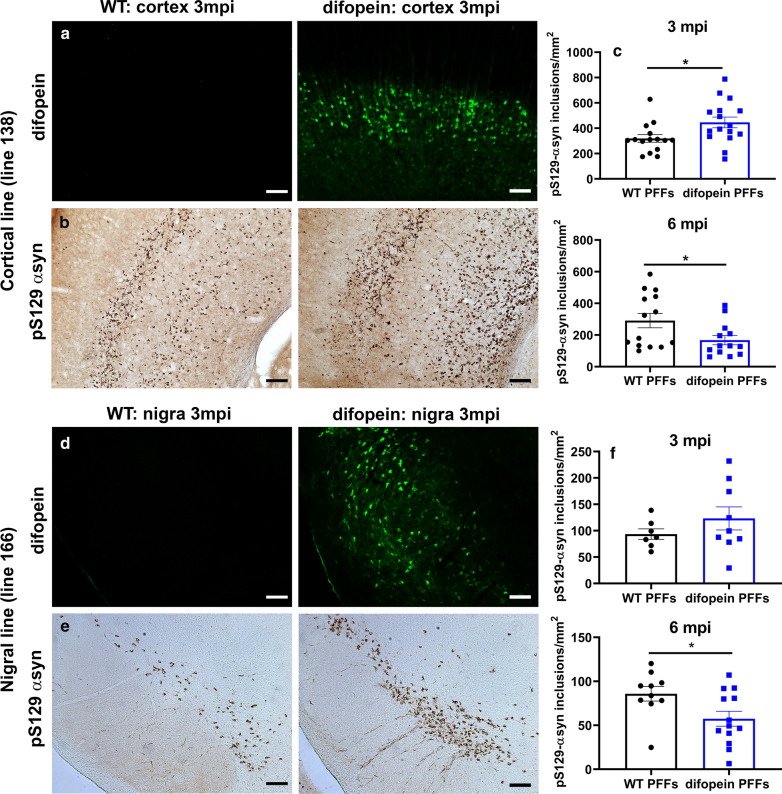
Alpha-synuclein (αsyn) is the key component of proteinaceous aggregates termed Lewy Bodies that pathologically define a group of disorders known as synucleinopathies, including Parkinson's Disease (PD) and Dementia with Lewy Bodies. αSyn is hypothesized to misfold and spread throughout the brain in a prion-like fashion. Transmission of αsyn necessitates the release of misfolded αsyn from one cell and the uptake of that αsyn by another, in which it can template the misfolding of endogenous αsyn upon cell internalization. 14-3-3 proteins are a family of highly expressed brain proteins that are neuroprotective in multiple PD models. We have previously shown that 14-3-3θ acts as a chaperone to reduce αsyn aggregation, cell-to-cell transmission, and neurotoxicity in the in vitro pre-formed fibril (PFF) model. In this study, we expanded our studies to test the impact of 14-3-3s on αsyn toxicity in the in vivo αsyn PFF model. We used both transgenic expression models and adenovirus associated virus (AAV)-mediated expression to examine whether 14-3-3 manipulation impacts behavioral deficits, αsyn aggregation, and neuronal counts in the PFF model. 14-3-3θ transgene overexpression in cortical and amygdala regions rescued social dominance deficits induced by PFFs at 6 months post injection, whereas 14-3-3 inhibition by transgene expression of the competitive 14-3-3 peptide inhibitor difopein in the cortex and amygdala accelerated social dominance deficits. The behavioral rescue by 14-3-3θ overexpression was associated with delayed αsyn aggregation induced by PFFs in these brain regions. Conversely, 14-3-3 inhibition by difopein in the cortex and amygdala accelerated αsyn aggregation and reduction in NECAB1-positive neuron counts induced by PFFs. 14-3-3θ overexpression by AAV in the substantia nigra (SN) also delayed αsyn aggregation in the SN and partially rescued PFF-induced reduction in tyrosine hydroxylase (TH)-positive dopaminergic cells in the SN. 14-3-3 inhibition in the SN accelerated nigral αsyn aggregation and enhanced PFF-induced reduction in TH-positive dopaminergic cells. These data indicate a neuroprotective role for 14-3-3θ against αsyn toxicity in vivo.
α-突触核蛋白(αsyn)是构成路易小体的关键蛋白成分,路易小体是一组被称为突触核蛋白病的病理学定义的疾病,包括帕金森病(PD)和路易体痴呆。αsyn 被假设以类朊病毒的方式错误折叠并在大脑中传播。αsyn 的传递需要从一个细胞中释放出错误折叠的 αsyn,并被另一个细胞摄取,在这个过程中,它可以在细胞内化时模板化内源性 αsyn 的错误折叠。14-3-3 蛋白是一组高度表达的脑蛋白,在多种 PD 模型中具有神经保护作用。我们之前已经表明,14-3-3θ 作为一种伴侣蛋白,可减少体外预形成纤维(PFF)模型中 αsyn 的聚集、细胞间传递和神经毒性。在这项研究中,我们扩展了研究范围,以测试 14-3-3 对体内 αsyn PFF 模型中 αsyn 毒性的影响。我们使用转基因表达模型和腺相关病毒(AAV)介导的表达来检查 14-3-3 操作是否会影响 PFF 模型中的行为缺陷、αsyn 聚集和神经元计数。在注射后 6 个月,皮层和杏仁核区域的 14-3-3θ 转基因过表达挽救了 PFF 诱导的社会优势缺陷,而皮层和杏仁核中竞争性 14-3-3 肽抑制剂 difopein 的转基因表达抑制则加速了社会优势缺陷。14-3-3θ 过表达的行为挽救与 PFF 在这些大脑区域诱导的 αsyn 聚集延迟有关。相反,皮层和杏仁核中 difopein 的 14-3-3 抑制加速了 PFF 诱导的 NECAB1 阳性神经元计数减少和 αsyn 聚集。AAV 在黑质(SN)中的 14-3-3θ 过表达也延迟了 SN 中的 αsyn 聚集,并部分挽救了 PFF 诱导的 SN 中酪氨酸羟化酶(TH)阳性多巴胺能细胞减少。SN 中 14-3-3 的抑制加速了黑质 αsyn 聚集,并增强了 PFF 诱导的 TH 阳性多巴胺能细胞减少。这些数据表明 14-3-3θ 在体内对 αsyn 毒性具有神经保护作用。