Llandro Hayley, Allison James R, Currie Charlotte C, Edwards David C, Bowes Charlotte, Durham Justin, Jakubovics Nicholas, Rostami Nadia, Holliday Richard
Newcastle upon Tyne Hospitals NHS Foundation Trust, Newcastle upon Tyne, UK.
Newcastle upon Tyne Hospitals NHS Foundation Trust, Newcastle upon Tyne, UK; School of Dental Sciences, Newcastle University, UK.
Br Dent J. 2021 Jan 8:1-7. doi: 10.1038/s41415-020-2503-9.
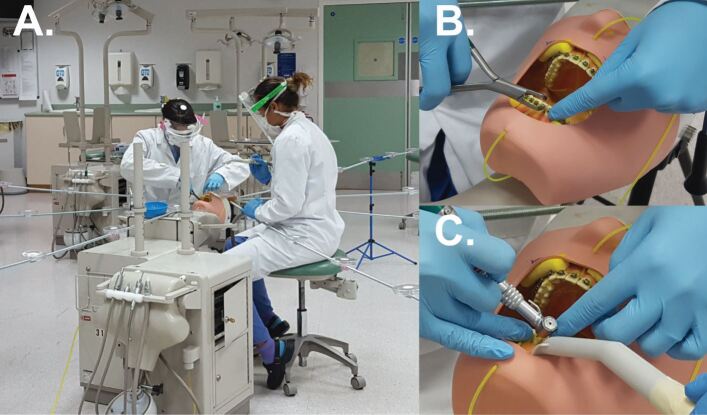
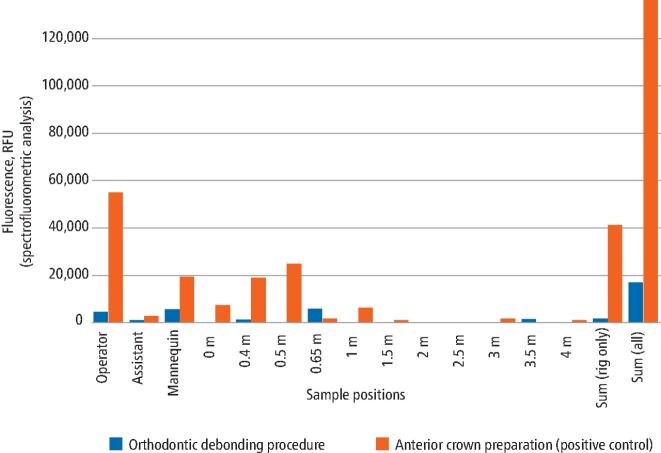
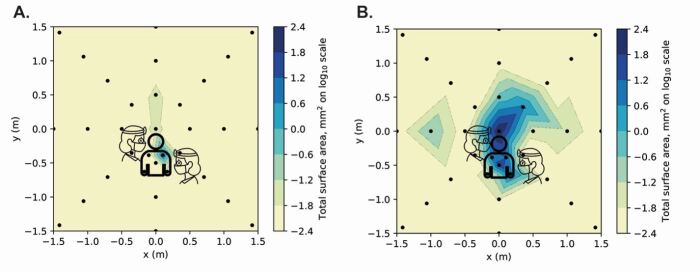
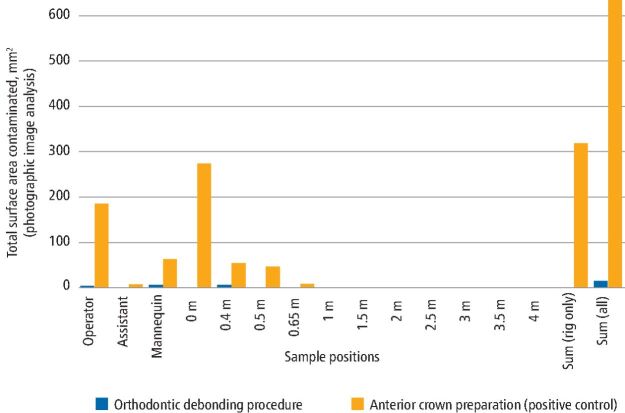
Introduction Dental procedures produce splatter and aerosol which have potential to spread pathogens such as SARS-CoV-2. Mixed evidence exists on the aerosol-generating potential of orthodontic procedures. The aim of this study was to evaluate splatter and/or settled aerosol contamination during orthodontic debonding.Material and methods Fluorescein dye was introduced into the oral cavity of a mannequin. Orthodontic debonding was undertaken with surrounding samples collected. Composite bonding cement was removed using a speed-increasing handpiece with dental suction. A positive control condition included a water-cooled, high-speed air-turbine crown preparation. Samples were analysed using digital image analysis and spectrofluorometric analysis.Results Contamination across the eight-metre experimental rig was 3% of the positive control on spectrofluorometric analysis and 0% on image analysis. Contamination of the operator, assistant and mannequin was 8%, 25% and 28% of the positive control, respectively.Discussion Splatter and settled aerosol from orthodontic debonding is distributed mainly within the immediate locality of the mannequin. Widespread contamination was not observed.Conclusions Orthodontic debonding is unlikely to produce widespread contamination via splatter and settled aerosol, but localised contamination is likely. This highlights the importance of personal protective equipment for the operator, assistant and patient. Further work is required to examine suspended aerosol.
引言
牙科操作会产生飞沫和气溶胶,有可能传播如严重急性呼吸综合征冠状病毒2(SARS-CoV-2)等病原体。关于正畸操作产生气溶胶的可能性,存在相互矛盾的证据。本研究的目的是评估正畸去粘结过程中的飞沫和/或沉降气溶胶污染情况。
材料与方法
将荧光素染料引入人体模型口腔。进行正畸去粘结操作,并收集周围样本。使用带牙科抽吸装置的增速手机去除复合粘结剂。阳性对照条件包括水冷高速气涡轮牙体预备。使用数字图像分析和荧光光谱分析对样本进行分析。
结果
在荧光光谱分析中,八米实验装置上的污染为阳性对照的3%,在图像分析中为0%。操作者、助手和人体模型的污染分别为阳性对照的8%、25%和28%。
讨论
正畸去粘结产生的飞沫和沉降气溶胶主要分布在人体模型附近区域。未观察到广泛污染。
结论
正畸去粘结不太可能通过飞沫和沉降气溶胶产生广泛污染,但可能存在局部污染。这凸显了操作者、助手和患者个人防护设备的重要性。需要进一步开展工作来检测悬浮气溶胶。