Henriksson Emma, Andersen Birgitte
Liver Disease Research, Global Drug Discovery, Novo Nordisk A/S, Maaloev, Denmark.
Front Endocrinol (Lausanne). 2020 Dec 22;11:601349. doi: 10.3389/fendo.2020.601349. eCollection 2020.
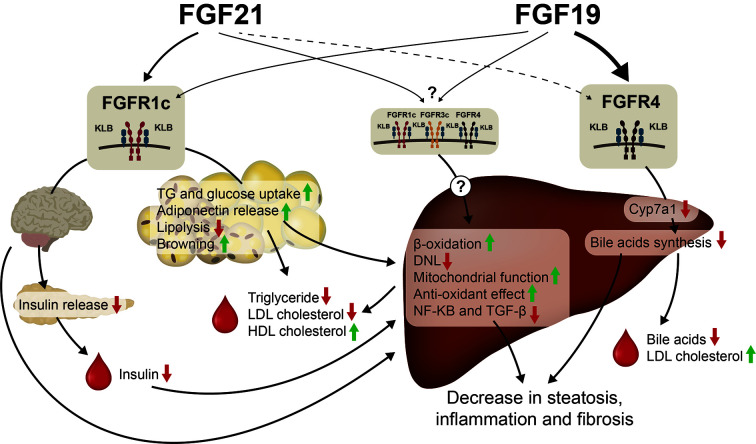
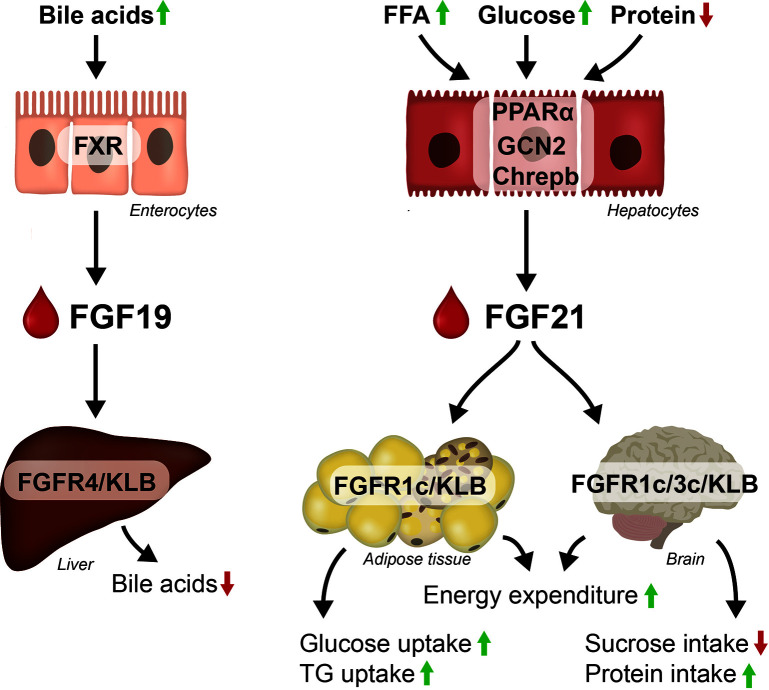
FGF19 and FGF21 analogues are currently in clinical development for the potential treatment of NASH. In Phase 2 clinical trials analogues of FGF19 and FGF21 decrease hepatic steatosis with up to 70% (MRI-PDFF) after 12 weeks and as early as 12-16 weeks of treatment an improvement in NASH resolution and fibrosis has been observed. Therefore, this class of compounds is currently of great interest in the field of NASH. FGF19 and FGF21 belong to the endocrine FGF19 subfamily and both require the co-receptor beta-klotho for binding and signalling through the FGF receptors. FGF19 is expressed in the ileal enterocytes and is released into the enterohepatic circulation in response to bile acids stimuli and in the liver FGF19 inhibits hepatic bile acids synthesis by transcriptional regulation of Cyp7A1, which is the rate limiting enzyme. FGF21 is, on the other hand, highly expressed in the liver and is released in response to high glucose, high free-fatty acids and low amino-acid supply and regulates energy, glucose and lipid homeostasis by actions in the CNS and in the adipose tissue. FGF19 and FGF21 are differentially expressed, have distinct target tissues and separate physiological functions. It is therefore of peculiar interest to understand why treatment with both FGF19 and FGF21 analogues have strong beneficial effects on NASH parameters in mice and human and whether the mode of action is overlapping This review will highlight the physiological and pharmacological effects of FGF19 and FGF21. The potential mode of action behind the anti-steatotic, anti-inflammatory and anti-fibrotic effects of FGF19 and FGF21 will be discussed. Finally, development of drugs is always a risk benefit analysis and the human relevance of adverse effects observed in pre-clinical species as well as findings in humans will be discussed. The aim is to provide a comprehensive overview of the current understanding of this drug class for the potential treatment of NASH.
FGF19和FGF21类似物目前正处于临床试验阶段,有望用于治疗非酒精性脂肪性肝炎(NASH)。在2期临床试验中,FGF19和FGF21类似物可降低肝脂肪变性,治疗12周后,肝脂肪变性降低幅度高达70%(磁共振成像-质子密度脂肪分数),且早在治疗12 - 16周时,就已观察到NASH消退和纤维化有所改善。因此,这类化合物目前在NASH领域备受关注。FGF19和FGF21属于内分泌FGF19亚家族,二者都需要共受体β-klotho才能通过FGF受体进行结合和信号传导。FGF19在回肠肠细胞中表达,在胆汁酸刺激下释放进入肠肝循环,在肝脏中,FGF19通过对限速酶Cyp7A1进行转录调控来抑制肝脏胆汁酸合成。另一方面,FGF21在肝脏中高度表达,在高血糖、高游离脂肪酸和低氨基酸供应的情况下释放,并通过作用于中枢神经系统和脂肪组织来调节能量、葡萄糖和脂质稳态。FGF19和FGF21表达存在差异,具有不同的靶组织和各自独立的生理功能。因此,特别令人感兴趣的是,为何同时使用FGF19和FGF21类似物对小鼠和人类的NASH参数具有强大的有益作用,以及其作用模式是否重叠。本综述将重点介绍FGF19和FGF21的生理和药理作用。将讨论FGF19和FGF21抗脂肪变性、抗炎和抗纤维化作用背后的潜在作用模式。最后,药物研发始终是一项风险效益分析,将讨论临床前物种中观察到的不良反应的人体相关性以及在人体中的研究结果。目的是全面概述目前对这类有望用于治疗NASH的药物的认识。