Key Laboratory of Advanced Control and Optimization for Chemical Processes, Ministry of Education, East China University of Science and Technology, Shanghai, China.
Department of Rehabilitation, Huashan Hospital, Fudan University, Shanghai, China.
Neural Plast. 2020 Dec 13;2020:8882764. doi: 10.1155/2020/8882764. eCollection 2020.
Stroke is the leading cause of serious and long-term disability worldwide. Survivors may recover some motor functions after rehabilitation therapy. However, many stroke patients missed the best time period for recovery and entered into the sequela stage of chronic stroke.
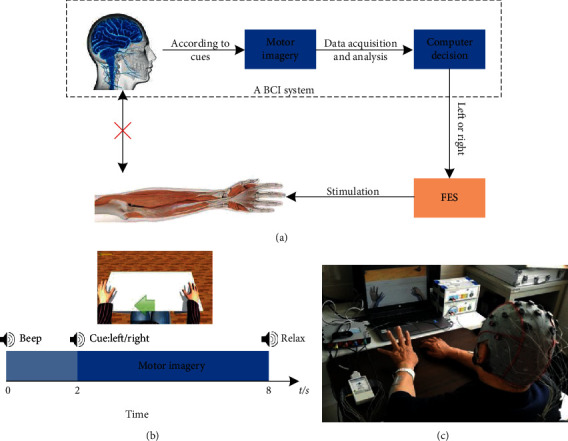
Studies have shown that motor imagery- (MI-) based brain-computer interface (BCI) has a positive effect on poststroke rehabilitation. This study used both virtual limbs and functional electrical stimulation (FES) as feedback to provide patients with a closed-loop sensorimotor integration for motor rehabilitation. An MI-based BCI system acquired, analyzed, and classified motor attempts from electroencephalogram (EEG) signals. The FES system would be activated if the BCI detected that the user was imagining wrist dorsiflexion on the instructed side of the body. Sixteen stroke patients in the sequela stage were randomly assigned to a BCI group and a control group. All of them participated in rehabilitation training for four weeks and were assessed by the Fugl-Meyer Assessment (FMA) of motor function.
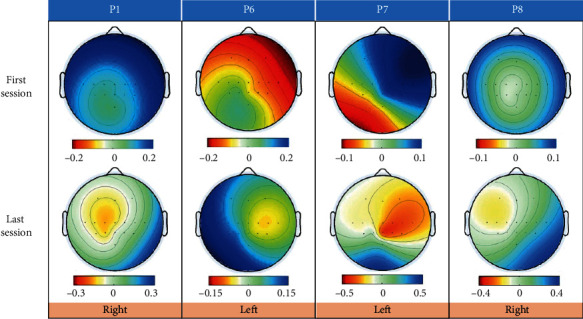
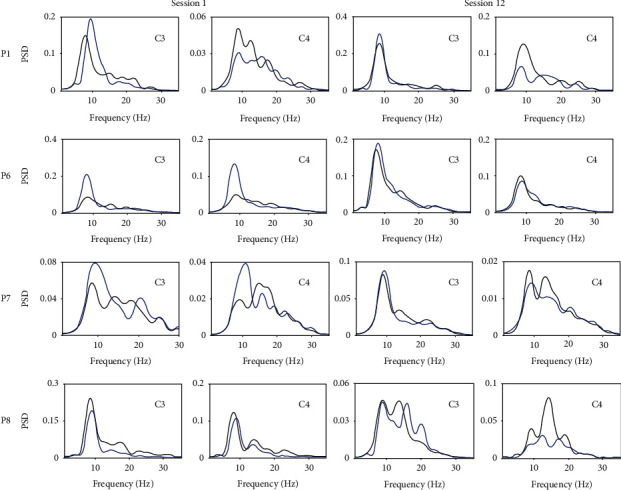
The average improvement score of the BCI group was 3.5, which was higher than that of the control group (0.9). The active EEG patterns of the four patients in the BCI group whose FMA scores increased gradually became centralized and shifted to sensorimotor areas and premotor areas throughout the study.
Study results showed evidence that patients in the BCI group achieved larger functional improvements than those in the control group and that the BCI-FES system is effective in restoring motor function to upper extremities in stroke patients. This study provides a more autonomous approach than traditional treatments used in stroke rehabilitation.
中风是全球范围内导致严重和长期残疾的主要原因。康复治疗后,幸存者可能会恢复一些运动功能。然而,许多中风患者错过了康复的最佳时期,进入了慢性中风的后遗症阶段。
研究表明,基于运动想象的脑-机接口(BCI)对中风后的康复有积极作用。本研究使用虚拟肢体和功能性电刺激(FES)作为反馈,为患者提供运动康复的闭环感觉运动整合。基于运动想象的 BCI 系统从脑电图(EEG)信号中获取、分析和分类运动尝试。如果 BCI 检测到用户正在想象身体指令侧的腕部背屈,FES 系统将被激活。16 名处于后遗症阶段的中风患者被随机分配到 BCI 组和对照组。他们都参加了四周的康复训练,并通过运动功能 Fugl-Meyer 评估(FMA)进行评估。
BCI 组的平均改善评分为 3.5,高于对照组(0.9)。BCI 组中 FMA 评分逐渐增加的 4 名患者的主动 EEG 模式在整个研究过程中变得集中,并转移到感觉运动区和运动前区。
研究结果表明,BCI 组患者的功能改善比对照组更大,BCI-FES 系统对中风患者上肢运动功能的恢复有效。与中风康复中传统治疗方法相比,本研究提供了一种更自主的方法。