Yu Xiao-Ming, Jin Xue-Ming, Lu Yan, Gao Yang, Xu Hai-Chen, Xue Xin, Fang Lei, Hu Jun
Department of Rehabilitation, Shanghai Seventh People's Hospital, Shanghai University of Traditional Chinese Medicine, Shanghai 200137, China.
School of Rehabilitation Medicine, Shanghai University of Traditional Chinese Medicine, Shanghai 201203, China.
Evid Based Complement Alternat Med. 2020 Dec 19;2020:9218078. doi: 10.1155/2020/9218078. eCollection 2020.
Tai Chi (TC) is known to enhance balance control and walking function in stroke survivors. However, motor disorders in stroke patients may limit the implementation of TC exercise and increase the risk of falling. The body weight support (BWS) device can provide protection during the early rehabilitation of stroke survivors using an overhead suspension system. Theoretically, combining TC with BWS may be an effective intervention for stroke survivors. This study aimed to examine the effects of body weight support-Tai Chi training on balance control and walking function in stroke survivors with hemiplegia.
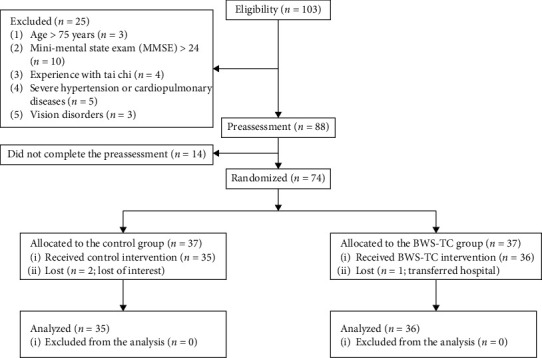
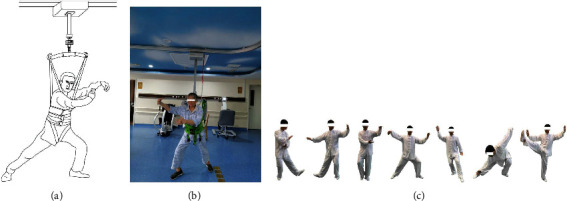
Seventy-one stroke survivors with hemiplegia aged 30-75 years were randomly allocated to the control group ( = 35) or the BWS-TC group ( = 36). During BWS-TC training, the subjects performed 7 Tai Chi footwork forms, and gradual easy-to-difficult progression (from 40% to 0% body weight) was followed. The subjects participated in 40 min rehabilitation sessions three times per week for 12 weeks. The primary outcome was dynamic balance in the limits-of-stability test. The secondary outcomes, which reflect improvements walking function, included spatiotemporal parameters, the joint range of motion in the affected limb during the swing phase, the Berg Balance Scale score, and the Fugl-Meyer Assessment score. Evaluations were performed at baseline and 12 weeks and compared between groups.
After training, significant between-group differences were observed in the scores for overall, forward, left, right, forward-left, and forward-right directional control in the limits-of-stability test ( < 0.05). Furthermore, the scores for gait cycle time, step length, step velocity, and range of motion of the joints were better in the BWS-TC group than in the control group ( < 0.05).
The 12-week BWS-TC training may enhance dynamic balance and walking function in stroke survivors with hemiplegia.
众所周知,太极拳(TC)可增强中风幸存者的平衡控制能力和行走功能。然而,中风患者的运动障碍可能会限制太极拳运动的实施,并增加跌倒风险。体重支持(BWS)装置可通过高架悬挂系统在中风幸存者的早期康复过程中提供保护。从理论上讲,将太极拳与体重支持相结合可能是对中风幸存者的一种有效干预措施。本研究旨在探讨体重支持-太极拳训练对偏瘫中风幸存者平衡控制能力和行走功能的影响。
71名年龄在30-75岁之间的偏瘫中风幸存者被随机分为对照组(n = 35)或体重支持-太极拳组(n = 36)。在体重支持-太极拳训练期间,受试者进行7种太极拳步法练习,并遵循逐渐由易到难的进程(从体重的40%到0%)。受试者每周参加3次、每次40分钟的康复训练课程,共持续12周。主要结局指标是稳定性极限测试中的动态平衡。反映行走功能改善情况的次要结局指标包括时空参数、摆动期患侧肢体的关节活动范围、伯格平衡量表评分和Fugl-Meyer评估评分。在基线和12周时进行评估,并在组间进行比较。
训练后,在稳定性极限测试中,整体、向前、向左、向右、向前-向左和向前-向右方向控制的得分在组间存在显著差异(P < 0.05)。此外,体重支持-太极拳组在步态周期时间、步长、步速和关节活动范围方面的得分优于对照组(P < 0.05)。
为期12周的体重支持-太极拳训练可能会增强偏瘫中风幸存者的动态平衡能力和行走功能。