Sestito Simona, D'Auria Enza, Baldassarre Maria Elisabetta, Salvatore Silvia, Tallarico Valeria, Stefanelli Ettore, Tarsitano Flora, Concolino Daniela, Pensabene Licia
Pediatric Unit, Department of Medical and Surgical Sciences, University "Magna Graecia" of Catanzaro, Catanzaro, Italy.
Department of Pediatrics, Vittore Buzzi Children's Hospital-University of Milan, Milan, Italy.
Front Pediatr. 2020 Dec 22;8:583946. doi: 10.3389/fped.2020.583946. eCollection 2020.
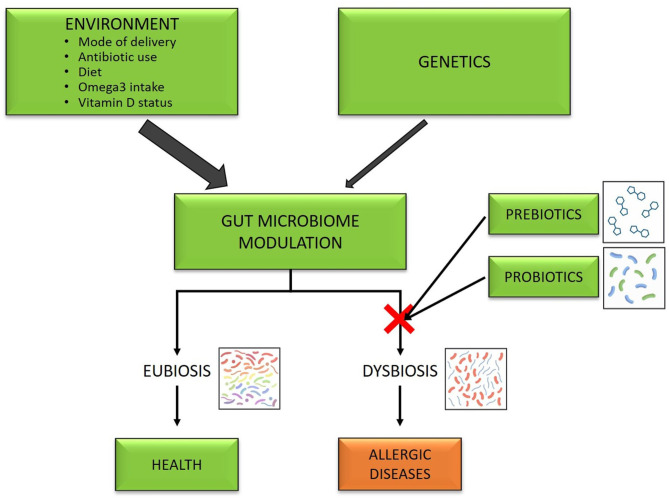
Allergic diseases have been linked to genetic and/or environmental factors, such as antibiotic use, westernized high fat and low fiber diet, which lead to early intestinal dysbiosis, and account for the rise in allergy prevalence, especially in western countries. Allergic diseases have shown reduced microbial diversity, including fewer lactobacilli and bifidobacteria, within the neonatal microbiota, before the onset of atopic diseases. Raised interest in microbiota manipulating strategies to restore the microbial balance for atopic disease prevention, through prebiotics, probiotics, or synbiotics supplementation, has been reported. We reviewed and discussed the role of prebiotics and/or probiotics supplementation for allergy prevention in infants. We searched PubMed and the Cochrane Database using keywords relating to "allergy" OR "allergic disorders," "prevention" AND "prebiotics" OR "probiotics" OR "synbiotics." We limited our evaluation to papers of English language including children aged 0-2 years old. Different products or strains used, different period of intervention, duration of supplementation, has hampered the draw of definitive conclusions on the clinical impact of probiotics and/or prebiotics for prevention of allergic diseases in infants, except for atopic dermatitis in infants at high-risk. This preventive effect on eczema in high-risk infants is supported by clear evidence for probiotics but only moderate evidence for prebiotic supplementation. However, the optimal prebiotic or strain of probiotic, dose, duration, and timing of intervention remains uncertain. Particularly, a combined pre- and post-natal intervention appeared of stronger benefit, although the definition of the optimal intervention starting time during gestation, the timing, and duration in the post-natal period, as well as the best target population, are still an unmet need.
过敏性疾病与遗传和/或环境因素有关,如抗生素使用、西化的高脂肪和低纤维饮食,这些因素会导致早期肠道菌群失调,并导致过敏患病率上升,尤其是在西方国家。在特应性疾病发作之前,过敏性疾病已显示新生儿微生物群中的微生物多样性降低,包括乳酸杆菌和双歧杆菌数量减少。据报道,人们对通过补充益生元、益生菌或合生元来操纵微生物群策略以恢复微生物平衡预防特应性疾病的兴趣有所增加。我们回顾并讨论了补充益生元或益生菌对预防婴儿过敏的作用。我们使用与“过敏”或“过敏性疾病”、“预防”以及“益生元”或“益生菌”或“合生元”相关的关键词在PubMed和Cochrane数据库中进行了搜索。我们将评估限于英文论文,包括0至2岁的儿童。所使用的不同产品或菌株、不同的干预时期、补充持续时间,阻碍了就益生菌和/或益生元对预防婴儿过敏性疾病的临床影响得出明确结论,高危婴儿的特应性皮炎除外。益生菌对高危婴儿湿疹有预防作用有明确证据支持,但益生元补充仅有中等证据支持。然而,最佳的益生元或益生菌菌株、剂量、持续时间和干预时机仍不确定。特别是,产前和产后联合干预似乎益处更大,尽管妊娠期最佳干预开始时间、产后时期的时机和持续时间以及最佳目标人群的定义仍未得到满足。