School of Public Health and Social Work, Institute of Health and Biomedical Innovation, Queensland University of Technology, Brisbane, QLD 4059, Australia.
Int J Environ Res Public Health. 2021 Jan 6;18(2):396. doi: 10.3390/ijerph18020396.
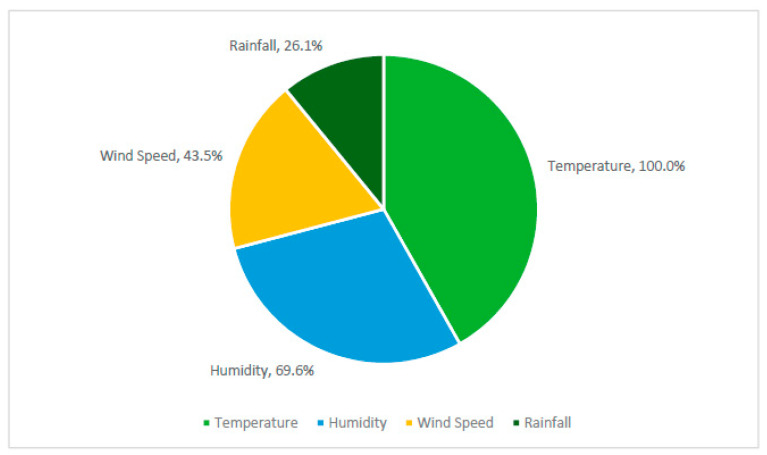
Weather and climate play a significant role in infectious disease transmission, through changes to transmission dynamics, host susceptibility and virus survival in the environment. Exploring the association of weather variables and COVID-19 transmission is vital in understanding the potential for seasonality and future outbreaks and developing early warning systems. Previous research examined the effects of weather on COVID-19, but the findings appeared inconsistent. This review aims to summarize the currently available literature on the association between weather and COVID-19 incidence and provide possible suggestions for developing weather-based early warning system for COVID-19 transmission. Studies eligible for inclusion used ecological methods to evaluate associations between weather (i.e., temperature, humidity, wind speed and rainfall) and COVID-19 transmission. The review showed that temperature was reported as significant in the greatest number of studies, with COVID-19 incidence increasing as temperature decreased and the highest incidence reported in the temperature range of 0-17 °C. Humidity was also significantly associated with COVID-19 incidence, though the reported results were mixed, with studies reporting positive and negative correlation. A significant interaction between humidity and temperature was also reported. Wind speed and rainfall results were not consistent across studies. Weather variables including temperature and humidity can contribute to increased transmission of COVID-19, particularly in winter conditions through increased host susceptibility and viability of the virus. While there is less indication of an association with wind speed and rainfall, these may contribute to behavioral changes that decrease exposure and risk of infection. Understanding the implications of associations with weather variables and seasonal variations for monitoring and control of future outbreaks is essential for early warning systems.
天气和气候通过改变传播动力学、宿主易感性和环境中病毒的存活能力,在传染病传播中发挥着重要作用。探索天气变量与 COVID-19 传播之间的关联对于了解季节性和未来疫情爆发的可能性以及开发预警系统至关重要。先前的研究已经考察了天气对 COVID-19 的影响,但结果似乎不一致。本综述旨在总结目前关于天气与 COVID-19 发病率之间关联的文献,并为开发基于天气的 COVID-19 传播预警系统提供可能的建议。符合纳入标准的研究使用生态方法评估了天气(即温度、湿度、风速和降雨量)与 COVID-19 传播之间的关联。综述表明,温度在最多的研究中被报道为具有显著意义,随着温度的降低 COVID-19 发病率增加,报告的发病率最高的温度范围为 0-17°C。湿度也与 COVID-19 发病率显著相关,尽管报告的结果不一致,有些研究报告了正相关,有些则报告了负相关。还报告了湿度和温度之间的显著交互作用。风速和降雨量的结果在不同的研究中并不一致。天气变量包括温度和湿度,可能会导致 COVID-19 的传播增加,特别是在冬季条件下,通过增加宿主易感性和病毒的生存能力。虽然与风速和降雨量的关联不太明显,但这些因素可能会导致行为变化,从而减少暴露和感染的风险。了解天气变量和季节性变化对未来疫情监测和控制的影响对于预警系统至关重要。