Raharinirina N Alexia, Gubela Nils, Börnigen Daniela, Smith Maureen Rebecca, Oh Djin-Ye, Budt Matthias, Mache Christin, Schillings Claudia, Fuchs Stephan, Dürrwald Ralf, Wolff Thorsten, Hölzer Martin, Paraskevopoulou Sofia, von Kleist Max
Department of Mathematics & Computer Science, Freie Universität Berlin, Berlin, Germany.
International Max-Planck Research School for Biology and Computation (IMPRS-BAC), Max-Planck Institute for Molecular Genetics, Berlin, Germany.
Nature. 2025 Mar;639(8053):196-204. doi: 10.1038/s41586-024-08477-8. Epub 2025 Jan 29.
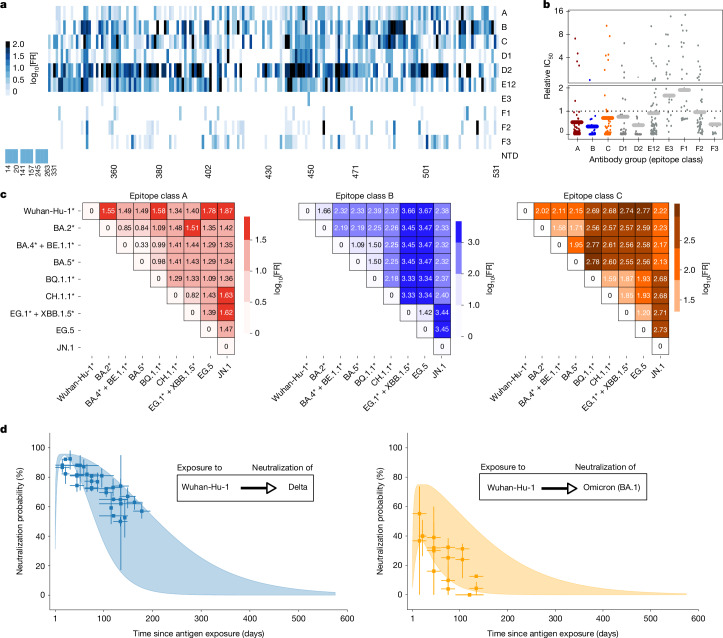
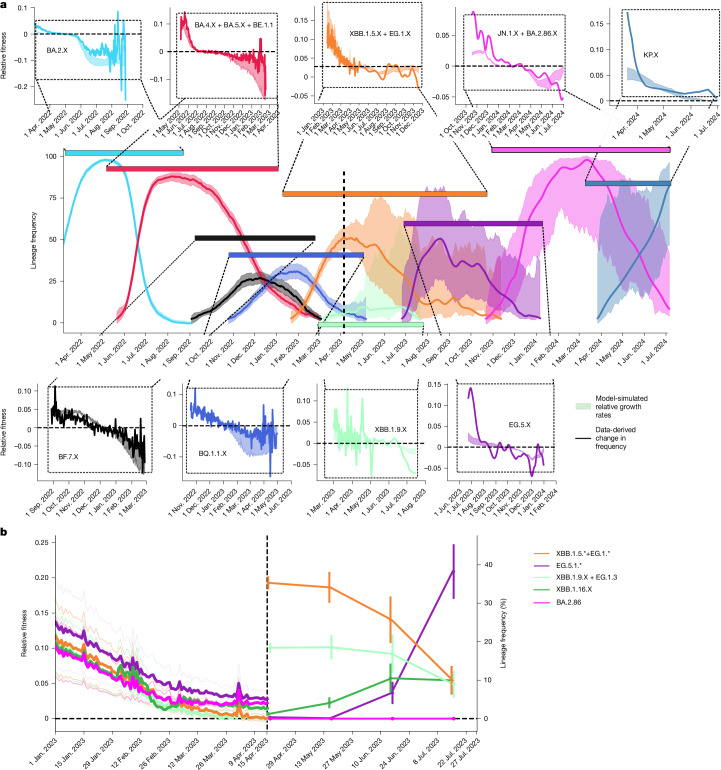
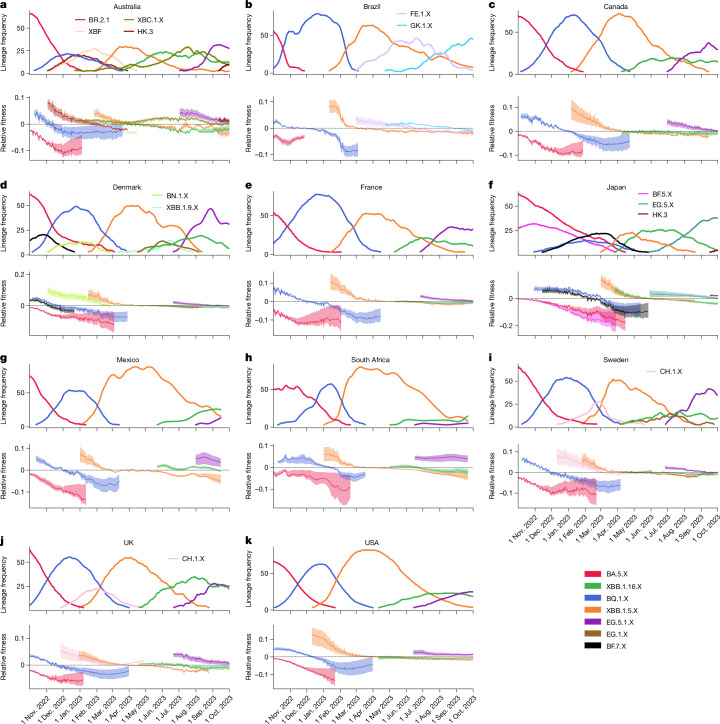
Since the onset of the pandemic, many SARS-CoV-2 variants have emerged, exhibiting substantial evolution in the virus' spike protein, the main target of neutralizing antibodies. A plausible hypothesis proposes that the virus evolves to evade antibody-mediated neutralization (vaccine- or infection-induced) to maximize its ability to infect an immunologically experienced population. Because viral infection induces neutralizing antibodies, viral evolution may thus navigate on a dynamic immune landscape that is shaped by local infection history. Here we developed a comprehensive mechanistic model, incorporating deep mutational scanning data, antibody pharmacokinetics and regional genomic surveillance data, to predict the variant-specific relative number of susceptible individuals over time. We show that this quantity precisely matched historical variant dynamics, predicted future variant dynamics and explained global differences in variant dynamics. Our work strongly suggests that the ongoing pandemic continues to shape variant-specific population immunity, which determines a variant's ability to transmit, thus defining variant fitness. The model can be applied to any region by utilizing local genomic surveillance data, allows contextualizing risk assessment of variants and provides information for vaccine design.
自疫情爆发以来,出现了许多严重急性呼吸综合征冠状病毒2(SARS-CoV-2)变体,其病毒刺突蛋白(中和抗体的主要靶点)发生了显著进化。一个合理的假设提出,病毒进化以逃避抗体介导的中和作用(疫苗或感染诱导的),从而最大限度地提高其感染有免疫经验人群的能力。由于病毒感染会诱导中和抗体,因此病毒进化可能会在由局部感染历史塑造的动态免疫环境中发展。在此,我们开发了一个综合的机理模型,纳入深度突变扫描数据、抗体药代动力学和区域基因组监测数据,以预测随时间变化的变体特异性易感个体相对数量。我们表明,这一数量与历史变体动态精确匹配,预测了未来变体动态,并解释了变体动态的全球差异。我们的工作有力地表明,当前的疫情仍在塑造变体特异性群体免疫,群体免疫决定了变体的传播能力,从而定义了变体适应性。通过利用当地基因组监测数据,该模型可应用于任何地区,能够对变体的风险评估进行背景化,并为疫苗设计提供信息。