• 文献检索
  • 文档翻译
  • 深度研究
  • 学术资讯
  • Suppr Zotero 插件Zotero 插件
  • 邀请有礼
  • 套餐&价格
  • 历史记录
应用&插件
Suppr Zotero 插件Zotero 插件浏览器插件Mac 客户端Windows 客户端微信小程序
定价
高级版会员购买积分包购买API积分包
服务
文献检索文档翻译深度研究API 文档MCP 服务
关于我们
关于 Suppr公司介绍联系我们用户协议隐私条款
关注我们

Suppr 超能文献

核心技术专利:CN118964589B侵权必究
粤ICP备2023148730 号-1Suppr @ 2026

文献检索

告别复杂PubMed语法,用中文像聊天一样搜索,搜遍4000万医学文献。AI智能推荐,让科研检索更轻松。

立即免费搜索

文件翻译

保留排版,准确专业,支持PDF/Word/PPT等文件格式,支持 12+语言互译。

免费翻译文档

深度研究

AI帮你快速写综述,25分钟生成高质量综述,智能提取关键信息,辅助科研写作。

立即免费体验

基于卷积自动编码器的模型 HistoCAE 用于分割肝脏全切片图像中的存活肿瘤区域。

Convolutional autoencoder based model HistoCAE for segmentation of viable tumor regions in liver whole-slide images.

机构信息

Department of Computer Science, Stony Brook University, Stony Brook, NY, 11794, USA.

Department of Mathematics and Statistics, Georgia State University, Atlanta, GA, 30303, USA.

出版信息

Sci Rep. 2021 Jan 8;11(1):139. doi: 10.1038/s41598-020-80610-9.

DOI:10.1038/s41598-020-80610-9
PMID:33420322
原文链接:https://pmc.ncbi.nlm.nih.gov/articles/PMC7794421/
Abstract

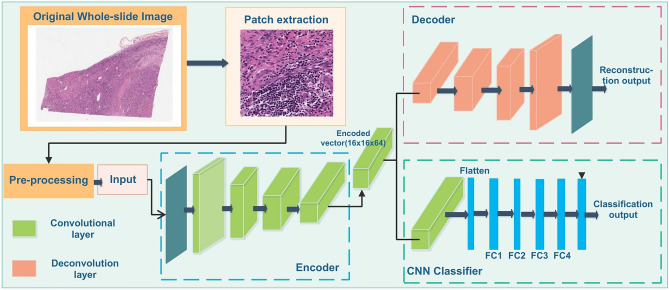
Liver cancer is one of the leading causes of cancer deaths in Asia and Africa. It is caused by the Hepatocellular carcinoma (HCC) in almost 90% of all cases. HCC is a malignant tumor and the most common histological type of the primary liver cancers. The detection and evaluation of viable tumor regions in HCC present an important clinical significance since it is a key step to assess response of chemoradiotherapy and tumor cell proportion in genetic tests. Recent advances in computer vision, digital pathology and microscopy imaging enable automatic histopathology image analysis for cancer diagnosis. In this paper, we present a multi-resolution deep learning model HistoCAE for viable tumor segmentation in whole-slide liver histopathology images. We propose convolutional autoencoder (CAE) based framework with a customized reconstruction loss function for image reconstruction, followed by a classification module to classify each image patch as tumor versus non-tumor. The resulting patch-based prediction results are spatially combined to generate the final segmentation result for each WSI. Additionally, the spatially organized encoded feature map derived from small image patches is used to compress the gigapixel whole-slide images. Our proposed model presents superior performance to other benchmark models with extensive experiments, suggesting its efficacy for viable tumor area segmentation with liver whole-slide images.

摘要

肝癌是亚洲和非洲癌症死亡的主要原因之一。几乎所有病例中,有 90%是由肝细胞癌 (HCC) 引起的。HCC 是一种恶性肿瘤,也是原发性肝癌最常见的组织学类型。检测和评估 HCC 中的存活肿瘤区域具有重要的临床意义,因为这是评估化学放射治疗反应和遗传测试中肿瘤细胞比例的关键步骤。计算机视觉、数字病理学和显微镜成像的最新进展使得癌症诊断的自动组织病理学图像分析成为可能。在本文中,我们提出了一种用于全切片肝组织病理学图像中存活肿瘤分割的多分辨率深度学习模型 HistoCAE。我们提出了一种基于卷积自动编码器 (CAE) 的框架,该框架具有用于图像重建的定制重建损失函数,随后是一个分类模块,用于将每个图像补丁分类为肿瘤与非肿瘤。基于补丁的预测结果在空间上进行组合,为每个 WSI 生成最终的分割结果。此外,从小图像补丁中提取的空间组织编码特征图用于压缩千兆像素的全切片图像。通过广泛的实验,我们提出的模型优于其他基准模型,这表明它在使用肝全切片图像进行存活肿瘤区域分割方面具有很好的效果。
https://cdn.ncbi.nlm.nih.gov/pmc/blobs/a6a9/7794421/0ec5ad8a96be/41598_2020_80610_Fig4_HTML.jpg
https://cdn.ncbi.nlm.nih.gov/pmc/blobs/a6a9/7794421/822fe43feef2/41598_2020_80610_Fig1_HTML.jpg
https://cdn.ncbi.nlm.nih.gov/pmc/blobs/a6a9/7794421/9ebeae3da274/41598_2020_80610_Fig2_HTML.jpg
https://cdn.ncbi.nlm.nih.gov/pmc/blobs/a6a9/7794421/e1171196b2d6/41598_2020_80610_Fig3_HTML.jpg
https://cdn.ncbi.nlm.nih.gov/pmc/blobs/a6a9/7794421/0ec5ad8a96be/41598_2020_80610_Fig4_HTML.jpg
https://cdn.ncbi.nlm.nih.gov/pmc/blobs/a6a9/7794421/822fe43feef2/41598_2020_80610_Fig1_HTML.jpg
https://cdn.ncbi.nlm.nih.gov/pmc/blobs/a6a9/7794421/9ebeae3da274/41598_2020_80610_Fig2_HTML.jpg
https://cdn.ncbi.nlm.nih.gov/pmc/blobs/a6a9/7794421/e1171196b2d6/41598_2020_80610_Fig3_HTML.jpg
https://cdn.ncbi.nlm.nih.gov/pmc/blobs/a6a9/7794421/0ec5ad8a96be/41598_2020_80610_Fig4_HTML.jpg

相似文献

1
Convolutional autoencoder based model HistoCAE for segmentation of viable tumor regions in liver whole-slide images.基于卷积自动编码器的模型 HistoCAE 用于分割肝脏全切片图像中的存活肿瘤区域。
Sci Rep. 2021 Jan 8;11(1):139. doi: 10.1038/s41598-020-80610-9.
2
LiverNet: efficient and robust deep learning model for automatic diagnosis of sub-types of liver hepatocellular carcinoma cancer from H&E stained liver histopathology images.LiverNet:一种高效、稳健的深度学习模型,用于从 H&E 染色的肝脏组织病理学图像中自动诊断肝肝细胞癌亚型。
Int J Comput Assist Radiol Surg. 2021 Sep;16(9):1549-1563. doi: 10.1007/s11548-021-02410-4. Epub 2021 May 30.
3
Pathologic liver tumor detection using feature aligned multi-scale convolutional network.基于特征对齐多尺度卷积网络的病理性肝肿瘤检测
Artif Intell Med. 2022 Mar;125:102244. doi: 10.1016/j.artmed.2022.102244. Epub 2022 Jan 10.
4
Automatic Liver Tumor Segmentation on Dynamic Contrast Enhanced MRI Using 4D Information: Deep Learning Model Based on 3D Convolution and Convolutional LSTM.基于三维卷积和卷积长短期记忆网络的 4D 信息的动态对比增强 MRI 自动肝脏肿瘤分割:深度学习模型。
IEEE Trans Med Imaging. 2022 Oct;41(10):2965-2976. doi: 10.1109/TMI.2022.3175461. Epub 2022 Sep 30.
5
Liver tissue segmentation in multiphase CT scans using cascaded convolutional neural networks.使用级联卷积神经网络对多期 CT 扫描中的肝组织进行分割。
Int J Comput Assist Radiol Surg. 2019 Aug;14(8):1275-1284. doi: 10.1007/s11548-019-01989-z. Epub 2019 Apr 30.
6
A hybrid network for automatic hepatocellular carcinoma segmentation in H&E-stained whole slide images.一种用于 H&E 染色全切片图像中肝细胞癌自动分割的混合网络。
Med Image Anal. 2021 Feb;68:101914. doi: 10.1016/j.media.2020.101914. Epub 2020 Nov 25.
7
Automated segmentation of cell membranes to evaluate HER2 status in whole slide images using a modified deep learning network.使用改进的深度学习网络对全切片图像中的细胞膜进行自动分割,以评估 HER2 状态。
Comput Biol Med. 2019 Jul;110:164-174. doi: 10.1016/j.compbiomed.2019.05.020. Epub 2019 May 30.
8
Clinical application of mask region-based convolutional neural network for the automatic detection and segmentation of abnormal liver density based on hepatocellular carcinoma computed tomography datasets.基于掩模区域的卷积神经网络在基于肝细胞癌 CT 数据集的异常肝密度自动检测和分割中的临床应用。
PLoS One. 2021 Aug 10;16(8):e0255605. doi: 10.1371/journal.pone.0255605. eCollection 2021.
9
Automatic segmentation of hepatocellular carcinoma on dynamic contrast-enhanced MRI based on deep learning.基于深度学习的动态对比增强磁共振成像对肝细胞癌的自动分割
Phys Med Biol. 2024 Mar 12;69(6). doi: 10.1088/1361-6560/ad2790.
10
DLNLF-net: Denoised local and non-local deep features fusion network for malignancy characterization of hepatocellular carcinoma.DLNLF-net:用于肝细胞癌恶性特征分析的去噪局部和非局部深度特征融合网络。
Comput Methods Programs Biomed. 2022 Dec;227:107201. doi: 10.1016/j.cmpb.2022.107201. Epub 2022 Oct 25.

引用本文的文献

1
ASS1 inhibits liver cancer by promoting CAD ubiquitination and reversing the urea cycle and pyrimidine synthesis imbalance.ASS1通过促进CAD泛素化以及逆转尿素循环和嘧啶合成失衡来抑制肝癌。
Hepatol Commun. 2025 Aug 15;9(9). doi: 10.1097/HC9.0000000000000769. eCollection 2025 Sep 1.
2
AI-Powered Mobile App for Nuclear Cataract Detection.用于核性白内障检测的人工智能移动应用程序。
Sensors (Basel). 2025 Jun 25;25(13):3954. doi: 10.3390/s25133954.
3
Artificial intelligence-based pathological analysis of liver cancer: Current advancements and interpretative strategies.

本文引用的文献

1
Neural Image Compression for Gigapixel Histopathology Image Analysis.神经图像压缩在千兆像素病理图像分析中的应用。
IEEE Trans Pattern Anal Mach Intell. 2021 Feb;43(2):567-578. doi: 10.1109/TPAMI.2019.2936841. Epub 2021 Jan 8.
2
SegNet: A Deep Convolutional Encoder-Decoder Architecture for Image Segmentation.SegNet:一种用于图像分割的深度卷积编解码器架构。
IEEE Trans Pattern Anal Mach Intell. 2017 Dec;39(12):2481-2495. doi: 10.1109/TPAMI.2016.2644615. Epub 2017 Jan 2.
3
Fully Convolutional Networks for Semantic Segmentation.
基于人工智能的肝癌病理分析:当前进展与解读策略
ILIVER. 2024 Feb 8;3(1):100082. doi: 10.1016/j.iliver.2024.100082. eCollection 2024 Mar.
4
Advances and challenges in pathomics for liver cancer: From diagnosis to prognostic stratification.肝癌病理组学的进展与挑战:从诊断到预后分层
World J Clin Oncol. 2025 Jun 24;16(6):107646. doi: 10.5306/wjco.v16.i6.107646.
5
Liver Tumor Prediction using Attention-Guided Convolutional Neural Networks and Genomic Feature Analysis.使用注意力引导卷积神经网络和基因组特征分析进行肝肿瘤预测
MethodsX. 2025 Mar 22;14:103276. doi: 10.1016/j.mex.2025.103276. eCollection 2025 Jun.
6
A survey on recent trends in deep learning for nucleus segmentation from histopathology images.关于从组织病理学图像进行细胞核分割的深度学习最新趋势的调查。
Evol Syst (Berl). 2023 Mar 6:1-46. doi: 10.1007/s12530-023-09491-3.
7
Computational pathology model to assess acute and chronic transformations of the tubulointerstitial compartment in renal allograft biopsies.计算病理学模型评估肾移植活检中肾小管间质腔的急性和慢性转化。
Sci Rep. 2024 Mar 4;14(1):5345. doi: 10.1038/s41598-024-55936-3.
8
A systematic review on deep learning-based automated cancer diagnosis models.基于深度学习的自动化癌症诊断模型的系统评价。
J Cell Mol Med. 2024 Mar;28(6):e18144. doi: 10.1111/jcmm.18144.
9
Computational pathology: A survey review and the way forward.计算病理学:综述与未来发展方向
J Pathol Inform. 2024 Jan 14;15:100357. doi: 10.1016/j.jpi.2023.100357. eCollection 2024 Dec.
10
Applications of discriminative and deep learning feature extraction methods for whole slide image analysis: A survey.判别式和深度学习特征提取方法在全切片图像分析中的应用:一项综述。
J Pathol Inform. 2023 Sep 14;14:100335. doi: 10.1016/j.jpi.2023.100335. eCollection 2023.
全卷积网络用于语义分割。
IEEE Trans Pattern Anal Mach Intell. 2017 Apr;39(4):640-651. doi: 10.1109/TPAMI.2016.2572683. Epub 2016 May 24.
4
Enhancing automatic classification of hepatocellular carcinoma images through image masking, tissue changes and trabecular features.通过图像掩蔽、组织变化和小梁特征增强肝细胞癌图像的自动分类。
J Pathol Inform. 2015 Jun 3;6:26. doi: 10.4103/2153-3539.158044. eCollection 2015.
5
Automated discrimination of lower and higher grade gliomas based on histopathological image analysis.基于组织病理学图像分析的低级别和高级别胶质瘤自动鉴别
J Pathol Inform. 2015 Mar 24;6:15. doi: 10.4103/2153-3539.153914. eCollection 2015.