Institute for Sports Medicine, Alpine Medicine and Health Tourism, UMIT-University for Health Sciences, Medical Informatics and Technology, Hall, Austria.
Department of Anaesthesiology and Critical Care Medicine, Innsbruck, Austria.
Br J Anaesth. 2021 Mar;126(3):590-598. doi: 10.1016/j.bja.2020.12.010. Epub 2020 Dec 9.
Critically ill coronavirus disease 2019 (COVID-19) patients present with a hypercoagulable state with high rates of macrovascular and microvascular thrombosis, for which hypofibrinolysis might be an important contributing factor.
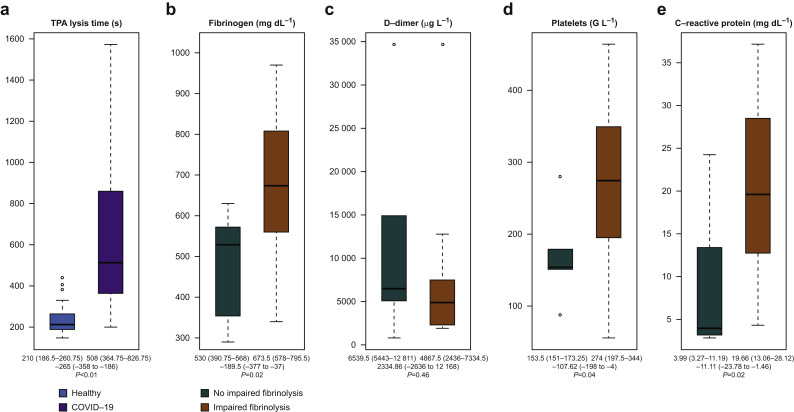
We retrospectively analysed 20 critically ill COVID-19 patients at Innsbruck Medical University Hospital whose coagulation function was tested with ClotPro® and compared with that of 60 healthy individuals at Augsburg University Clinic. ClotPro is a viscoelastic whole blood coagulation testing device. It includes the TPA test, which uses tissue factor (TF)-activated whole blood with added recombinant tissue-derived plasminogen activator (r-tPA) to induce fibrinolysis. For this purpose, the lysis time (LT) is measured as the time from when maximum clot firmness (MCF) is reached until MCF falls by 50%. We compared COVID-19 patients with prolonged LT in the TPA test and those with normal LT.
Critically ill COVID-19 patients showed hypercoagulability in ClotPro assays. MCF was higher in the EX test (TF-activated assay), IN test (ellagic acid-activated assay), and FIB test (functional fibrinogen assay) with decreased maximum lysis (ML) in the EX test (hypofibrinolysis) and highly prolonged TPA test LT (decreased fibrinolytic response), as compared with healthy persons. COVID-19 patients with decreased fibrinolytic response showed higher fibrinogen levels, higher thrombocyte count, higher C-reactive protein levels, and decreased ML in the EX test and IN test.
Critically ill COVID-19 patients have impaired fibrinolysis. This hypofibrinolytic state could be at least partially dependent on a decreased fibrinolytic response.
危重症 2019 冠状病毒病(COVID-19)患者表现出高凝状态,大血管和微血管血栓形成率高,纤溶活性降低可能是一个重要的促成因素。
我们回顾性分析了因 COVID-19 入住因斯布鲁克医科大学医院的 20 例危重症患者,使用 ClotPro®检测其凝血功能,并与奥格斯堡大学诊所的 60 名健康个体进行比较。ClotPro 是一种粘弹性全血凝血检测设备。它包括 TPA 测试,该测试使用组织因子(TF)激活的全血,加入重组组织来源的纤溶酶原激活剂(r-tPA)诱导纤溶。为此,测量从达到最大凝块硬度(MCF)到 MCF 下降 50%的时间作为溶解时间(LT)。我们比较了 TPA 测试中 LT 延长的 COVID-19 患者和 LT 正常的 COVID-19 患者。
危重症 COVID-19 患者的 ClotPro 检测结果显示出高凝状态。在 EX 测试(TF 激活测试)、IN 测试(鞣花酸激活测试)和 FIB 测试(功能性纤维蛋白原测试)中 MCF 更高,而在 EX 测试(纤溶活性降低)中最大溶解(ML)降低,TPA 测试 LT 高度延长(纤溶反应降低),与健康人相比。纤维蛋白溶解反应降低的 COVID-19 患者表现出更高的纤维蛋白原水平、更高的血小板计数、更高的 C 反应蛋白水平以及 EX 测试和 IN 测试中 ML 降低。
危重症 COVID-19 患者的纤溶活性受损。这种纤溶活性降低的状态至少部分依赖于纤溶反应的降低。