Cancer Research UK Beatson Institute, Glasgow, G61 1BD, UK.
Heidelberg Institute for Stem Cell Technology and Experimental Medicine (HI-STEM gGmbH), Im Neuenheimer Feld 280, Heidelberg, 69120, Germany; Division of Cancer Progression and Metastasis German Cancer Research Center (DKFZ), Im Neuenheimer Feld 280, Heidelberg, 69120, Germany.
Curr Opin Genet Dev. 2021 Feb;66:50-56. doi: 10.1016/j.gde.2020.12.003. Epub 2021 Jan 7.
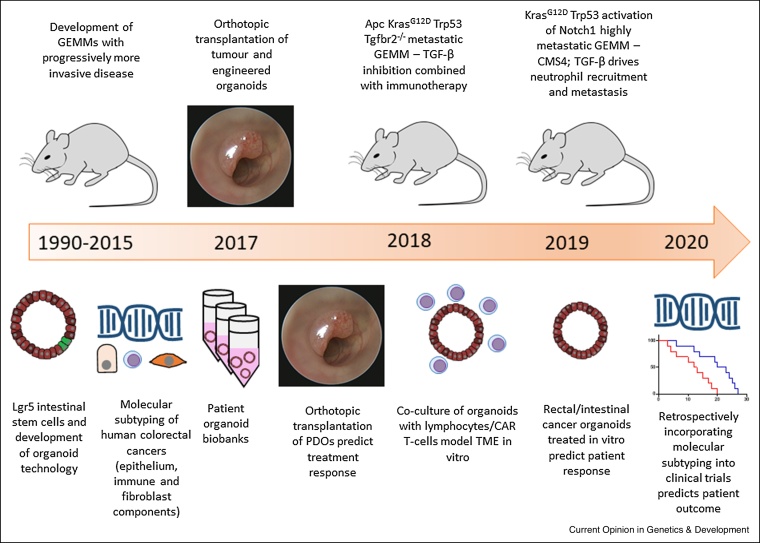
Modelling human colon cancer has long been the ambition of researchers and oncologists with the aim to better replicate disease progression and treatment response. Advances in our understanding of genetics, stem cell biology, tumour microenvironment and immunology have prepared the groundwork for recent major advances. In the last two years the field has seen the progression of: using patient derived organoids (alone and in co-culture) as predictors of treatment response; molecular stratification of tumours that predict outcome and treatment response; mouse models of metastatic disease; and transplant models that can be used to de-risk clinical trials. We will discuss these advances in this review.
长期以来,研究人员和肿瘤学家一直致力于建立人类结肠癌模型,旨在更好地复制疾病进展和治疗反应。我们对遗传学、干细胞生物学、肿瘤微环境和免疫学的理解的进步为最近的重大进展奠定了基础。在过去的两年中,该领域已经取得了以下进展:使用患者来源的类器官(单独使用和共培养)作为治疗反应的预测因子;预测结果和治疗反应的肿瘤分子分层;转移性疾病的小鼠模型;以及可用于降低临床试验风险的移植模型。我们将在这篇综述中讨论这些进展。