Department of Oncology, University of Torino, via Santena 5/bis, 10126, Torino, Italy.
Department of Neurosciences, Biomedicine and Movement Sciences, Section of Biochemistry, University of Verona, Verona, Italy.
J Exp Clin Cancer Res. 2021 Jan 11;40(1):28. doi: 10.1186/s13046-020-01824-3.
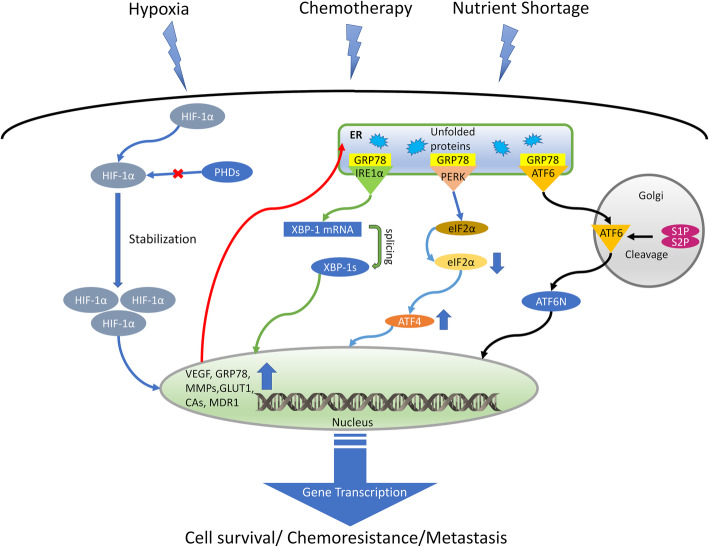
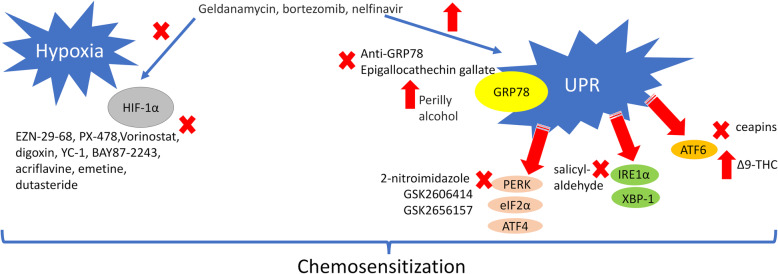
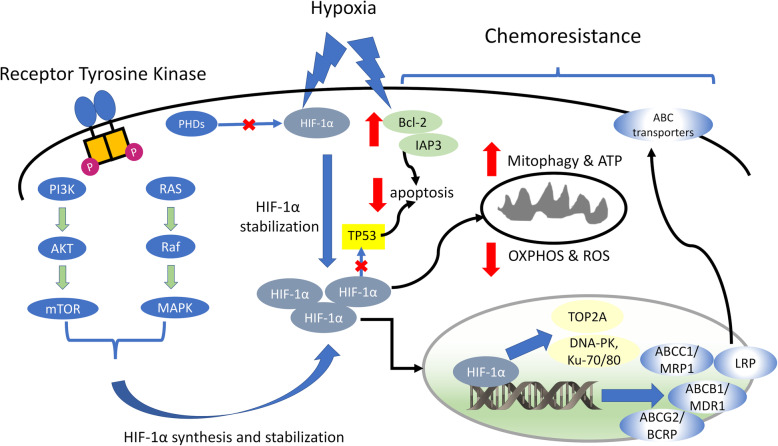
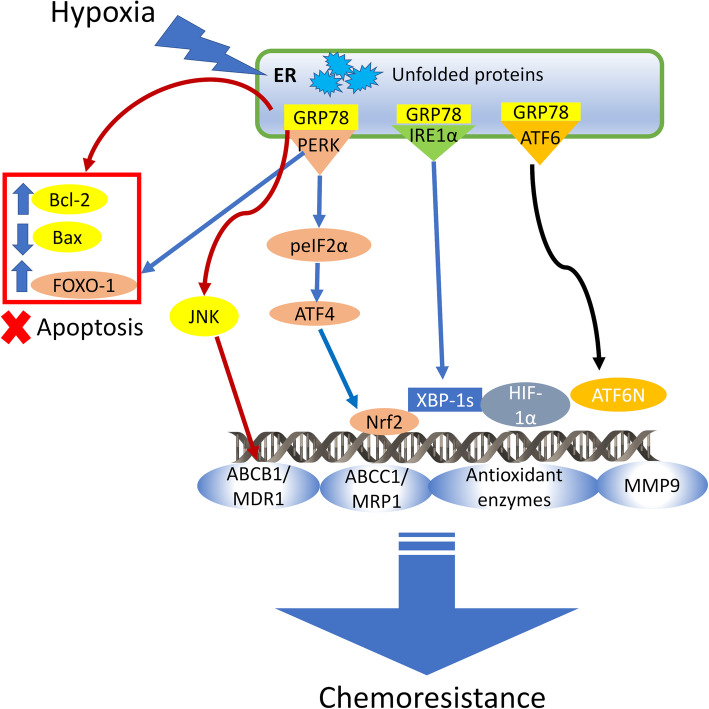
Solid tumors often grow in a micro-environment characterized by < 2% O tension. This condition, together with the aberrant activation of specific oncogenic patwhays, increases the amount and activity of the hypoxia-inducible factor-1α (HIF-1α), a transcription factor that controls up to 200 genes involved in neoangiogenesis, metabolic rewiring, invasion and drug resistance. Hypoxia also induces endoplasmic reticulum (ER) stress, a condition that triggers cell death, if cells are irreversibly damaged, or cell survival, if the stress is mild.Hypoxia and chronic ER stress both induce chemoresistance. In this review we discuss the multiple and interconnected circuitries that link hypoxic environment, chronic ER stress and chemoresistance. We suggest that hypoxia and ER stress train and select the cells more adapted to survive in unfavorable conditions, by activating pleiotropic mechanisms including apoptosis inhibition, metabolic rewiring, anti-oxidant defences, drugs efflux. This adaptative process unequivocally expands clones that acquire resistance to chemotherapy.We believe that pharmacological inhibitors of HIF-1α and modulators of ER stress, although characterized by low specificty and anti-cancer efficacy when used as single agents, may be repurposed as chemosensitizers against hypoxic and chemorefractory tumors in the next future.
实体瘤常生长在氧张力<2%的微环境中。这种情况,加上特定致癌途径的异常激活,增加了缺氧诱导因子-1α(HIF-1α)的数量和活性,HIF-1α是一种转录因子,可控制多达 200 个与新生血管形成、代谢重编程、侵袭和耐药性相关的基因。缺氧还会诱导内质网(ER)应激,如果细胞受到不可逆转的损伤,就会引发细胞死亡,如果应激较轻,则会引发细胞存活。缺氧和慢性 ER 应激均会诱导化疗耐药性。在这篇综述中,我们讨论了将缺氧环境、慢性 ER 应激和化疗耐药性联系起来的多种相互关联的电路。我们认为,缺氧和 ER 应激通过激活包括凋亡抑制、代谢重编程、抗氧化防御、药物外排等在内的多种多效性机制,训练和选择更能适应不利条件的细胞,从而使细胞获得耐药性。这个适应过程无疑会使获得化疗耐药性的克隆扩增。我们相信,HIF-1α的药理学抑制剂和 ER 应激调节剂,虽然在作为单一药物使用时特异性和抗癌疗效较低,但在未来可能会被重新用作针对缺氧和化疗抵抗肿瘤的化疗增敏剂。