Alqethami Afnan, Aldhebiani Amal Y
Department of Biology, Faculty of Applied Science, Umm Al-Qura University, Makkah 21955, Saudi Arabia.
Biological Sciences Department, Faculty of Science, King Abdulaziz University, Jeddah, Saudi Arabia.
Saudi J Biol Sci. 2021 Jan;28(1):805-812. doi: 10.1016/j.sjbs.2020.11.013. Epub 2020 Nov 11.
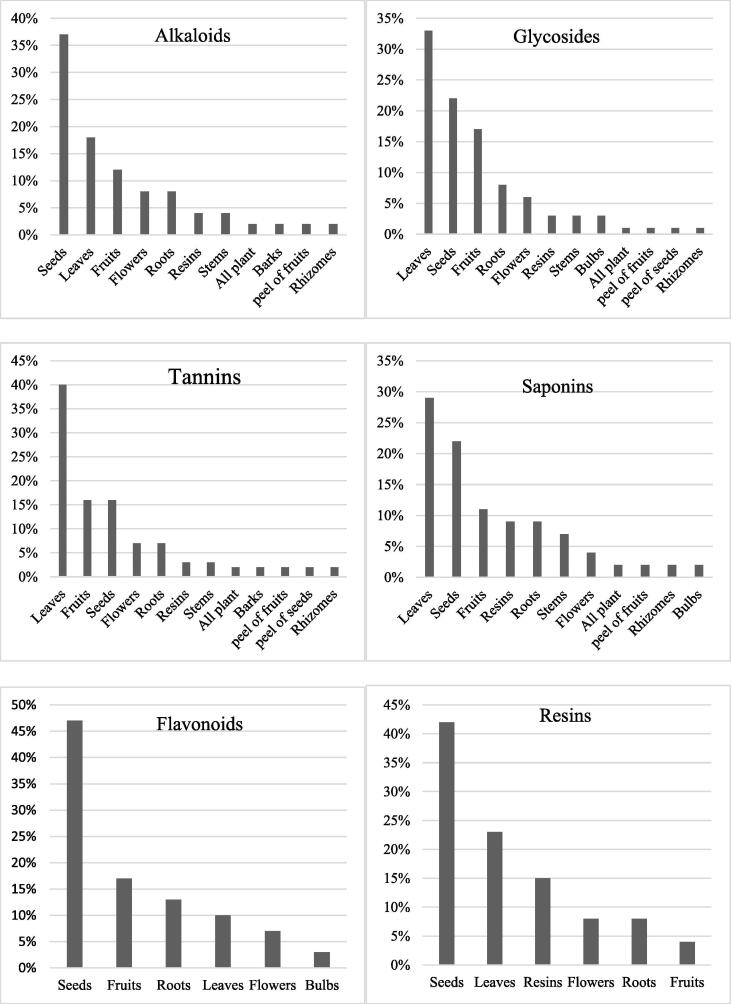
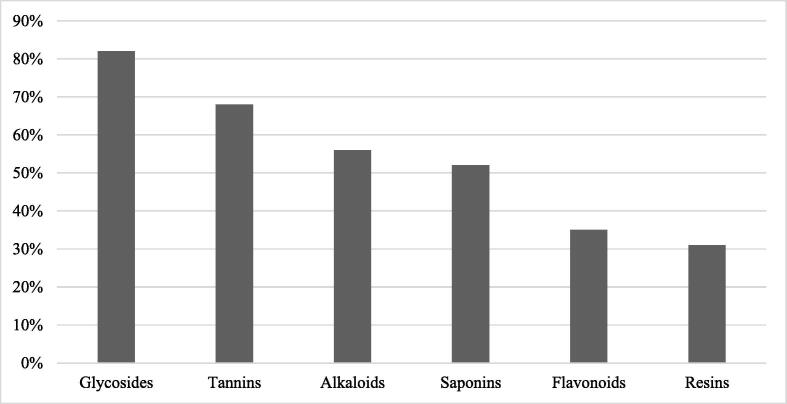
Ethnobotanical and phytochemical studies are useful to discover new drugs. Phytochemical screening is an important step in the detection of the bioactive components existing in medicinal plants that are used in traditional medicine. Very few phytochemical studies investigating medicinal plants used in traditional medicine exist in Saudi Arabia. Eighty-five medicinal plants used in traditional medicine in Jeddah, Saudi Arabia are investigated here for the first time. This research aims to screen of 85 medicinal plants used in traditional medicine in Jeddah for the presence of secondary metabolites, and to answer the following question: Is the ethnomedicinal importance of medicinal plants used in Jeddah conform to their secondary metabolite content. Ethnobotanical fieldwork took place in Jeddah from August 2018 to September 2019. Eighty-five different plant species belonging to 37 families were identified. Screening of 85 medicinal plants was performed for the presence of alkaloids, glycosides, flavonoids, tannins, saponins and resins using standard methods. The most commonly distributed phytochemical compounds among medicinal plants used were glycosides (82%; 70 species), tannins (68%; 58 species), alkaloids (56%; 48 species), saponins (52%, 44 species) and flavonoids (35%; 30 species). On the other hand, the least commonly distributed compounds were resins (31%; 26 species). All the six groups of secondary metabolites were found in seeds of L., L. and L. It can be said that the ethnomedicinal importance of these 85 medicinal plants used in Jeddah conform to their secondary metabolite content. More research should be carried out on the quantitative analysis of phytochemicals in these 85 medicinal plants used in traditional medicine in Jeddah. Furthermore, there is a need to focus phytochemical screening on ethnobotanical studies to complete research into traditional medicine which leads to the discovery of new drugs.
民族植物学和植物化学研究有助于发现新药。植物化学筛选是检测传统医学中使用的药用植物中存在的生物活性成分的重要步骤。沙特阿拉伯对用于传统医学的药用植物进行的植物化学研究很少。沙特阿拉伯吉达用于传统医学的85种药用植物首次在此进行了研究。本研究旨在筛选吉达用于传统医学的85种药用植物中次生代谢物的存在情况,并回答以下问题:吉达使用的药用植物的民族药用重要性是否与其次生代谢物含量相符。2018年8月至2019年9月在吉达开展了民族植物学实地调查。共鉴定出37科85种不同的植物物种。采用标准方法对85种药用植物进行生物碱、糖苷、黄酮类、单宁、皂苷和树脂的筛选。在所使用的药用植物中分布最普遍的植物化学化合物是糖苷(82%;70种)、单宁(68%;58种)、生物碱(56%;48种)、皂苷(52%,44种)和黄酮类(35%;30种)。另一方面,分布最不普遍的化合物是树脂(31%;26种)。在L.、L.和L.的种子中发现了所有六类次生代谢物。可以说,吉达使用的这85种药用植物的民族药用重要性与其次生代谢物含量相符。应对吉达用于传统医学的这85种药用植物中的植物化学物质进行更多的定量分析研究。此外,有必要将植物化学筛选重点放在民族植物学研究上,以完成对传统医学的研究,从而发现新药。