Simar Cédric, Cebolla Ana-Maria, Chartier Gaëlle, Petieau Mathieu, Bontempi Gianluca, Berthoz Alain, Cheron Guy
Machine Learning Group (MLG), Computer Science Department, Université libre de Bruxelles (ULB), Brussels, Belgium.
Laboratory of Neurophysiology and Movement Biomechanics, ULB Neuroscience Institute, Université libre de Bruxelles, Brussels, Belgium.
Front Neurosci. 2020 Dec 16;14:588357. doi: 10.3389/fnins.2020.588357. eCollection 2020.
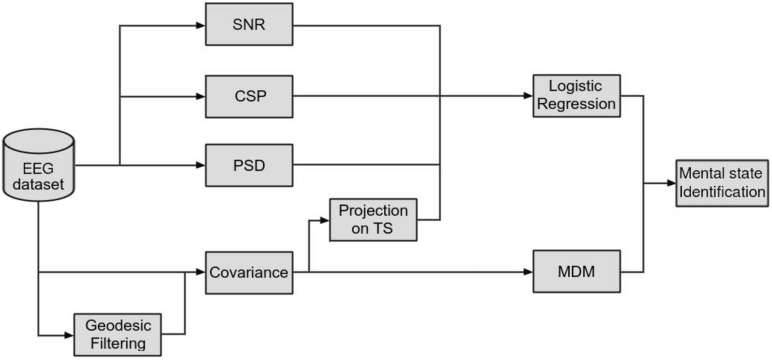
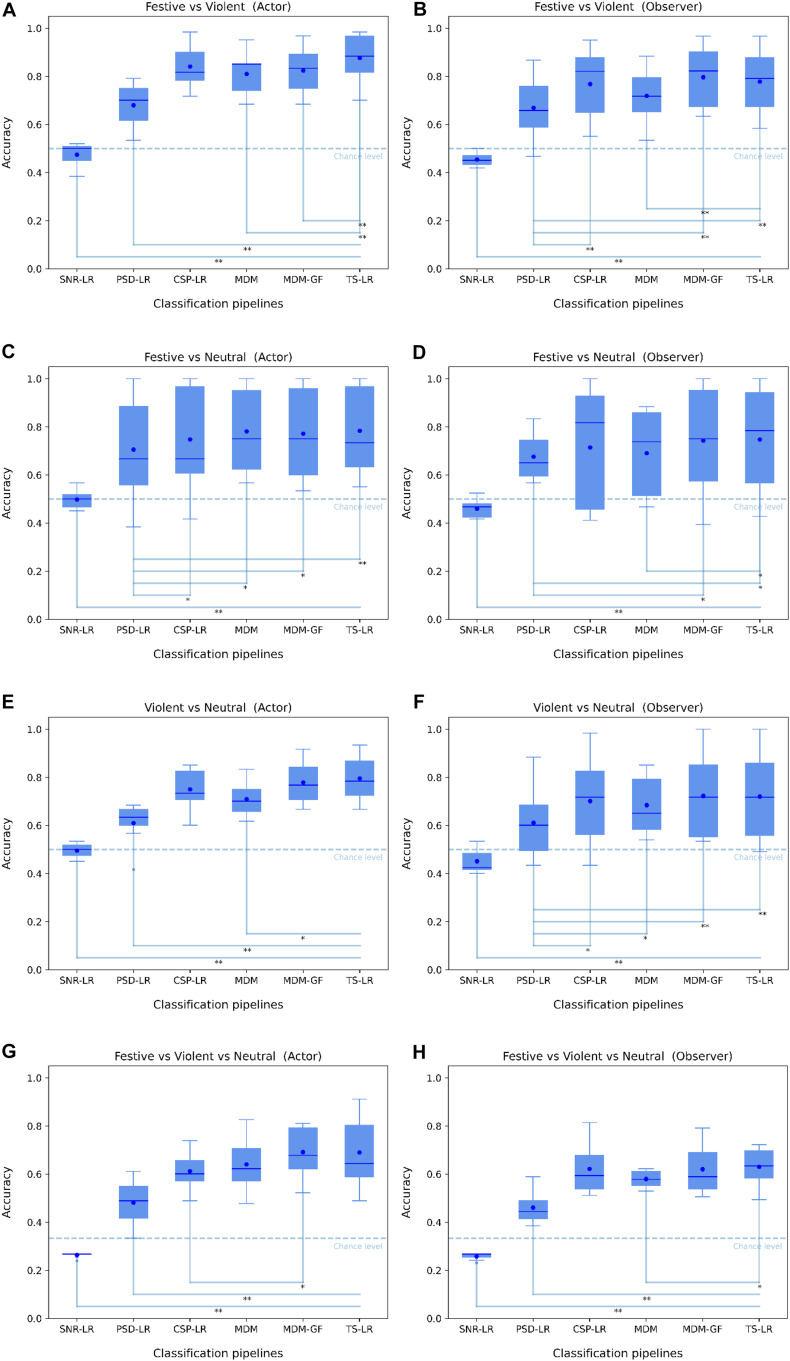
Interactions between two brains constitute the essence of social communication. Daily movements are commonly executed during social interactions and are determined by different mental states that may express different positive or negative behavioral intent. In this context, the effective recognition of festive or violent intent before the action execution remains crucial for survival. Here, we hypothesize that the EEG signals contain the distinctive features characterizing movement intent already expressed before movement execution and that such distinctive information can be identified by state-of-the-art classification algorithms based on Riemannian geometry. We demonstrated for the first time that a classifier based on covariance matrices and Riemannian geometry can effectively discriminate between neutral, festive, and violent mental states only on the basis of non-invasive EEG signals in both the actor and observer participants. These results pave the way for new electrophysiological discrimination of mental states based on non-invasive EEG recordings and cutting-edge machine learning techniques.
两个大脑之间的相互作用构成了社会交流的本质。日常动作通常在社会互动中执行,并由可能表达不同积极或消极行为意图的不同心理状态所决定。在这种情况下,在动作执行之前有效识别喜庆或暴力意图对于生存仍然至关重要。在此,我们假设脑电图信号包含运动执行前已表达的运动意图的独特特征,并且这种独特信息可以通过基于黎曼几何的先进分类算法来识别。我们首次证明,基于协方差矩阵和黎曼几何的分类器仅根据参与者(行动者和观察者)的非侵入性脑电图信号就能有效区分中性、喜庆和暴力心理状态。这些结果为基于非侵入性脑电图记录和前沿机器学习技术的心理状态新电生理鉴别方法铺平了道路。