Dong Xue, Du Xinxin, Bao Min
CAS Key Laboratory of Behavioral Science, Institute of Psychology, Chinese Academy of Sciences (CAS), Beijing, China.
Department of Psychology, University of Chinese Academy of Sciences, Beijing, China.
Front Hum Neurosci. 2020 Dec 23;14:589634. doi: 10.3389/fnhum.2020.589634. eCollection 2020.
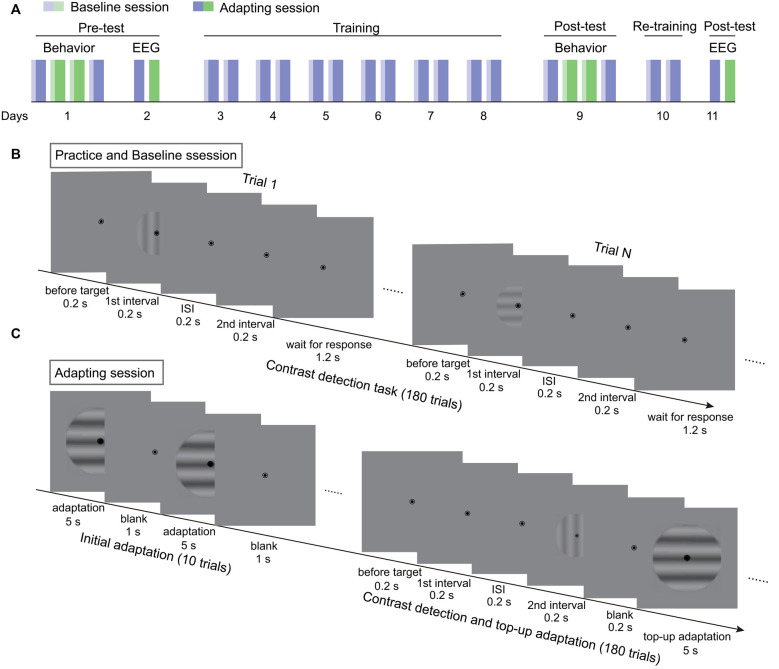
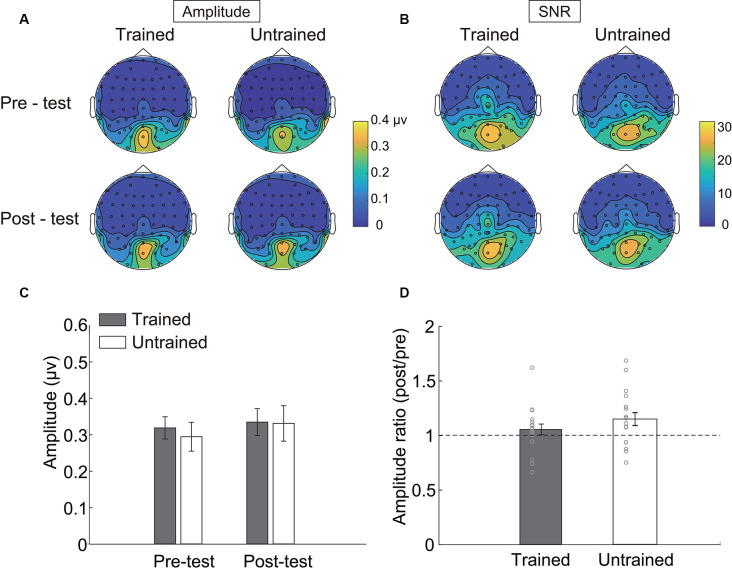
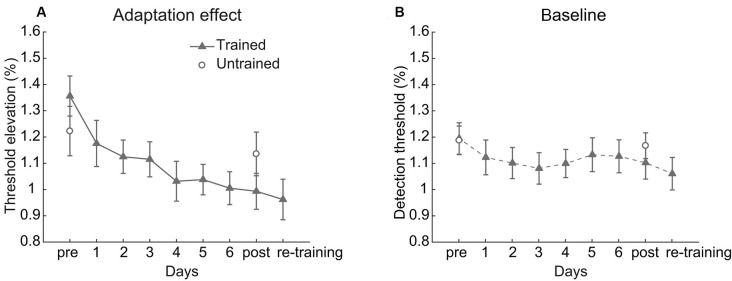
Adaptation can optimize information processing by allowing the visual system to always adjust to the environment. However, only a few studies have investigated how the visual system makes adjustments to repeatedly occurring changes in the input, still less about the related neural mechanism. Our previous study found that contrast adaptation attenuated after multiple daily sessions of repeated adaptation, which was explained by the habituation of either the adapter's effective strength or the adaptation mechanisms. To examine the former hypothesis, in the present study we used the frequency tagging technique to measure the adapter-elicited steady-state visual evoked potential (SSVEP) amplitudes. Participants repeatedly adapted to the same contrast adapter in a top-up manner for six continuous days, which was called training of adaptation. The behavioral adaptation effect and SSVEP response to the trained adapter and an untrained control adapter were measured before and after training. The psychophysical results showed that the effect of adaptation in the trained condition significantly reduced after training, replicating our previous finding. Contradicting the prediction of the hypothesis that repeated adaptation attenuated the effective strength of the adapter, the SSVEP amplitude was unchanged after training, which was further confirmed by an equivalence test. Taken together, the results challenge the account of habituation of adapter in repeated adaptation, while leaving the account of habituation of adaptation mechanism to be tested.
适应可以通过让视觉系统始终适应环境来优化信息处理。然而,只有少数研究调查了视觉系统如何对输入中反复出现的变化进行调整,关于相关神经机制的研究更少。我们之前的研究发现,在每天多次重复适应后,对比度适应会减弱,这可以用适应器有效强度的习惯化或适应机制的习惯化来解释。为了检验前一个假设,在本研究中,我们使用频率标记技术来测量适应器诱发的稳态视觉诱发电位(SSVEP)振幅。参与者以补充的方式连续六天反复适应相同的对比度适应器,这被称为适应训练。在训练前后测量对训练过的适应器和未训练的对照适应器的行为适应效果和SSVEP反应。心理物理学结果表明,训练后训练条件下的适应效果显著降低,重复了我们之前的发现。与重复适应会减弱适应器有效强度这一假设的预测相反,训练后SSVEP振幅没有变化,这通过等效性检验得到了进一步证实。综上所述,这些结果对重复适应中适应器习惯化的观点提出了挑战,同时留下了适应机制习惯化的观点有待检验。