Takeuchi Kosuke, Nakamura Masatoshi
Faculty of Rehabilitation, Kobe International University, Kobe, Japan.
Graduate School of Comprehensive Human Sciences, University of Tsukuba, Tsukuba, Japan.
Front Physiol. 2020 Dec 3;11:612967. doi: 10.3389/fphys.2020.612967. eCollection 2020.
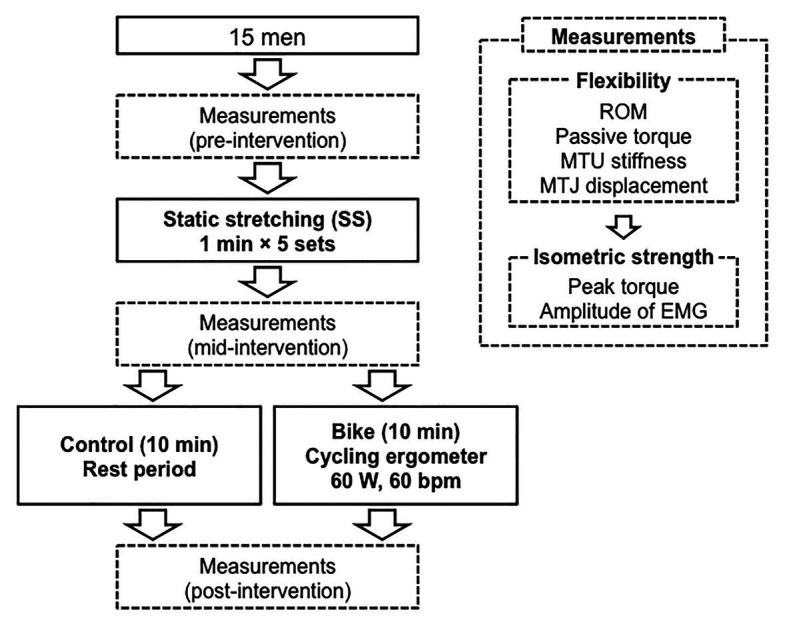
Aerobic exercise could improve stretch-induced strength deficits. However, mechanisms of the improvement were unclear. The purpose of the study was to examine the effects of aerobic exercise after static stretching (SS) on flexibility and isometric strength in ankle plantar-flexor muscles. Fifteen healthy males received two interventions after SS of their ankle plantar-flexor muscles for 5 min. One was aerobic exercise for 10-min on a cycling ergometer, and the other was a 10-min rest as a control. Range of motion (ROM) of ankle dorsiflexion, passive torque at terminal ROM, muscle-tendon unit (MTU) stiffness, muscle tendon junction displacement, peak torque of ankle plantarflexion, and the amplitude of electromyography (EMG) were measured. Immediately after the SS, in both interventions, ROM, passive torque, and muscle tendon junction displacement increased significantly ( < 0.05), while MTU stiffness, peak torque, and the amplitude of EMG were significantly decreased ( < 0.05). After 10-min on a cycling ergometer, the decreased peak torque and amplitude of EMG indicated higher values than those before SS ( < 0.05), while MTU stiffness was no change. In conclusion, SS increased ROM because of the decreased MTU stiffness as well as increased tolerance for stretching. Aerobic exercise could increase the muscle strength and amplitude of EMG which decreased after static stretching.
有氧运动可以改善拉伸诱导的力量缺陷。然而,改善的机制尚不清楚。本研究的目的是探讨静态拉伸(SS)后进行有氧运动对踝关节跖屈肌柔韧性和等长力量的影响。15名健康男性在踝关节跖屈肌进行5分钟的静态拉伸后接受两种干预措施。一种是在自行车测力计上进行10分钟的有氧运动,另一种是作为对照进行10分钟的休息。测量了踝关节背屈的活动范围(ROM)、终末ROM时的被动扭矩、肌肉-肌腱单元(MTU)刚度、肌腱连接处位移、踝关节跖屈的峰值扭矩以及肌电图(EMG)的幅度。在静态拉伸后,两种干预措施中,ROM、被动扭矩和肌腱连接处位移均显著增加(<0.05),而MTU刚度、峰值扭矩和EMG幅度均显著降低(<0.05)。在自行车测力计上运动10分钟后,降低的峰值扭矩和EMG幅度显示出比静态拉伸前更高的值(<0.05),而MTU刚度没有变化。总之,静态拉伸由于MTU刚度降低以及拉伸耐受性增加而增加了ROM。有氧运动可以增加静态拉伸后降低的肌肉力量和EMG幅度。