Mathisen Therese Fostervold, Aambø Jenny, Bratland-Sanda Solfrid, Sundgot-Borgen Christine, Svantorp-Tveiten Kethe, Sundgot-Borgen Jorunn
Faculty of Health and Welfare, Østfold University College, Fredrikstad, Norway.
Department of Sports Medicine, Norwegian School of Sport Sciences, Oslo, Norway.
Front Psychol. 2020 Dec 11;11:585901. doi: 10.3389/fpsyg.2020.585901. eCollection 2020.
The fitness centers are settings for health promotion, yet may serve as a stage for counterproductive figure idealization. Such idealization may take the form of a drive toward the thin, the muscular, or lean body figure ideal, which all hold the potential to impel an experience of body appearance pressure (BAP) and body dissatisfaction. The aim of this study was to explore figure idealization, body dissatisfaction, and experience of BAP in fitness instructors.
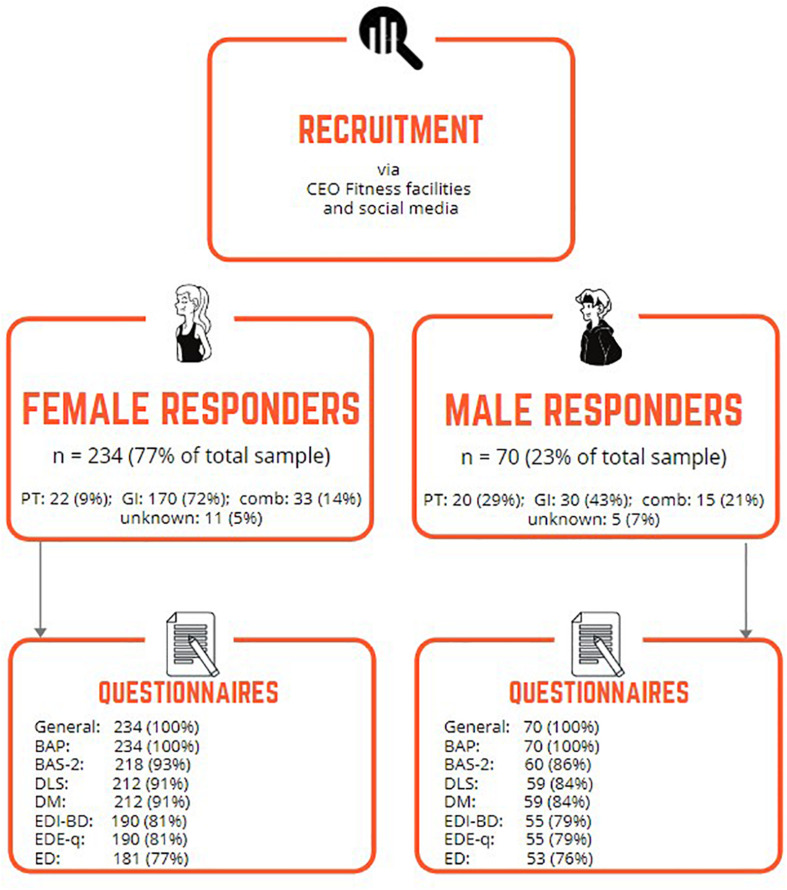
Fitness instructors, 70 (23%) males and 236 (77%) females, were recruited through their facility chief executive officer and social media for a digital survey on mental health. Results are presented for body appreciation (BAS-2), body dissatisfaction (EDI-BD), drive for muscularity (DM), drive for leanness (DLS), questions on BAP, symptoms of eating disorders (EDE-q), and history of weight regulation and eating disorders (EDs).
Attempts to gain body weight were reported by 17% of females and 53% of males, whereas ∼76% of males and females, respectively, reported to have attempted weight reduction. Reasons for body weight manipulation were predominantly appearance related, and 10-20% reported disordered eating behavior. Mean BAS-2 and EDI-BD were acceptable, but 28% of females were above clinical cutoff in EDI-BD, and mean DLS were high in both sexes. In total, 8% of females were above clinical cutoff in EDE-q, which corresponded well with the self-reported ED. Approximately 90% of the sample perceived BAP to be a societal issue and reported predominantly customers and colleagues to be the cause of their personal experience of BAP. Fewer than 50% knew of any actions taken by their employer to reduce BAP. There were few differences according to profession or educational level.
Fitness instructors report BAP to affect them negatively, which may put them at risk of impaired mental health. Educational level did not protect against figure idealization and BAP. To care for their employees and to optimize their position as a public health promoter, the fitness industry should target BAP in health promotion programs.
健身中心是促进健康的场所,但也可能成为适得其反的身材理想化的舞台。这种理想化可能表现为追求瘦、肌肉发达或苗条身材的理想状态,所有这些都有可能引发身体外表压力(BAP)体验和身体不满。本研究的目的是探讨健身教练中的身材理想化、身体不满和BAP体验。
通过其机构首席执行官和社交媒体招募了70名(23%)男性和236名(77%)女性健身教练,进行关于心理健康的数字调查。报告了身体欣赏(BAS-2)、身体不满(EDI-BD)、肌肉发达驱动力(DM)、苗条驱动力(DLS)、BAP相关问题、饮食失调症状(EDE-q)以及体重调节和饮食失调(EDs)病史的结果。
17%的女性和53%的男性报告曾试图增加体重,而分别约76%的男性和女性报告曾试图减肥。体重控制的原因主要与外表有关,10 - 20%的人报告有饮食紊乱行为。BAS-2和EDI-BD的平均值尚可,但28%的女性EDI-BD高于临床临界值,且两性的DLS平均值都较高。总共有8%的女性EDE-q高于临床临界值,这与自我报告的ED情况相符。约90%的样本认为BAP是一个社会问题,主要报告客户和同事是其个人BAP体验的原因。不到50%的人知道雇主采取了任何减少BAP的行动。根据职业或教育水平几乎没有差异。
健身教练报告BAP对他们有负面影响,这可能使他们面临心理健康受损的风险。教育水平并不能防止身材理想化和BAP。为了关心员工并优化其作为公共健康促进者的地位,健身行业应在健康促进项目中针对BAP。