Norwegian School of Sport Sciences, Department of Sports Medicine, Sognsveien 220, N-0806, Oslo, Norway.
Regional Department for Eating Disorders, Division of Mental Health and Addiction, Oslo University Hospital, Postbox 4956 Nydalen, 0424, Oslo, Norway.
BMC Public Health. 2021 Mar 19;21(1):532. doi: 10.1186/s12889-021-10550-0.
Body image is considered a core issue for public health and associates with university students' overall health. Due to positive associations between exercise and body image, it has been suggested that students within an exercise science program might be more body appreciative compared to other students. On the other hand, the strong societal idealization of the athletic body may expose them to a pressure of having a specific body appearance, which may result in unfavorable health consequences. Nevertheless, studies investigating these hypotheses are lacking. We therefore aimed to explore the level and associations of body appreciation, body appearance pressure, body image related mental health constructs, physical activity, and exercise, in Norwegian university exercise science and non-health reference students.
Male and female exercise science students (n = 517) and reference students (n = 476), from nine large universities in Norway took part in this cross-sectional study. Participants responded to the Body appreciation scale-2, a self-developed questionnaire on body appearance pressure, Physical Appearance Comparison Scale-Revised, Sociocultural attitudes towards appearance questionnaire-4R, Rosenberg Self-Esteem Scale, Satisfaction with Life Scale, and questions about physical activity and exercise. Between group differences were analyzed using student independent t-test and ANCOVA for parametric data and Chi-square test for categorical data, and associations were evaluated by Person's correlation. P-values ≤0.05 were defined as significant.
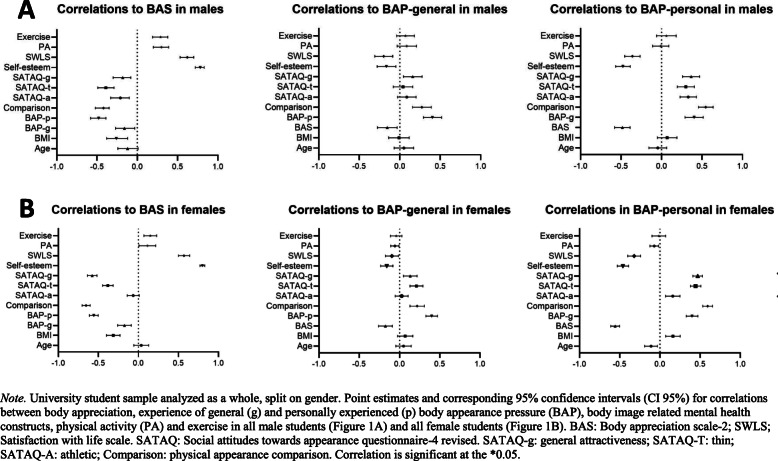
Female exercise science students had higher scores on body appreciation compared to reference students. No group difference was found in males. A high percentage of students reported experiencing body appearance pressure, with 69 and 85% among male and female exercise science students, and 57 and 83% among male and female reference students. Fitness centers were the settings where most respondents experienced body appearance pressure. Body appreciation was strongly associated with favorable scores on body image related mental health constructs, while personally experienced body appearance pressure associated with destructive scores on the same constructs.
Body appearance pressure is an issue among university students regardless of study program. Actions to promote body appreciation and prevent body appearance pressure may include an implementation of media literacy, body functionality, and exercise as topics within the education program to safeguard students' health and well-being.
No. NCT04256967 .
体像被认为是公共卫生的核心问题,与大学生的整体健康有关。由于运动与体像之间存在积极的关联,因此有人认为,与其他学生相比,运动科学专业的学生可能更能欣赏自己的身体。另一方面,社会对运动员身体的理想化可能会使他们面临拥有特定身体外貌的压力,这可能会导致不良的健康后果。然而,目前缺乏研究这些假设的研究。因此,我们旨在探讨挪威大学运动科学专业和非健康专业学生的体像欣赏水平及其与体像相关的心理健康结构、身体活动和运动的关联。
来自挪威九所大型大学的男性和女性运动科学专业学生(n=517)和非健康专业学生(n=476)参加了这项横断面研究。参与者回答了体像欣赏量表-2、一份关于体像压力的自我开发问卷、身体外貌比较量表修订版、社会文化态度量表-4R、罗森伯格自尊量表、生活满意度量表,以及关于身体活动和运动的问题。采用学生独立 t 检验和参数数据的协方差分析、分类数据的卡方检验分析组间差异,采用 Person 相关评估相关性。P 值≤0.05 定义为有统计学意义。
女性运动科学专业学生的体像欣赏得分高于非健康专业学生。男性组无差异。高比例的学生报告经历体像压力,其中 69%和 85%的男性和女性运动科学专业学生以及 57%和 83%的男性和女性非健康专业学生报告经历体像压力。健身中心是大多数受访者经历体像压力的场所。体像欣赏与体像相关心理健康结构的良好评分密切相关,而个人经历的体像压力与同一结构的破坏性评分相关。
体像压力是大学生面临的一个问题,无论其专业如何。为促进体像欣赏和预防体像压力,可以采取一些措施,如在教育计划中实施媒体素养、身体功能和运动等主题,以保护学生的健康和福祉。
否,NCT04256967。