Dadabayev Alisher R, Joshi Sonalee A, Reda Mariam H, Lake Tamar, Hausman Mark S, Domino Edward, Liberzon Israel
Department of Anesthesiology, VA Ann Arbor Healthcare System, Ann Arbor, MI, USA.
Department of Anesthesiology, University of Michigan Health System, Ann Arbor, MI, USA.
Chronic Stress (Thousand Oaks). 2020 Dec 22;4:2470547020981670. doi: 10.1177/2470547020981670. eCollection 2020 Jan-Dec.
To date, treatment options (i.e. psychotherapy, antidepressant medications) for patients with posttraumatic stress disorder (PTSD), are relatively few, and considering their limited efficacy, novel therapies have gained interest among researchers and treatment providers alike. Among patients with chronic pain (CP) about one third experience comorbid PTSD, which further complicates their already challenging pharmacological regimens. Low dose ketamine infusion has shown promise in PTSD, and in treatment of CP, however they have not been studied in comorbid population and under rigorous control conditions.
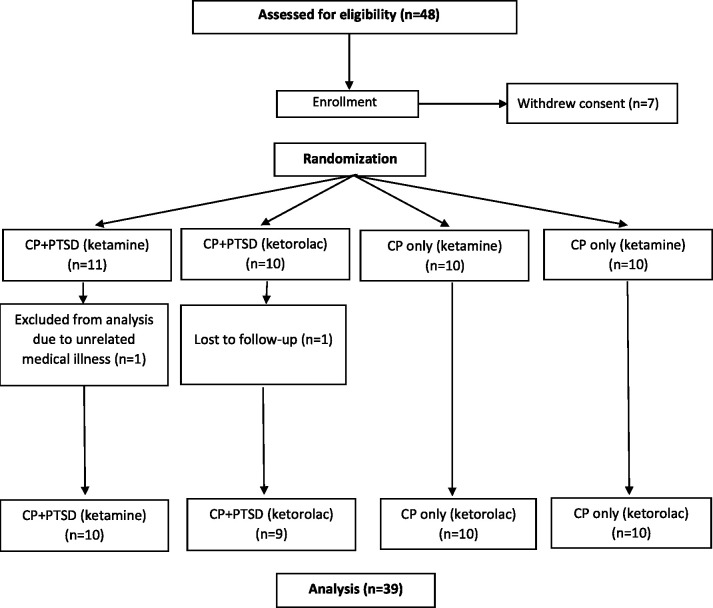
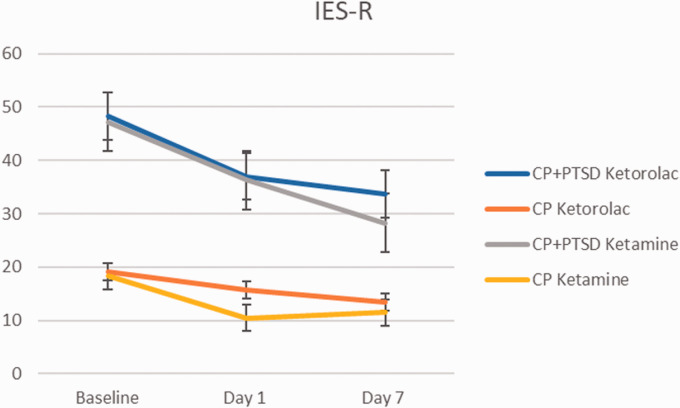
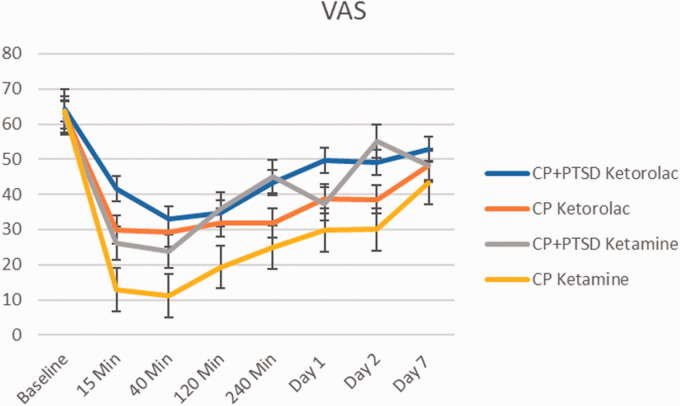
We compared the effects of a single dose of either ketamine (0.5 mg/kg) or ketorolac (15 mg) over a 40-minute of IV infusion in CP patients with and without PTSD, in double blind, randomized study. Measures were collected before, during, one day and seven days after the infusion. A planned sample size of 40 patients randomly assigned to treatment order was estimated to provide 80% power to detect a hypothesized treatment difference after the infusion. The primary outcome measures were change in PTSD symptom severity assessed with the Impact of Event Scale-Revised (IES-R) and Visual Analogue Scale (VAS) for pain administered by a study clinician 24 hours post infusion. Secondary outcome measures included Impact of Event Scale-Revised (IES-R), VAS and Brief Pain Inventory (Short Form) for pain 1 week after the infusion.
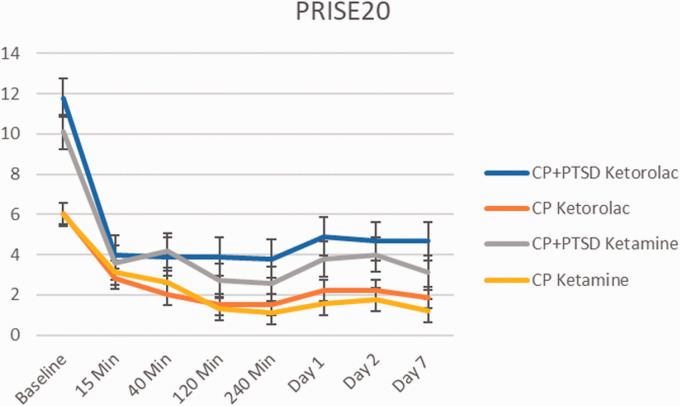
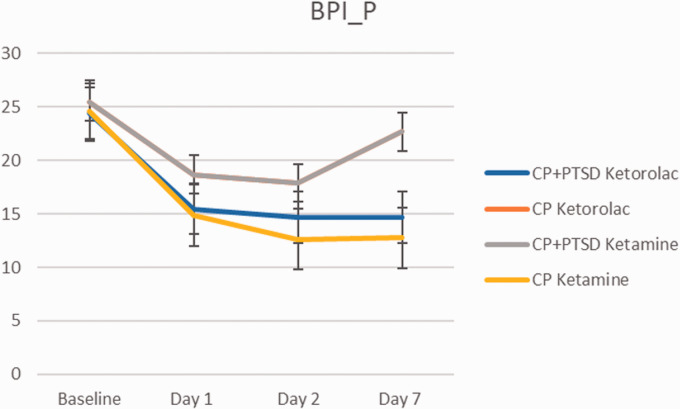
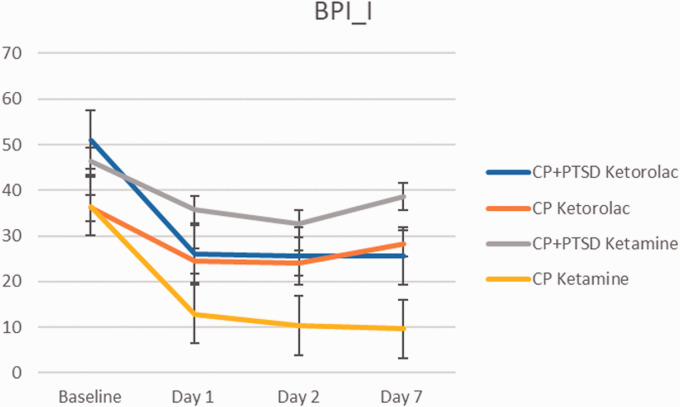
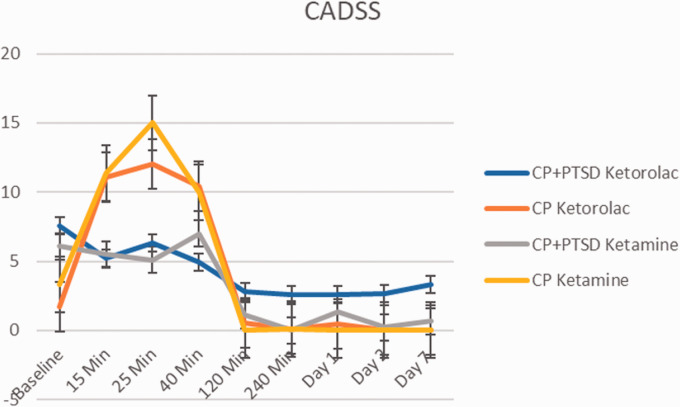
Both treatments offered comparable improvement of PTSD and CP symptoms that persisted for 7 days after the infusion. Patients with comorbid PTSD and CP experienced less dissociative side effects compared to the CP group. Surprisingly, ketorolac infusion resulted in dissociative symptoms in CP patients only.
This first prospective study comparing effects of subanesthetic ketamine versus ketorolac infusions for comorbid PTSD and CP, suggests that both ketamine and ketorolac might offer meaningful and durable response for both PTSD and CP symptoms.
迄今为止,创伤后应激障碍(PTSD)患者的治疗选择(即心理治疗、抗抑郁药物)相对较少,鉴于其疗效有限,新型疗法已引起研究人员和治疗提供者的关注。在慢性疼痛(CP)患者中,约三分之一患有共病PTSD,这使他们本就具有挑战性的药物治疗方案更加复杂。低剂量氯胺酮输注已显示出对PTSD以及CP治疗的前景,但尚未在共病患者群体中以及严格对照条件下进行研究。
在一项双盲、随机研究中,我们比较了单次静脉输注氯胺酮(0.5mg/kg)或酮咯酸(15mg)40分钟对伴有和不伴有PTSD的CP患者的影响。在输注前、输注期间、输注后一天和七天收集测量数据。估计计划样本量为40名随机分配治疗顺序的患者,以提供80%的检验效能来检测输注后假设的治疗差异。主要结局指标是输注后24小时由研究临床医生使用事件影响量表修订版(IES-R)评估的PTSD症状严重程度变化以及疼痛视觉模拟量表(VAS)。次要结局指标包括输注后1周的事件影响量表修订版(IES-R)、VAS和简明疼痛量表(简表)。
两种治疗方法在输注后7天内对PTSD和CP症状均有相似程度的改善。与CP组相比,共病PTSD和CP的患者解离性副作用较少。令人惊讶的是,仅酮咯酸输注在CP患者中导致了解离症状。
这项比较亚麻醉剂量氯胺酮与酮咯酸输注对共病PTSD和CP影响的首次前瞻性研究表明,氯胺酮和酮咯酸可能对PTSD和CP症状均提供有意义且持久的反应。