Shastri Sourabh, Singh Kuljeet, Kumar Sachin, Kour Paramjit, Mansotra Vibhakar
Department of Computer Science and IT, University of Jammu, Jammu, Jammu and Kashmir 180006 India.
Int J Inf Technol. 2021;13(4):1291-1301. doi: 10.1007/s41870-020-00571-0. Epub 2021 Jan 3.
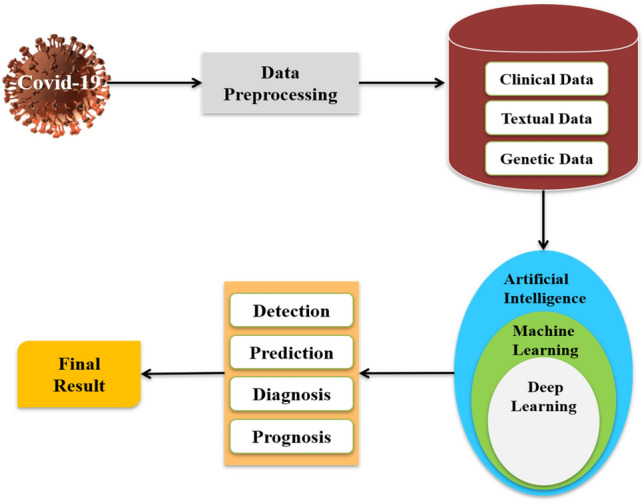
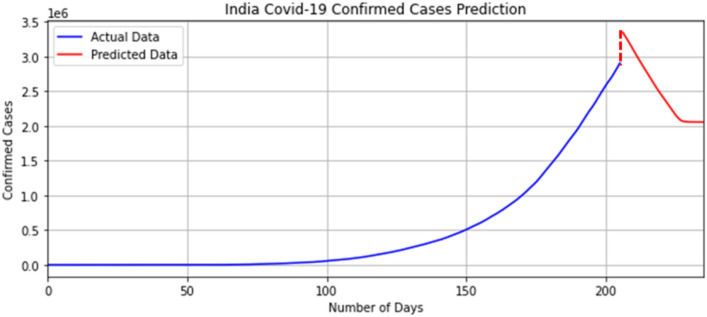
The pandemic of Severe Acute Respiratory Syndrome Coronavirus 2 (SARS-CoV-2) is spreading all over the world. Medical health care systems are in urgent need to diagnose this pandemic with the support of new emerging technologies like artificial intelligence (AI), internet of things (IoT) and Big Data System. In this dichotomy study, we divide our research in two ways-, the review of literature is carried out on databases of Elsevier, Google Scholar, Scopus, PubMed and Wiley Online using keywords Coronavirus, Covid-19, artificial intelligence on Covid-19, Coronavirus 2019 and collected the latest information about Covid-19. Possible applications are identified from the same to enhance the future research. We have found various databases, websites and dashboards working on real time extraction of Covid-19 data. This will be conducive for future research to easily locate the available information. , we designed a nested ensemble model using deep learning methods based on long short term memory (LSTM). Proposed Deep-LSTM ensemble model is evaluated on intensive care Covid-19 confirmed and death cases of India with different classification metrics such as accuracy, precision, recall, f-measure and mean absolute percentage error. Medical healthcare facilities are boosted with the intervention of AI as it can mimic human intelligence. Contactless treatment is possible only with the help of AI assisted automated health care systems. Furthermore, remote location self treatment is one of the key benefits provided by AI based systems.
严重急性呼吸综合征冠状病毒2(SARS-CoV-2)大流行正在全球蔓延。医疗保健系统迫切需要在人工智能(AI)、物联网(IoT)和大数据系统等新兴技术的支持下诊断这一流行病。在这项二分法研究中,我们将研究分为两种方式——在爱思唯尔、谷歌学术、Scopus、PubMed和威利在线数据库上使用关键词“冠状病毒”“新冠病毒-19”“关于新冠病毒-19的人工智能”“2019冠状病毒”进行文献综述,并收集有关新冠病毒-19的最新信息。从这些信息中确定可能的应用,以加强未来的研究。我们发现了各种致力于实时提取新冠病毒-19数据的数据库、网站和仪表板。这将有利于未来的研究轻松找到可用信息。此外,我们使用基于长短期记忆(LSTM)的深度学习方法设计了一个嵌套集成模型。所提出的深度LSTM集成模型在印度重症监护新冠病毒-19确诊和死亡病例上使用不同的分类指标进行评估,如准确率、精确率、召回率、F值和平均绝对百分比误差。人工智能的介入增强了医疗保健设施,因为它可以模仿人类智能。只有借助人工智能辅助的自动化医疗保健系统才能实现非接触式治疗。此外,远程自我治疗是基于人工智能的系统提供的关键优势之一。