Bartrés-Faz David, Macià Dídac, Cattaneo Gabriele, Borràs Roger, Tarrero Clara, Solana Javier, Tormos José M, Pascual-Leone Alvaro
Department of Medicine, Faculty of Medicine and Health Sciences, University of Barcelona, Spain; and Guttmann Institute, University Institute of Neurorehabilitation affiliated to the Autonomous University of Barcelona (UAB), Spain.
Department of Medicine, Faculty of Medicine and Health Sciences, University of Barcelona, Spain.
BJPsych Open. 2021 Jan 11;7(1):e30. doi: 10.1192/bjo.2020.163.
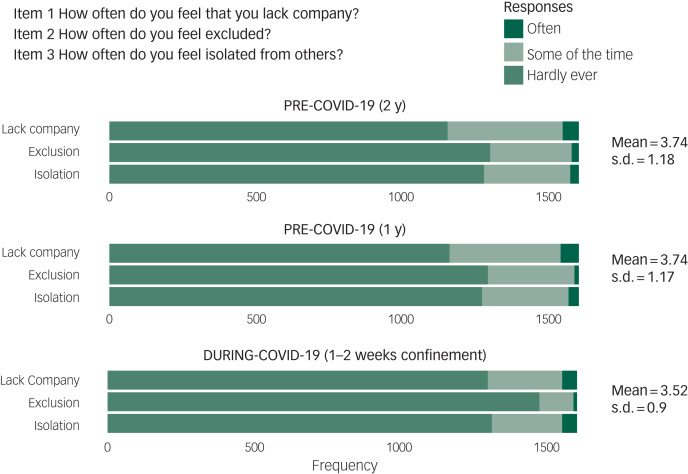
As in previous periods of quarantine, lockdown confinement measures dictated to control SARS-CoV-2 would be expected to negatively affect mental health. We investigated the immediate effects (over a 10 day period) of a strict nationwide stay-at-home order imposed in Spain, one of the countries most affected by the COVID-19 pandemic. Focusing our analysis on the feelings of loneliness, we obtained our measures within a social context characterised by strong and continuous public and governmental support for increasing social bonds and cooperation in order to face the common public threat. Leveraging data from the Barcelona Brain Health Initiative, a prospective population-based study cohort, the short UCLA Loneliness Scale was administered to 1604 participants 2 years and 1 year before the stay-at-home lockdown and repeated, on average, 10 days after the official confinement order issued by the Spanish government. Ratings of loneliness remained stable during the 2 years before lockdown; however, they decreased significantly during the early stages of home confinement. This effect was particularly significant for the item 'feeling excluded from others' and was also observed among individuals who were confined alone. Overall, the results suggest that gestures and manifestations of appreciation by people for the labour and efforts of certain individuals, along with official campaigns designed to promote feelings of inclusion and belonging, may have beneficial effects on feelings of loneliness, a negative emotional state strongly regarded as a risk factor for impaired mental and general health status. Further assessments during the later stages of home confinement are now warranted.
与以往的隔离期一样,为控制SARS-CoV-2而规定的封锁隔离措施预计会对心理健康产生负面影响。我们调查了西班牙实施的一项严格的全国性居家令(西班牙是受COVID-19疫情影响最严重的国家之一)在10天内产生的即时影响。我们将分析重点放在孤独感上,在一个社会背景下获取我们的测量数据,该背景的特点是公众和政府大力且持续地支持加强社会联系与合作,以应对共同的公共威胁。利用巴塞罗那脑健康倡议(一项基于人群的前瞻性研究队列)的数据,在居家封锁前2年和1年,对1604名参与者进行了简短的加州大学洛杉矶分校孤独感量表测试,并在西班牙政府发布官方隔离令后平均10天再次进行测试。在封锁前的2年里,孤独感评分保持稳定;然而,在居家隔离的早期阶段,评分显著下降。这种影响在“感觉被他人排斥”这一项上尤为显著,在单独隔离的个体中也观察到了这种情况。总体而言,结果表明,人们对某些人的劳动和努力表示赞赏的姿态和表现,以及旨在促进包容感和归属感的官方活动,可能对孤独感产生有益影响,孤独感是一种负面情绪状态,被强烈视为心理健康和总体健康状况受损的风险因素。现在有必要在居家隔离的后期阶段进行进一步评估。