Department of Pharmacy, West China Second University Hospital, Sichuan University, Chengdu, Sichuan, China.
Evidence-Based Pharmacy Center, West China Second University Hospital, Sichuan University, Chengdu, Sichuan, China.
PLoS One. 2021 Jan 11;16(1):e0245317. doi: 10.1371/journal.pone.0245317. eCollection 2021.
Intolerance to gastric feeding tubes is common among critically ill adults and may increase morbidity. Administration of prokinetics in the ICU is common. However, the efficacy and safety of prokinetics are unclear in critically ill adults with gastric feeding tubes. We conducted a systematic review to determine the efficacy and safety of prokinetics for improving gastric feeding tube tolerance in critically ill adults.
Randomized controlled trials (RCTs) were identified by systematically searching the Medline, Cochrane and Embase databases. Two independent reviewers extracted the relevant data and assessed the quality of the studies. We calculated pooled relative risks (RRs) for dichotomous outcomes and the mean differences (MDs) for continuous outcomes with the corresponding 95% confidence intervals (CIs). We assessed the risk of bias using the Cochrane risk-of-bias tool and used the Grading of Recommendations Assessment, Development, and Evaluation (GRADE) methodology to rate the quality of the evidence.
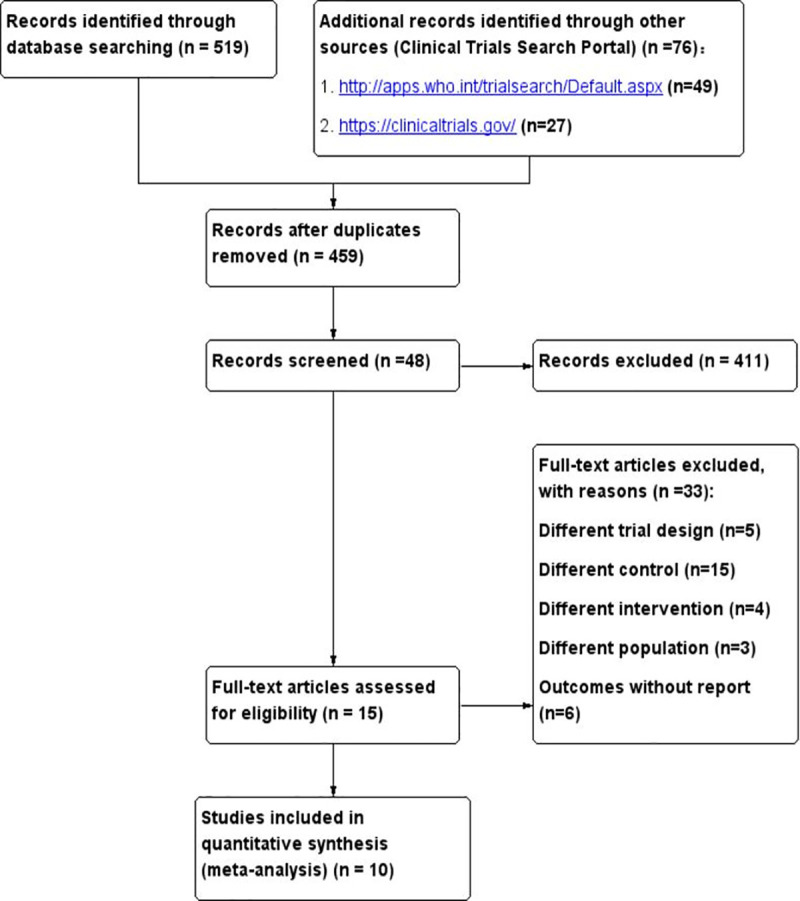
Fifteen RCTs met the inclusion criteria. A total of 10 RCTs involving 846 participants were eligible for the quantitative analysis. Most studies (10 of 13, 76.92%) showed that prokinetics had beneficial effects on feeding intolerance in critically ill adults. In critically ill adults receiving gastric feeding, prokinetic agents may reduce the ICU length of stay (MD -2.03, 95% CI -3.96, -0.10; P = 0.04; low certainty) and the hospital length of stay (MD -3.21, 95% CI -5.35, -1.06; P = 0.003; low certainty). However, prokinetics failed to improve the outcomes of reported adverse events and all-cause mortality.
As a class of drugs, prokinetics may improve tolerance to gastric feeding to some extent in critically ill adults. However, the certainty of the evidence suggesting that prokinetics reduce the ICU or hospital length of stay is low. Prokinetics did not significantly decrease the risks of reported adverse events or all-cause mortality among critically ill adults.
在危重症成人中,对胃饲管不耐受很常见,并且可能会增加发病率。在 ICU 中使用促动力药物很常见。然而,在有胃饲管的危重症成人中,促动力药物的疗效和安全性尚不清楚。我们进行了一项系统评价,以确定促动力药物在改善危重症成人胃饲管耐受性方面的疗效和安全性。
通过系统地搜索 Medline、Cochrane 和 Embase 数据库,确定了随机对照试验(RCT)。两名独立的综述作者提取了相关数据并评估了研究的质量。我们计算了二分类结局的合并相对风险(RR)和连续结局的均数差值(MD)及其相应的 95%置信区间(CI)。我们使用 Cochrane 偏倚风险工具评估了偏倚风险,并使用推荐评估、制定与评价(GRADE)方法来评价证据质量。
15 项 RCT 符合纳入标准。共有 10 项 RCT 纳入了 846 名参与者,适合进行定量分析。大多数研究(10/13,76.92%)表明促动力药物对危重症成人的喂养不耐受有有益影响。在接受胃饲的危重症成人中,促动力药物可能会降低 ICU 住院时间(MD -2.03,95%CI -3.96,-0.10;P = 0.04;低质量)和住院时间(MD -3.21,95%CI -5.35,-1.06;P = 0.003;低质量)。然而,促动力药物并未改善报告的不良事件和全因死亡率的结局。
作为一类药物,促动力药物可能在一定程度上改善危重症成人对胃饲的耐受性。然而,促动力药物降低 ICU 或住院时间的证据质量较低。促动力药物并未显著降低危重症成人报告的不良事件或全因死亡率的风险。