Polyak Stephen J, Crispe I Nicholas, Baumert Thomas F
Department of Laboratory Medicine and Pathology, University of Washington School of Medicine, Seattle, WA 98195, USA.
Department of Global Health, University of Washington, Seattle, WA 98195, USA.
Pathogens. 2021 Jan 7;10(1):44. doi: 10.3390/pathogens10010044.
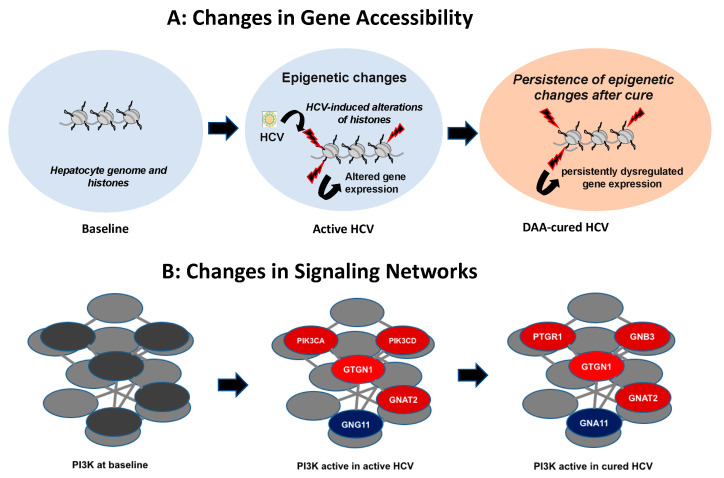
Chronic hepatitis C (CHC) is a major cause of hepatocellular carcinoma (HCC) worldwide. While directly acting antiviral (DAA) drugs are now able to cure virtually all hepatitis C virus (HCV) infections, even in subjects with advanced liver disease, what happens to the liver and progression of the disease after DAA-induced cure of viremia is only beginning to emerge. Several large-scale clinical studies in different patient populations have shown that patients with advanced liver disease maintain a risk for developing HCC even when the original instigator, the virus, is eliminated by DAAs. Here we review emerging studies derived from multiple, complementary experimental systems involving patient liver tissues, human liver cell cultures, human liver slice cultures, and animal models, showing that HCV infection induces epigenetic, signaling, and gene expression changes in the liver associated with altered hepatic innate immunity and liver cancer risk. Of critical importance is the fact that these virus-induced abnormalities persist after DAA cure of HCV. These nascent findings portend the discovery of pathways involved in post-HCV immunopathogenesis, which may be clinically actionable targets for more comprehensive care of DAA-cured individuals.
慢性丙型肝炎(CHC)是全球肝细胞癌(HCC)的主要病因。虽然直接作用抗病毒(DAA)药物目前几乎能够治愈所有丙型肝炎病毒(HCV)感染,即使是患有晚期肝病的患者,但在DAA诱导的病毒血症治愈后,肝脏会发生什么以及疾病的进展情况才刚刚开始显现。在不同患者群体中进行的几项大规模临床研究表明,即使最初的致病因素——病毒被DAA清除,晚期肝病患者仍有发生HCC的风险。在此,我们回顾了来自多个互补实验系统的新研究,这些系统涉及患者肝组织、人肝细胞培养物、人肝切片培养物和动物模型,结果表明HCV感染会诱导肝脏发生表观遗传、信号传导和基因表达变化,这些变化与肝脏固有免疫改变和肝癌风险相关。至关重要的是,这些病毒诱导的异常在DAA治愈HCV后仍然存在。这些新发现预示着将发现参与HCV后免疫发病机制的途径,这可能是对DAA治愈个体进行更全面护理的临床可操作靶点。