Francavilla Matteo, Marone Mauro, Marasco Paolo, Contillo Francesco, Monteleone Massimo
STAR Research Group, Department of Agriculture, Food, Natural Resources and Engineering (DAFNE), University of Foggia, Via Napoli 25, 71122 Foggia, Italy.
Foods. 2021 Jan 7;10(1):112. doi: 10.3390/foods10010112.
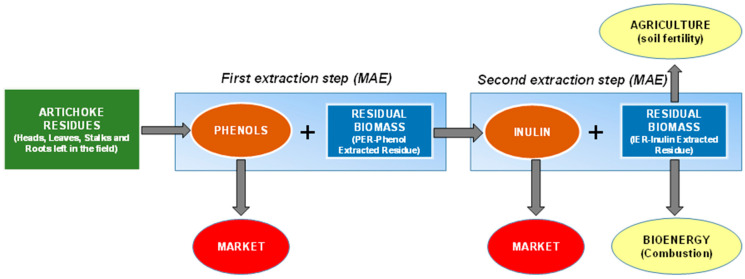
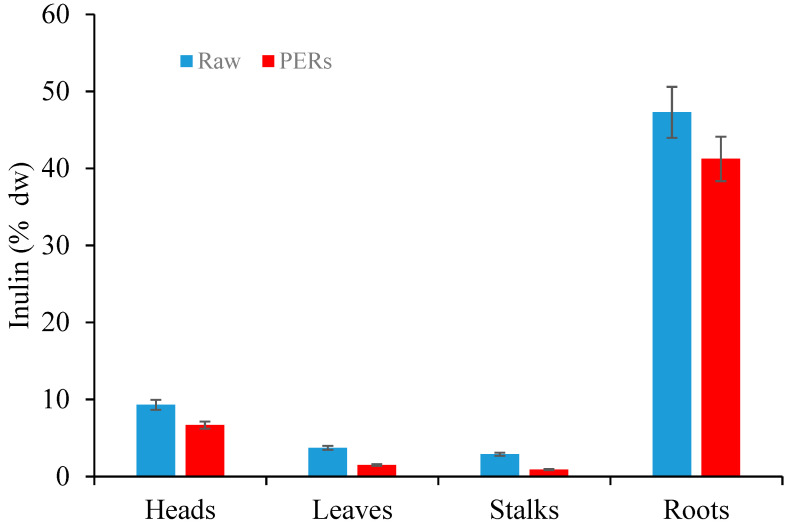
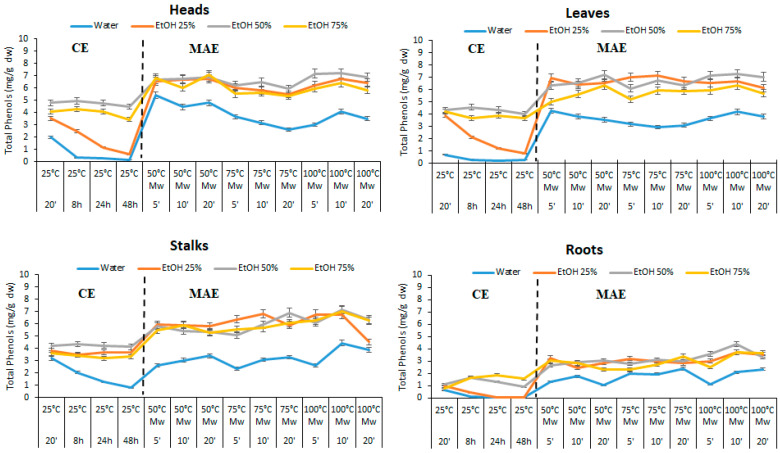
A sequential extraction process has been designed for valorizing globe artichoke plant residues and waste (heads, leaves, stalks, and roots left in the field) by means of green extraction techniques according to a biorefinery approach. We investigated two cascading extractions based on microwave-assisted extractions (MAE) and green solvents (water and ethanol) that have been optimized for varying temperature, solvent and extraction time. In the first step, phenols were extracted with yields that ranged between 6.94 mg g dw (in leaves) and 3.28 mg g dw (in roots), and a phenols productivity of 175.74 Kg Ha. In the second step, inulin was extracted with impressive yields (42% dw), higher than other conventional inulin sources, corresponding to an inulin productivity of 4883.58 Kg Ha. The remaining residues were found to be valuable feedstocks both for bioenergy production and green manure (back to the field), closing the loop according to the Circular Economy paradigm.
已设计了一种顺序提取工艺,旨在根据生物精炼方法,通过绿色提取技术将洋蓟植物残渣和废料(留在田间的头状花序、叶子、茎和根)转化为有价值的产品。我们研究了基于微波辅助提取(MAE)和绿色溶剂(水和乙醇)的两级串联提取,对不同温度、溶剂和提取时间进行了优化。第一步,提取酚类物质,产量在6.94毫克/克干重(叶子中)至3.28毫克/克干重(根中)之间,酚类物质生产率为175.74千克/公顷。第二步,提取菊粉,产量令人印象深刻(42%干重),高于其他传统菊粉来源,菊粉生产率为4883.58千克/公顷。发现剩余残渣是生物能源生产和绿肥(返回田间)的宝贵原料,符合循环经济范式,实现了闭环。