Department of Ophthalmology and Eye Hospital, University of Leipzig, Liebigstraße 12, 04103, Leipzig, Germany.
Int Ophthalmol. 2021 Apr;41(4):1203-1221. doi: 10.1007/s10792-020-01674-0. Epub 2021 Jan 12.
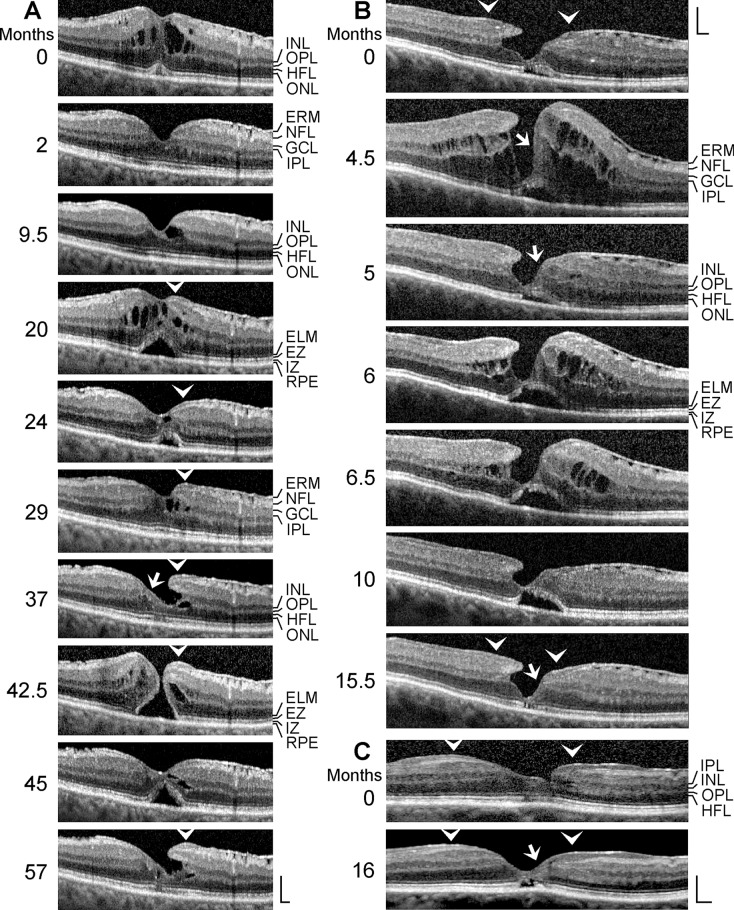
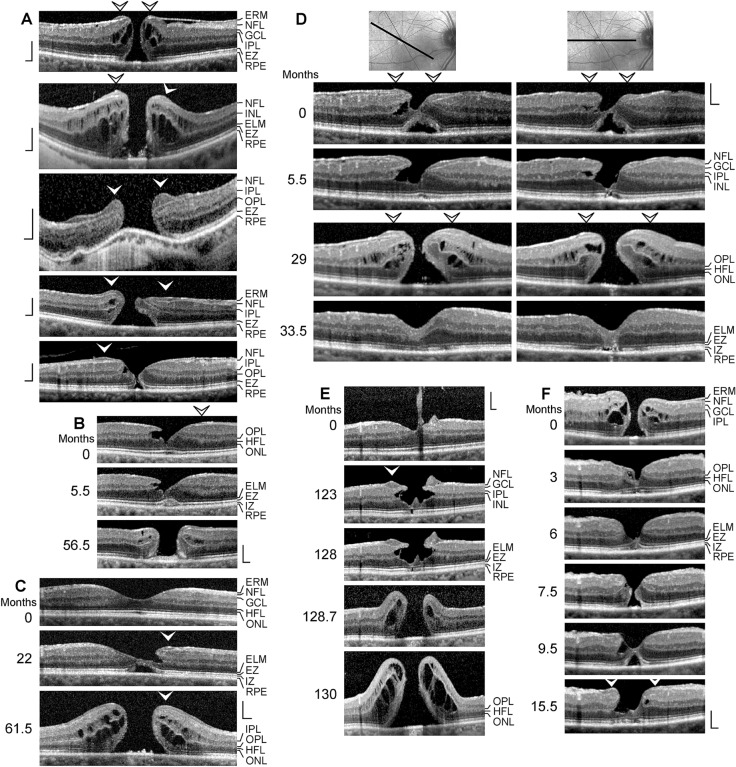
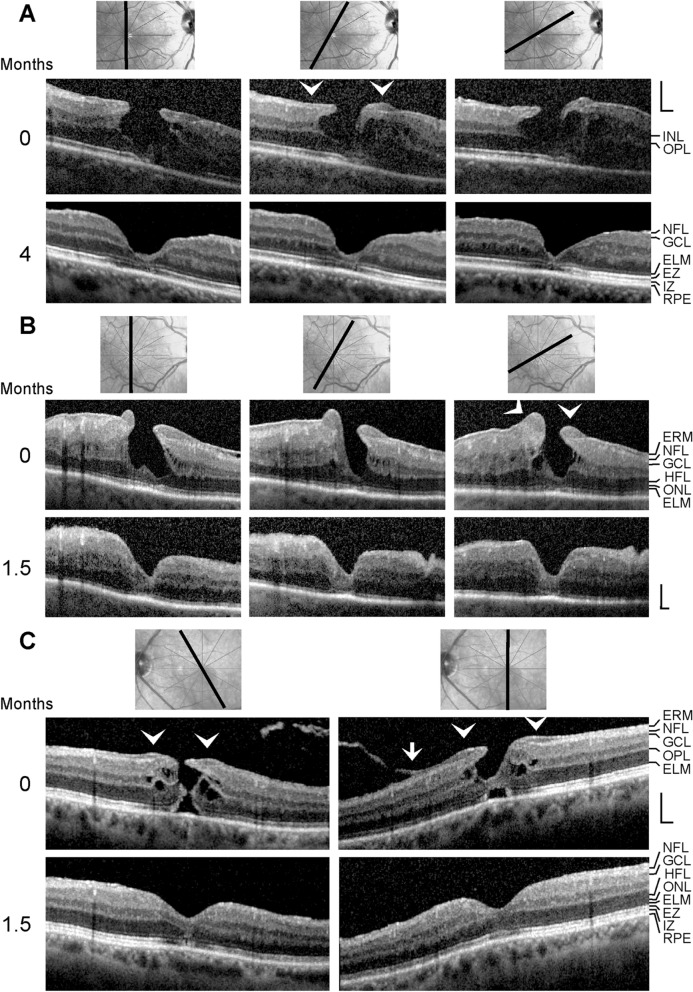
The development of degenerative lamellar macular holes (DLH) is largely unclear. This study was aimed at documenting with spectral-domain optical coherence tomography the tractional development and morphological alterations of DLH.
A retrospective case series of 44 eyes of 44 patients is described.
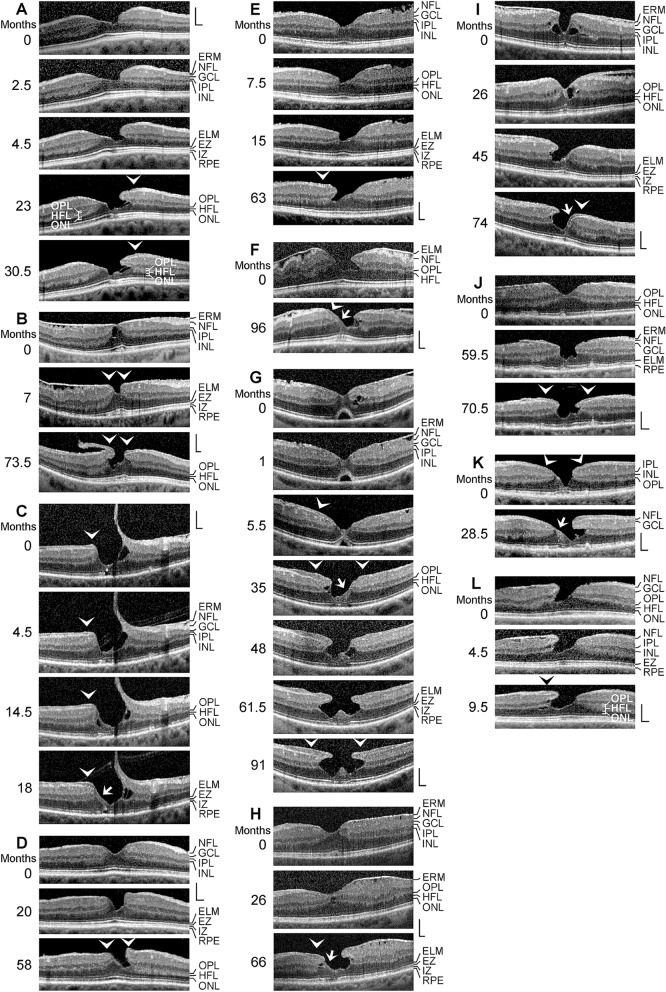
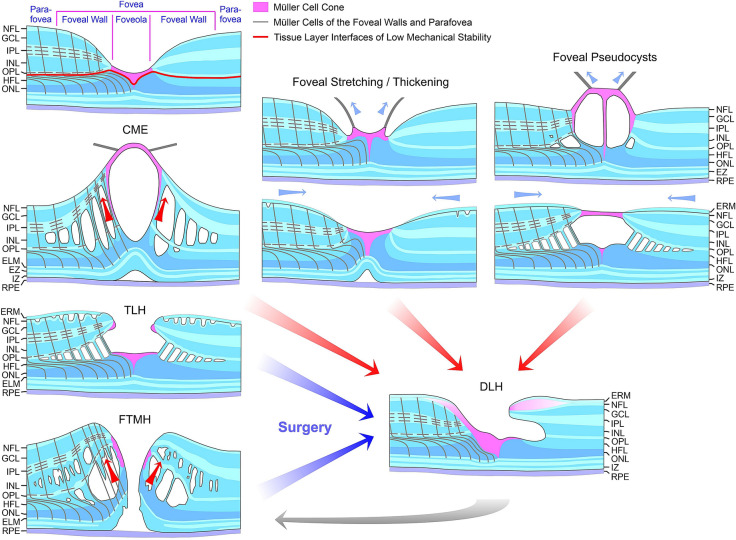
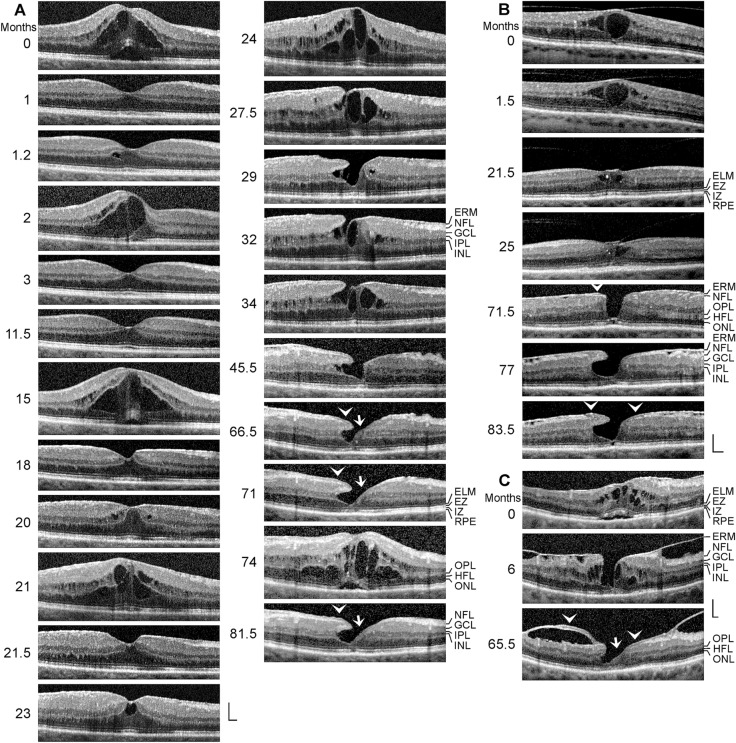
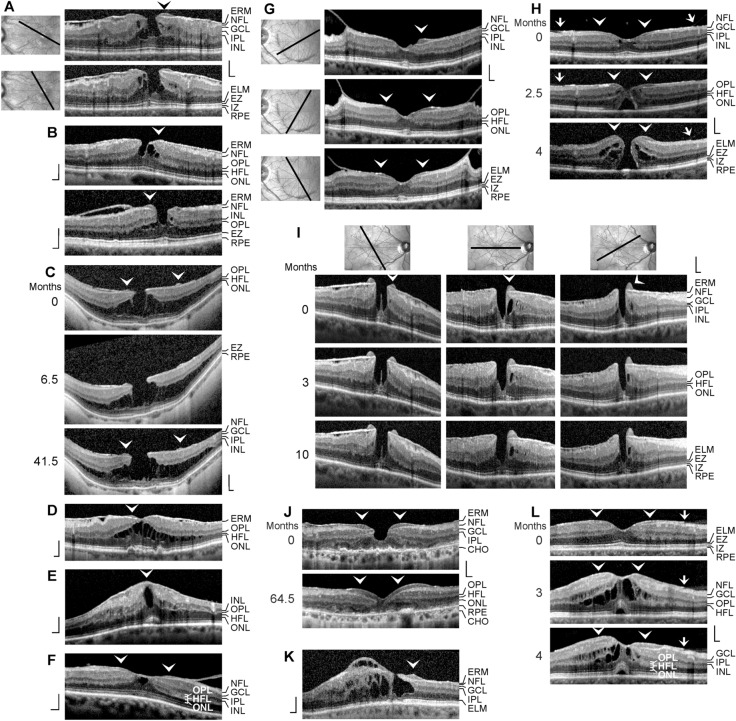
The development of DLH is preceded for months or years by tractional deformations of the fovea due to the action of contractile epiretinal membranes (ERM) and/or the partially detached posterior hyaloid, or by cystoid macular edema (CME). DLH may develop after a tractional stretching and thickening of the foveal center, from a foveal pseudocyst, after a detachment of the foveola from the retinal pigment epithelium, a disruption of the foveal structure due to CME, and after surgical treatment of tractional lamellar or full-thickness macular holes (FTMH). The foveal configuration of a DLH can be spontaneously reestablished after short transient episodes of CME and a small FTMH. A DLH can evolve to a FTMH by traction of an ERM. Surgical treatment of a DLH may result in an irregular regeneration of the foveal center without photoreceptors.
Tractional forces play an important role in the development of DLH and in the further evolution to FTMH. It is suggested that a DLH is the result of a retinal wound repair process after a tractional disruption of the Müller cell cone and a degeneration of Henle fibers, to prevent a further increase in the degenerative cavitations.
退行性板层黄斑裂孔(DLH)的发生机制尚不清楚。本研究旨在通过频域光学相干断层扫描(SD-OCT)记录 DLH 的牵拉性发展和形态改变。
本研究回顾性分析了 44 例 44 只眼的病例资料。
DLH 的发生通常是由于收缩性内界膜(ERM)和/或部分脱离的后玻璃体的作用,对黄斑中心凹产生牵拉,数月或数年后导致黄斑中心凹变形。也可能由于黄斑囊样水肿(CME)导致黄斑中心凹结构破坏,或在牵拉性板层或全层黄斑裂孔(FTMH)手术后,黄斑中心凹出现假性囊泡,或黄斑中心凹脱离视网膜色素上皮(RPE)后,先出现黄斑中心凹牵拉性增厚,再发展为 DLH。短暂的 CME 和小的 FTMH 后,DLH 可自行恢复黄斑中心凹形态。ERM 的牵拉可使小的 FTMH 进一步发展为 DLH。DLH 手术后,由于感光细胞缺失,黄斑中心凹可出现不规则再生。
牵拉力量在 DLH 的发展和进一步演变为 FTMH 中起重要作用。推测 DLH 是 Müller 细胞圆锥层和 Henle 纤维受到牵拉性损伤后的视网膜伤口修复过程的结果,目的是防止退行性空洞进一步扩大。