Mentis Alexios-Fotios A, Dardiotis Efthimios, Efthymiou Vasiliki, Chrousos George P
Public Health Laboratories, Hellenic Pasteur Institute, Athens, Greece; and, Department of Neurology, University Hospital of Larissa, University of Thessaly, Larissa, Greece.
Department of Neurology, University Hospital of Larissa, University of Thessaly, Larissa, Greece.
BMC Med. 2021 Jan 13;19(1):6. doi: 10.1186/s12916-020-01873-7.
The etiologies of chronic neurological diseases, which heavily contribute to global disease burden, remain far from elucidated. Despite available umbrella reviews on single contributing factors or diseases, no study has systematically captured non-purely genetic risk and/or protective factors for chronic neurological diseases.
We performed a systematic analysis of umbrella reviews (meta-umbrella) published until September 20th, 2018, using broad search terms in MEDLINE, SCOPUS, Web of Science, Cochrane Database of Systematic Reviews, Cumulative Index to Nursing and Allied Health Literature, ProQuest Dissertations & Theses, JBI Database of Systematic Reviews and Implementation Reports, DARE, and PROSPERO. The PRISMA guidelines were followed for this study. Reference lists of the identified umbrella reviews were also screened, and the methodological details were assessed using the AMSTAR tool. For each non-purely genetic factor association, random effects summary effect size, 95% confidence and prediction intervals, and significance and heterogeneity levels facilitated the assessment of the credibility of the epidemiological evidence identified.
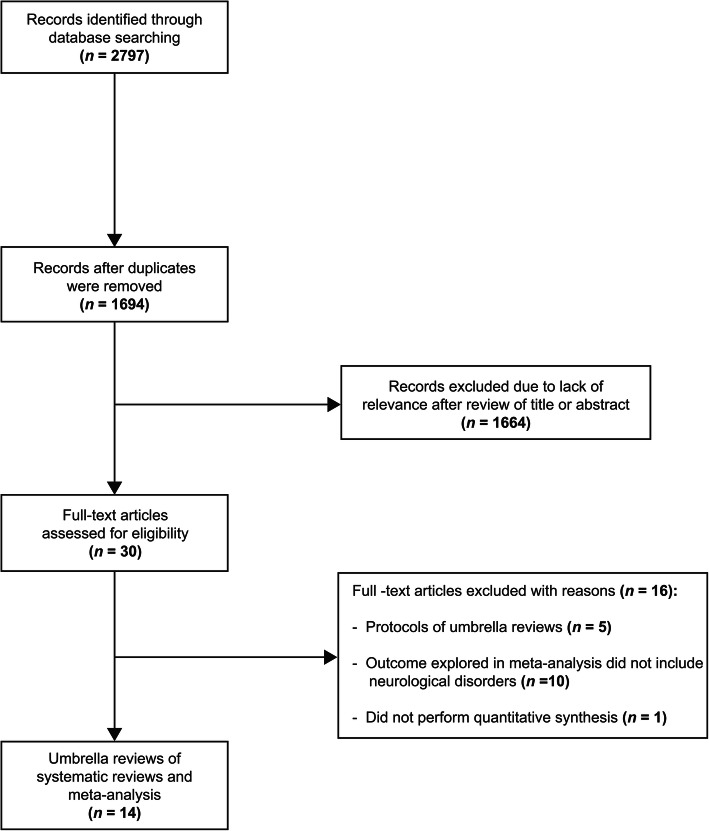
We identified 2797 potentially relevant reviews, and 14 umbrella reviews (203 unique meta-analyses) were eligible. The median number of primary studies per meta-analysis was 7 (interquartile range (IQR) 7) and that of participants was 8873 (IQR 36,394). The search yielded 115 distinctly named non-genetic risk and protective factors with a significant association, with various strengths of evidence. Mediterranean diet was associated with lower risk of dementia, Alzheimer disease (AD), cognitive impairment, stroke, and neurodegenerative diseases in general. In Parkinson disease (PD) and AD/dementia, coffee consumption, and physical activity were protective factors. Low serum uric acid levels were associated with increased risk of PD. Smoking was associated with elevated risk of multiple sclerosis and dementia but lower risk of PD, while hypertension was associated with lower risk of PD but higher risk of dementia. Chronic occupational exposure to lead was associated with higher risk of amyotrophic lateral sclerosis. Late-life depression was associated with higher risk of AD and any form of dementia.
We identified several non-genetic risk and protective factors for various neurological diseases relevant to preventive clinical neurology, health policy, and lifestyle counseling. Our findings could offer new perspectives in secondary research (meta-research).
慢性神经疾病对全球疾病负担有重大影响,但其病因仍远未阐明。尽管已有关于单一促成因素或疾病的综合评价,但尚无研究系统地梳理出慢性神经疾病的非纯遗传风险和/或保护因素。
我们对截至2018年9月20日发表的综合评价(元综合评价)进行了系统分析,在MEDLINE、SCOPUS、科学网、Cochrane系统评价数据库、护理学与健康相关文献累积索引、ProQuest学位论文数据库、JBI系统评价与实施报告数据库、DARE和PROSPERO中使用了广泛的检索词。本研究遵循PRISMA指南。还筛选了已识别的综合评价的参考文献列表,并使用AMSTAR工具评估方法细节。对于每个非纯遗传因素关联,随机效应汇总效应大小、95%置信区间和预测区间以及显著性和异质性水平有助于评估所识别的流行病学证据的可信度。
我们识别出2797篇潜在相关的评价,14篇综合评价(203项独特的荟萃分析)符合要求。每项荟萃分析的初级研究中位数为7项(四分位间距(IQR)为7),参与者中位数为8873名(IQR为36,394)。检索得到115个有显著关联的不同命名的非遗传风险和保护因素,证据强度各异。地中海饮食通常与痴呆、阿尔茨海默病(AD)、认知障碍、中风和神经退行性疾病的较低风险相关。在帕金森病(PD)和AD/痴呆中,喝咖啡和进行体育活动是保护因素。血清尿酸水平低与PD风险增加相关。吸烟与多发性硬化症和痴呆风险升高相关,但与PD风险降低相关,而高血压与PD风险降低相关,但与痴呆风险升高相关。长期职业性铅暴露与肌萎缩侧索硬化症风险升高相关。晚年抑郁症与AD和任何形式痴呆的风险升高相关。
我们识别出了多种与预防性临床神经病学、卫生政策和生活方式咨询相关的神经疾病的非遗传风险和保护因素。我们的发现可为二次研究(元研究)提供新的视角。