Bach Margit M, Daffertshofer Andreas, Dominici Nadia
Department of Human Movement Sciences, Faculty of Behavioural and Movement Sciences, Amsterdam Movement Sciences & Institute of Brain and Behavior Amsterdam, Vrije Universiteit Amsterdam, Amsterdam, The Netherlands.
Eur J Appl Physiol. 2021 Apr;121(4):1073-1085. doi: 10.1007/s00421-020-04592-2. Epub 2021 Jan 13.
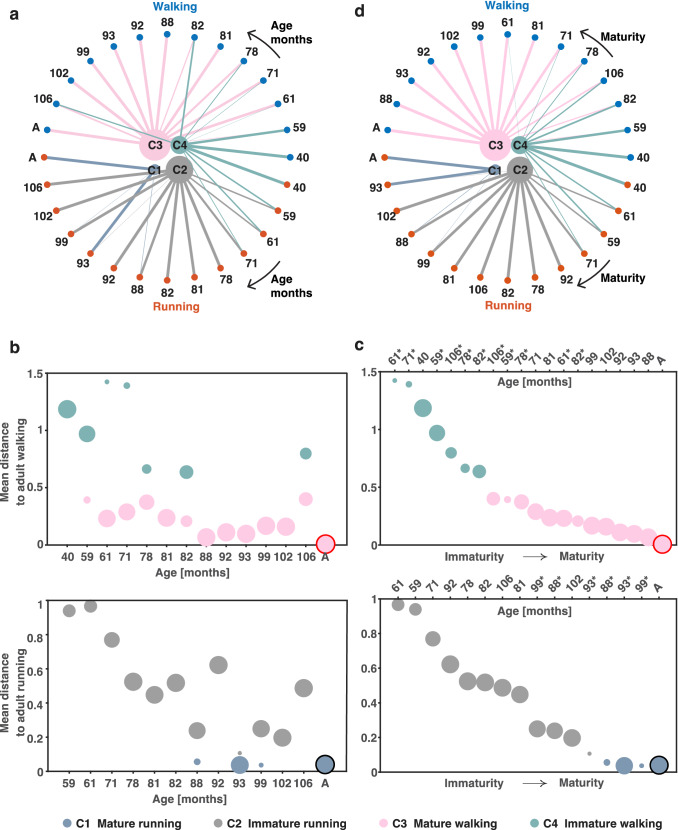
We sought to identify the developing maturity of walking and running in young children. We assessed gait patterns for the presence of flight and double support phases complemented by mechanical energetics. The corresponding classification outcomes were contrasted via a shotgun approach involving several potentially informative gait characteristics. A subsequent clustering turned out very effective to classify the degree of gait maturity.
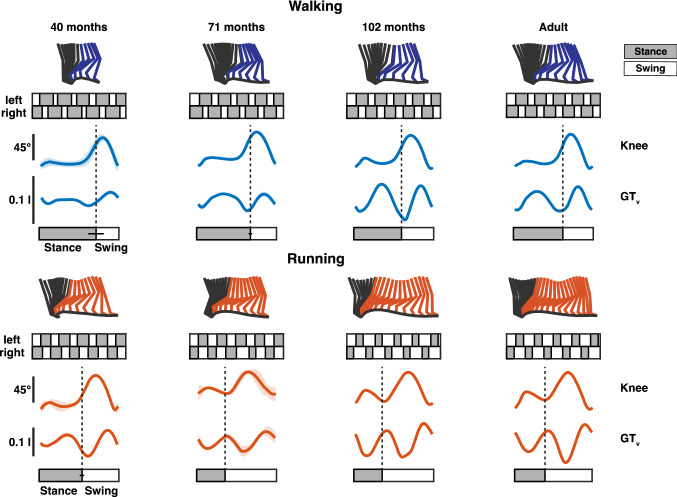
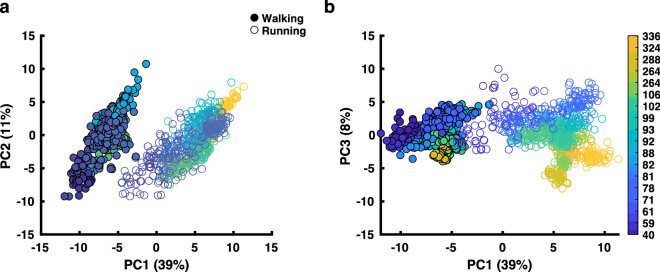
Participants (22 typically developing children aged 2-9 years and 7 young, healthy adults) walked/ran on a treadmill at comfortable speeds. We determined double support and flight phases and the relationship between potential and kinetic energy oscillations of the center-of-mass. Based on the literature, we further incorporated a total of 93 gait characteristics (including the above-mentioned ones) and employed multivariate statistics comprising principal component analysis for data compression and hierarchical clustering for classification.
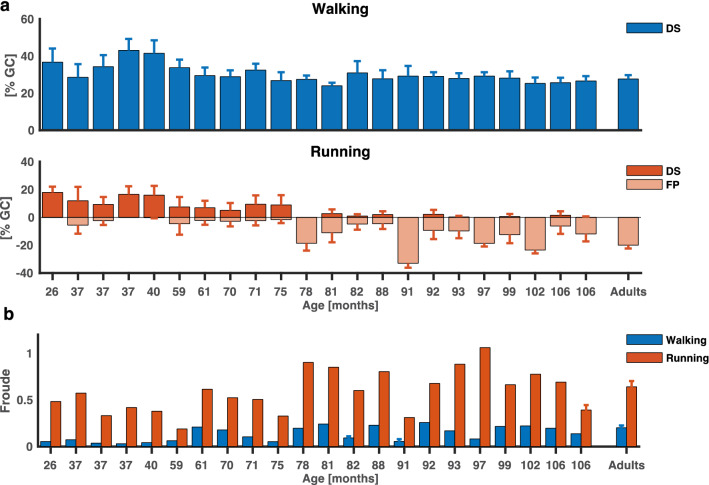
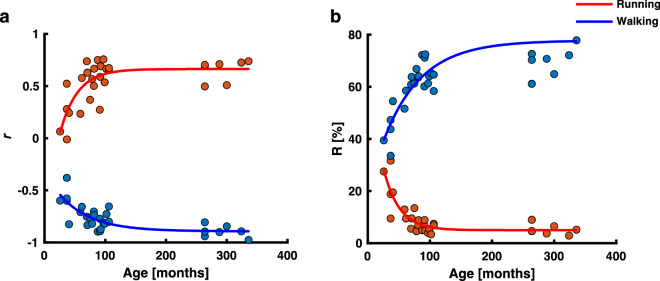
While the ability to run including a flight phase increased with age, the flight phase did not reach 20% of the gait cycle. It seems that children use a walk-run-strategy when learning to run. Yet, the correlation strength between potential and kinetic energies saturated and so did the amount of recovered mechanical energy. Clustering the set of gait characteristics allowed for classifying gait in more detail. This defines a metric for maturity in terms of deviations from adult gait, which disagrees with chronological age.
The degree of gait maturity estimated statistically using various gait characteristics does not always relate directly to the chronological age of the child.
我们试图确定幼儿行走和跑步的发育成熟度。我们评估了步态模式中是否存在腾空期和双支撑期,并辅以机械能学分析。通过涉及几种可能具有信息价值的步态特征的散弹枪方法,对相应的分类结果进行了对比。随后的聚类分析被证明对步态成熟度的分类非常有效。
参与者(22名年龄在2至9岁的发育正常儿童和7名年轻健康成年人)在跑步机上以舒适的速度行走/跑步。我们确定了双支撑期和腾空期以及质心势能和动能振荡之间的关系。基于文献,我们进一步纳入了总共93种步态特征(包括上述特征),并采用了多元统计方法,包括用于数据压缩的主成分分析和用于分类的层次聚类分析。
虽然包括腾空期的跑步能力随着年龄增长而提高,但腾空期未达到步态周期的20%。似乎儿童在学习跑步时采用走-跑策略。然而,势能和动能之间的相关强度达到饱和,恢复的机械能数量也达到饱和。对步态特征集进行聚类分析可以更详细地对步态进行分类。这根据与成人步态的偏差定义了一种成熟度指标,该指标与实际年龄不一致。
使用各种步态特征进行统计学估计的步态成熟度程度并不总是与儿童的实际年龄直接相关。