Max Planck Institute of Molecular Cell Biology and Genetics, 01307 Dresden, Germany.
Max Planck Institute for the Physics of Complex Systems, 01307 Dresden, Germany.
Mol Biol Cell. 2021 Apr 19;32(9):869-879. doi: 10.1091/mbc.E20-11-0723. Epub 2021 Jan 13.
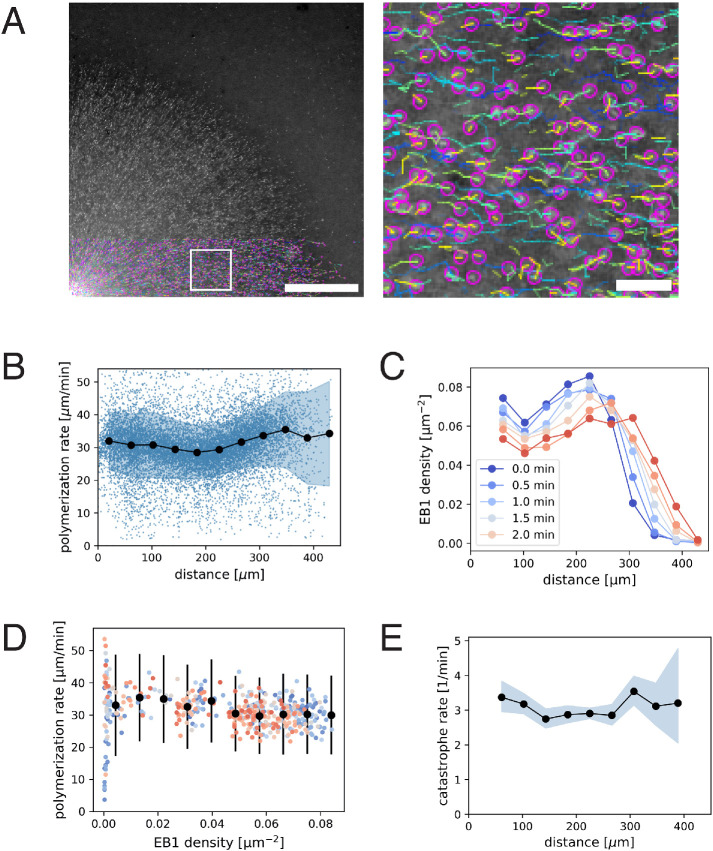
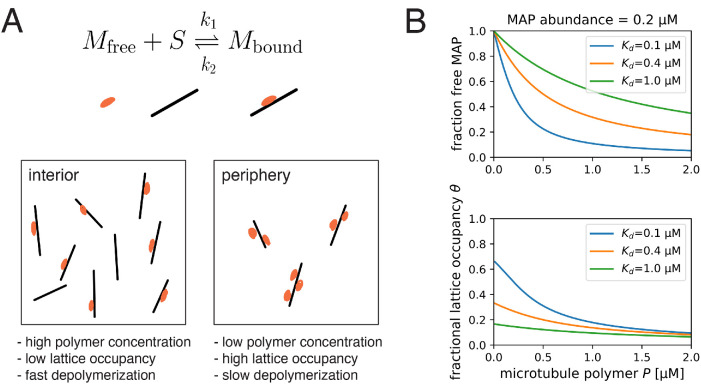
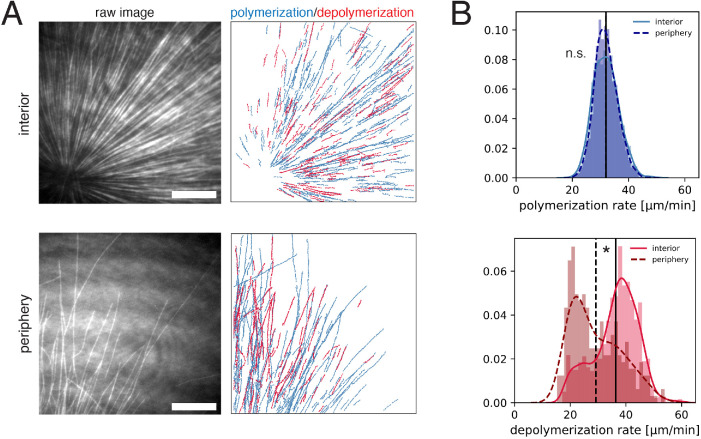
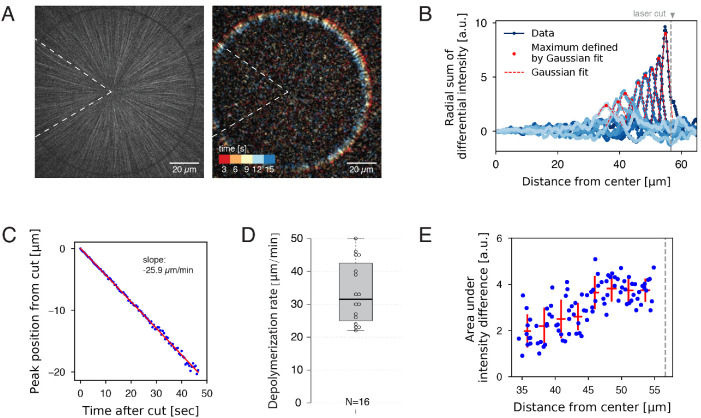
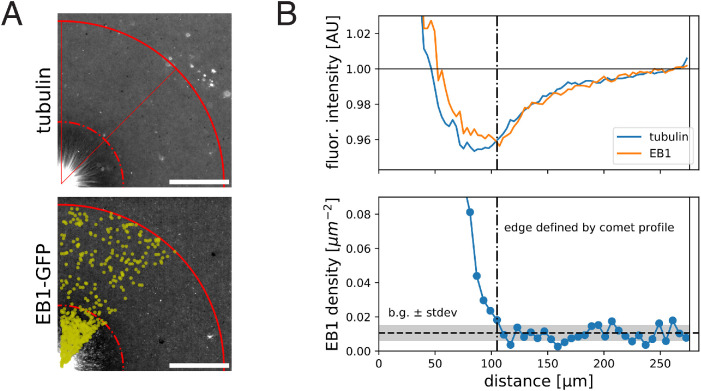
Microtubule plus-end depolymerization rate is a potentially important target of physiological regulation, but it has been challenging to measure, so its role in spatial organization is poorly understood. Here we apply a method for tracking plus ends based on time difference imaging to measure depolymerization rates in large interphase asters growing in egg extract. We observed strong spatial regulation of depolymerization rates, which were higher in the aster interior compared with the periphery, and much less regulation of polymerization or catastrophe rates. We interpret these data in terms of a limiting component model, where aster growth results in lower levels of soluble tubulin and microtubule-associated proteins (MAPs) in the interior cytosol compared with that at the periphery. The steady-state polymer fraction of tubulin was ∼30%, so tubulin is not strongly depleted in the aster interior. We propose that the limiting component for microtubule assembly is a MAP that inhibits depolymerization, and that egg asters are tuned to low microtubule density.
微管正极的解聚速率是生理调节的一个潜在重要目标,但由于难以测量,其在空间组织中的作用还不太清楚。在这里,我们应用一种基于时差成像的跟踪正极的方法来测量在卵提取物中生长的大间期星状体中的解聚速率。我们观察到解聚速率有很强的空间调节,在星状体内部比在外部更高,而聚合或崩溃速率的调节则少得多。我们根据限制成分模型来解释这些数据,其中星状体的生长导致内部细胞质中的可溶性微管蛋白和微管相关蛋白 (MAPs) 水平低于外部。微管蛋白的稳态聚合物分数约为 30%,因此星状体内部的微管蛋白并没有明显减少。我们提出,微管组装的限制成分是一种抑制解聚的 MAP,而卵星状体被调谐到低微管密度。