Shang Ke, Wei Bai, Cha Se-Yeoun, Zhang Jun-Feng, Park Jong-Yeol, Lee Yea-Jin, Jang Hyung-Kwan, Kang Min
Department of Veterinary Infectious Diseases and Avian Diseases, College of Veterinary Medicine and Center for Poultry Diseases Control, Jeonbuk National University, Iksan 54596, Korea.
Bio Disease Control (BIOD) Co., Ltd., Iksan 54596, Korea.
Animals (Basel). 2021 Jan 11;11(1):154. doi: 10.3390/ani11010154.
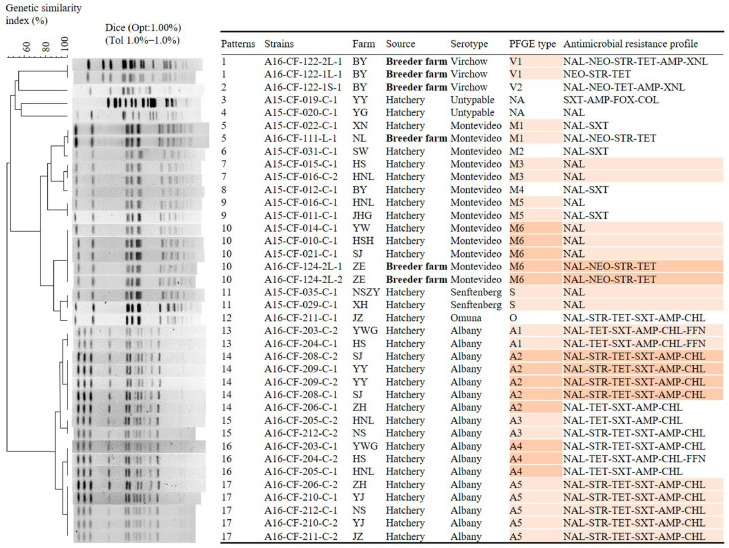
Positive identification rates of in hatcheries and upstream breeder farms were 16.4% (36/220) and 3.0% (6/200), respectively. Among the serovars identified in the hatcheries, . ser. Albany (17/36, 47.2%) was the most prevalent, followed by the serovars . ser. Montevideo (11/36, 30.6%) and . ser. Senftenberg (5/36, 13.9%), which were also predominant. Thirty-six isolates showed resistance to at least one antimicrobial tested, of which 52.8% ( = 19) were multidrug resistant (MDR). Thirty-three isolates (enrofloxacin, MIC ≥ 0.25) showed point mutations in the A and C genes. One isolate, . ser. Virchow, carrying the gene from the breeder farm was ceftiofur resistant. Pulsed-field gel electrophoresis (PFGE) showed that 52.0% . ser. Montevideo and 29.6% . ser. Albany isolates sourced from the downstream of hatcheries along the broiler chicken supply chain carried the same PFGE types as those of the hatcheries. Thus, the hatcheries showed a high prevalence of isolates with high antimicrobial resistance and no susceptible isolate. The AMR isolates from hatcheries originating from breeder farms could disseminate to the final retail market along the broiler chicken supply chain. The emergence of AMR in hatcheries may be due to the horizontal spread of resistant isolates. Therefore, control in hatcheries, particularly its horizontal transmission, is important.
孵化场和上游种鸡场的阳性鉴定率分别为16.4%(36/220)和3.0%(6/200)。在孵化场鉴定出的血清型中,……血清型奥尔巴尼(17/36,47.2%)最为常见,其次是……血清型蒙得维的亚(11/36,30.6%)和……血清型森夫滕贝格(5/36,13.9%),它们也占主导地位。36株分离株对至少一种测试抗菌药物耐药,其中52.8%(n = 19)为多重耐药(MDR)。33株分离株(恩诺沙星,MIC≥0.25)在A和C基因中出现点突变。一株来自种鸡场携带……基因的血清型维尔乔夫分离株对头孢噻呋耐药。脉冲场凝胶电泳(PFGE)显示,沿肉鸡供应链来自孵化场下游的52.0%的血清型蒙得维的亚和29.6%的血清型奥尔巴尼分离株携带与孵化场相同的PFGE类型。因此,孵化场显示……分离株的高流行率、高抗菌药物耐药性且无敏感分离株。来自种鸡场的孵化场的AMR分离株可能会沿肉鸡供应链传播到最终零售市场。孵化场中AMR……的出现可能是由于耐药分离株的水平传播。因此,控制孵化场中的……,特别是其水平传播,很重要。