Instituto de Oftalmobiología Aplicada (IOBA), Universidad de Valladolid, Edificio IOBA, Campus Miguel Delibes, Paseo de Belén 17, 47011, Valladolid, Spain.
Centro de Investigación Biomédica en Red de Bioingeniería, Biomateriales y Nanomedicina (CIBER-BBN), Instituto de Salud Carlos III, Madrid, Spain.
Stem Cell Res Ther. 2021 Jan 13;12(1):60. doi: 10.1186/s13287-020-02129-0.
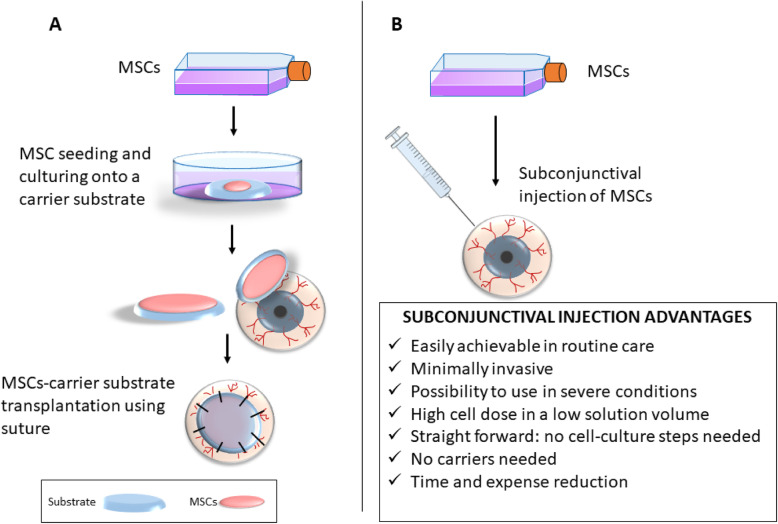
Mesenchymal stem cells (MSCs) have unique and beneficial properties and are currently used to treat a broad variety of diseases. These properties include the potential for differentiation into other cell types, secretion of different trophic factors that promote a regenerative microenvironment, anti-inflammatory actions, selective migration to damaged tissues, and non-immunogenicity. MSCs are effective for the treatment of ocular surface diseases such as dry eye, corneal burns, and limbal stem cell deficiency (LSCD), both in experimental models and in humans. LSCD is a pathological condition in which damage occurs to the limbal epithelial stem cells, or their niche, that are responsible for the continuous regeneration of the corneal epithelium. If LSCD is extensive and/or severe, it usually causes corneal epithelial defects, ulceration, and conjunctival overgrowth of the cornea. These changes can result in neovascularization and corneal opacity, severe inflammation, pain, and visual loss. The effectiveness of MSCs to reduce corneal opacity, neovascularization, and inflammation has been widely studied in different experimental models of LSCD and in some clinical trials; however, the methodological disparity used in the different studies makes it hard to compare outcomes among them. In this regard, the MSC route of administration used to treat LSCD and other ocular surface diseases is an important factor. It should be efficient, minimally invasive, and safe. So far, intravenous and intraperitoneal injections, topical administration, and MSC transplantation using carrier substrata like amniotic membrane (AM), fibrin, or synthetic biopolymers have been the most commonly used administration routes in experimental models. However, systemic administration carries the risk of potential side effects and transplantation requires surgical procedures that could complicate the process. Alternatively, subconjunctival injection is a minimally invasive and straightforward technique frequently used in ophthalmology. It enables performance of local treatments using high cell doses. In this review, we provide an overview of the current status of MSC administration by subconjunctival injection, analyzing the convenience, safety, and efficacy for treatment of corneal failure due to LSCD in different experimental models. We also provide a summary of the clinical trials that have been completed, are in progress, or being planned.
间充质干细胞(MSCs)具有独特且有益的特性,目前被用于治疗广泛的疾病。这些特性包括分化为其他细胞类型的潜能、分泌促进再生微环境的不同营养因子、抗炎作用、选择性迁移到受损组织以及非免疫原性。MSCs 可有效治疗眼表疾病,如干眼症、角膜烧伤和角膜缘干细胞缺乏症(LSCD),在实验模型和人类中均有应用。LSCD 是一种病理状态,其中角膜缘上皮干细胞或其龛位受到损伤,导致角膜上皮的持续再生。如果 LSCD 广泛且/或严重,通常会导致角膜上皮缺损、溃疡和角膜结膜过度生长。这些变化可导致新生血管形成和角膜混浊、严重炎症、疼痛和视力丧失。MSCs 降低角膜混浊、新生血管形成和炎症的有效性已在不同的 LSCD 实验模型和一些临床试验中得到广泛研究;然而,不同研究中使用的方法学差异使得难以比较它们之间的结果。在这方面,用于治疗 LSCD 和其他眼表疾病的 MSC 给药途径是一个重要因素。它应该是高效、微创且安全的。到目前为止,静脉内和腹腔内注射、局部给药以及使用羊膜(AM)、纤维蛋白或合成生物聚合物等载体基质进行 MSC 移植已成为实验模型中最常用的给药途径。然而,全身给药存在潜在副作用的风险,而移植需要手术程序,这可能会使过程复杂化。相比之下,结膜下注射是一种微创且简单的技术,在眼科中经常使用。它可以使用高细胞剂量进行局部治疗。在这篇综述中,我们通过结膜下注射概述了 MSC 给药的当前状态,分析了在不同实验模型中治疗 LSCD 导致的角膜衰竭的便利性、安全性和疗效。我们还总结了已完成、正在进行或正在计划的临床试验。